I just started a volunteer job as a chaplain assistant in the pastoral care dept. at a local Catholic hospital. Every Wednesday for about four hours (minus lunch) I visit patients on the cardiac floor. It's an interesting dynamic, different from a pastor visiting a parishioner, even those church members I've never met before. I don't represent a church or particular faith tradition or any at all, for that matter. I meet patients where they are, most of them men, offer to be of help to them, engage them in conversation, and pray with them, if they request it. Many times I am not asked to pray with patients so we visit, briefly or for a few minutes. Sometimes I am asked if I can do anything to get the doctor in sooner and get them released from the hospital. If it seems appropriate, I'll reply with "I'm in sales, not management" (in my experience, chaplains and pastors are often asked to do things they have no control over, i.e., "Can you do anything about this rain, heat, etc.?"). The laughter eases the tension so we can talk about their anger, fear, anxiety about being in the hospital because of their heart, a very scary thing indeed.
My direct supervisor is Sr. Victoria Nolan, a Sister of Charity of St. Vincent de Paul--retired from the pastoral care staff but now a volunteer, 88 years old with macular degeneration and a joy to be with. We usually eat lunch together and she tells me stories about her career as a nun. What a life she is living!
Today, just a few funny things happened that made the day interesting:
Before I went upstairs to visit folks, I went to the ladies room. As I was sitting 'doing my business' I looked over at the stall next to mine and saw two feet pointed the other way! Whoever he was, he finished quickly and left before I could ask him why he had to invade my privacy.
At the behest of a spouse of a patient, I went down to Security to ask about a parking pass. I was waiting behind a group of students. One of them, a man in his late twenties, early thirties said, "Let the young lady go ahead of us." That's nice coming from someone older than you, but younger it sounds like kissing up or just plain stupid. I wish I had had the nerve to ask him just how young he thought I was.
Lastly, I went into a patient's room, he was on the phone, I said I was from pastoral care, should I come back; he said "no", he didn't need a visit. When I reached the hallway, I heard him say into the phone "It was the Church!", like you would comment about something else pointless, unnecessary and irksome. ...And I'm racking my brain trying to think of something as universally pointless and irksome as the Church is to a lot of folks. Let that be your challenge for today. I'd like to know what you come up with.
Also, I'm reading a very funny teen book entitled An Abundance of Katherines by John Green. It's about a high school prodigy named Colin who is disasterously attracted to girls named Katherine. He's just been dumped by K-19 and goes on a summer road trip with his friend Hassan ("I'm not a terrorist."). If you like anagrams, a smattering of math, and quirky humor, you'll love this book. If you're thinking of recommending it to a young person, ages 13-17 would be appropriate (the word "fug" is used quite a bit; something I would not want my 10 yr. old picking up).
No parting words come to mind. Ciao!

Wednesday, March 14, 2007


Friday, March 09, 2007
Amazing grace/Not a hiding place

When the Christian Right gets excited about a film and urges folks to see it, the hair on the back of my neck rises, usually because the whole story is not being told.
Though the film is about William Wilberforce, who instigated the abolition of the British slave trade, many viewers will focus on its theme song and its author/composer, John Newton, a former slave trader. This hymn has become an anthem for our nation. It was included in the hymnals of Civil War soldiers. During the 1960's it was sung during civil rights protests. It was the most performed song in the memorial services occuring after 9/11.
It's a song about grace, that divine gift of unconditional love and acceptance, one that we wholeheartedly claim for ourselves but have difficulty sharing with others. Notice that the lyrics are written in the first person singular:
"Amazing grace/how sweet the sound/that saved a wretch like me/I once was lost/but now am found/Was blind but now I see".
The only inclusive verse is the last one, which was added from another hymn in 1790, eleven years after Newton penned his faith:
"When we've been there 10,000 years/bright shining as the sun/We've no less days to sing God's praise/then when we first begun".
A few years back I was writing a sermon based on the flood narrative in Genesis when I came upon another hymn of Newton's, "The Hiding Place". One verse in particular illuminated this man's faith and the faith of the Church at the time of King George III:
"You have only to repose/On my wisdom, love, and care/Where my wrath consumes my foes/Mercy shall my children spare/While they perish in the flood/You that bear my holy mark/Sprinkled with atoning blood/Shall be safe within the ark."
The ark was the Church, that hiding place for those who bear God's holy mark, i.e., baptism and the blood of Christ from the cross. Grace was for those who realized their sinful ways and turned; those who did not turn faced God's wrath. The theology of grace had not yet progessed to its inclusive, universal vision, at least, not in England.
Those who read this blog who are Unitarian Universalists know far more about this than I do, but Universalist thought in Christian theology dates back as far as St. Gregory of Nyssa in the 4th century. Universalism emerged in the American colonies as a denomination in 1793. Universalism rejects the notion of eternal damnation; instead it declares the existence of an all-loving God, who welcomes the whole of creation into redemptive relationship.
Grace isn't only about me or you; it's about us, all of us on this earth in need of forgiveness and right relationship with one another and with the Mystery that created all that there is. It's about community: inclusive, ever-widening, extravagant community.
The movie's website also lists a mission called The Amazing Change Campaign, which seeks to end slavery everywhere in the world. While ending child slavery and debt slavery is very much a justice issue that needs to be dealt with, there is another slavery that we see every day and it's called poverty; its slaves are the working poor of our country. If we're going to end slavery in this world, let's includes all the slaves, including each of us and the ways we are chained to the powers that be in this world. Free others, and free yourself in the process.
The Church is not a hiding place and neither is God. God and the Church may be our refuge for a time, but eventually we are called out into the world to share the love and redemption we have received so that all may know the freedom of grace.
Friday, March 02, 2007
Beauty tips for ministers
What do you get when you cross a fashion maven with a Masters in Divinity?
A blog with help for those in desperate need of style! If you thought the devil wore Prada, the clergy wears what PeaceBang says we should wear! She's a petite fashionista, with a dash of Linda Richmond and dimples. And she's also going to be featured on Nightline tonight, so tune in.
In PeaceBang's words: "Because you're in the public eye, and God knows you need to look good".
P.S. This entry may seem to be a stark contrast to the one below but I also realize the value of good humor and not taking things too seriously, especially myself. And let's face it: we live in a body with all manner of idiosyncracies and peccadilloes of its own. As Dolly Parton said in Steel Magnolias "It takes a lot of effort to look like this". PeaceBang has an eye for the bargain and for items that will last over the long haul. She also lives and works on the south shore of Massachusetts where I grew up, the milieu of my people, as it were. Just fun stuff.
A blog with help for those in desperate need of style! If you thought the devil wore Prada, the clergy wears what PeaceBang says we should wear! She's a petite fashionista, with a dash of Linda Richmond and dimples. And she's also going to be featured on Nightline tonight, so tune in.
In PeaceBang's words: "Because you're in the public eye, and God knows you need to look good".
P.S. This entry may seem to be a stark contrast to the one below but I also realize the value of good humor and not taking things too seriously, especially myself. And let's face it: we live in a body with all manner of idiosyncracies and peccadilloes of its own. As Dolly Parton said in Steel Magnolias "It takes a lot of effort to look like this". PeaceBang has an eye for the bargain and for items that will last over the long haul. She also lives and works on the south shore of Massachusetts where I grew up, the milieu of my people, as it were. Just fun stuff.
"The Secret" of faith

More magical thinking from the world of self-help. Apparently the "secret" to getting everything you want is "ask, believe, receive", the shorthand form of words of Jesus but taken entirely the wrong way. Qui-Gon Jinn in Star Wars: The Phantom Menace said much the same thing but with an eastern twist: Where you place your focus determines your reality. Still, he wasn't talking about material goods either.
I agree with the premise that the mind and its thoughts and intentions are a source of great power but a power that we are much too immature as a species to use wisely (see Global Consciousness Project). There may be indeed a law of attraction whereby events, material goods, health, and other desirables gravitate towards us (or us towards them). But do we ever consider how all these things come to pass? Sure, a new BMW parked in the driveway would be great, we think, but it didn't just poof, arrive out of nowhere. Resources and materials were culled and assembled, mostly likely at the environment's expense, by many persons with many different lives and contexts, often not paid a living wage. A great amount of fuel is used to ship automobiles to their final destination. Whatever we want, it almost always involves other people and the life of this earth. Do we ever take into consideration how what we want will affect those whose job it is to produce it?
In a most marvelous book, Mutant Message Down Under, the Aborigines in the narrative always begin their petitions to the divine with the words if it is in my highest good and the highest good for all of life everywhere. You'd think this would be our heart's desire but we do not trust the divine to know what our highest good is, not really anyway.
Some would say that human beings are naturally selfish, that it is part of our biological heritage, a survival tactic but something we have to live with and try our best to overcome. I don't believe that. We are selfish because we learned as a species to be fearful that there isn't enough. And so we hoard and stock up, separate ourselves from the earth and from each other, thinking that we are safe, that it is because of our efforts that we have enough. Most of us have more than enough and can afford to live with less, yours truly included. Poverty is not a judgment on the poor for not trying hard enough but on everyone else.
Having faith, whatever it is you believe in, implies an ethic, a certain moral behavior, unless what you believe in is only yourself. What is the point of faith, of belief, if it doesn't pull you out of yourself, your little corner of the world and cause you to grow and better the world around you? And not bettering the world by Oprah-fying it but by leaving as little a footprint on the earth as possible and a huge impression upon the lives of others.
P.S. Here's what Barbara Ehrenreich had to say about The Secret.
Saturday, February 24, 2007
Life after death
Today I crashed a memorial service. I've officiated at numerous funerals and memorials for persons I did not know, but this is one of the few times I've attended one for someone I had never met. I went with a friend for whom the deceased was a mentor, teacher, colleague and friend. My friend is still grieving the loss of her mother, who died last summer, so I went for support and friendship.
It was the first Unitarian Universalist memorial I had ever experienced. While it was beautiful, poetic, full of music and tribute to this wonderful woman's life, there were no words of resurrection. And I don't mean the resurrection of Jesus. I didn't expect that. What I mean is words of rebirth and hope for those present who obviously were going to miss this person. "Love never ends" was proclaimed several times, but for me it was not enough. What of this woman's spirit; does it not live on in those whose lives she touched, apparently too numerous to count? Isn't it still possible to encounter her warmth, her love, her humor on a daily basis, simply through memory and through the sharing of those memories? All of those persons she nurtured in the art of pastoral care; when they impart that gift to others, is she not immortal? None of this was ever really declared, not with any passion or conviction. Even if we cannot absolutely know that there is a God and be simply humble and awed in the presence of creation, still we can be passionate and convicted in our awe and humility that something has grasped our hearts and minds mightily.
I was left with no question as to who this incredible woman was to this world and that she lived a life well-lived. I was left with many questions concerning this congregation's view of an incarnational universe apart from Jesus. Can we relate to the universe as incarnational without a belief in Jesus as the son of God? I believe so, and it would have lent more power to this service which honored a powerful woman. We celebrated her life; what was missing was the celebration of the life-giving force within and among all life that is always creating, that never dies.
It was the first Unitarian Universalist memorial I had ever experienced. While it was beautiful, poetic, full of music and tribute to this wonderful woman's life, there were no words of resurrection. And I don't mean the resurrection of Jesus. I didn't expect that. What I mean is words of rebirth and hope for those present who obviously were going to miss this person. "Love never ends" was proclaimed several times, but for me it was not enough. What of this woman's spirit; does it not live on in those whose lives she touched, apparently too numerous to count? Isn't it still possible to encounter her warmth, her love, her humor on a daily basis, simply through memory and through the sharing of those memories? All of those persons she nurtured in the art of pastoral care; when they impart that gift to others, is she not immortal? None of this was ever really declared, not with any passion or conviction. Even if we cannot absolutely know that there is a God and be simply humble and awed in the presence of creation, still we can be passionate and convicted in our awe and humility that something has grasped our hearts and minds mightily.
I was left with no question as to who this incredible woman was to this world and that she lived a life well-lived. I was left with many questions concerning this congregation's view of an incarnational universe apart from Jesus. Can we relate to the universe as incarnational without a belief in Jesus as the son of God? I believe so, and it would have lent more power to this service which honored a powerful woman. We celebrated her life; what was missing was the celebration of the life-giving force within and among all life that is always creating, that never dies.
Monday, February 19, 2007
Get talking


Last night at our church's jr. high Pilgrim Fellowship meeting I was introduced to a great book entitled More Would You Rather?: 465 More Provocative Questions to Get Teenagers Talking. Some examples: Would you rather pet a porcupine or lick a cactus? Wear platform shoes or 6" stilettoes? Legalize marijuana or pornography? Get locked out of the house naked or trip and fall at your wedding? Spend a night in a bed full of itching powder or wear a poison-ivy suit for a week? Stuck in a mental institution surrounded by patients or in an elevator with a dozen therapists? Sniff an armpit or lick a foot? A bullet to the chest or a knife in the back? A quick, painful death or a long boring life?
This book not only got the kids talking but also the adults, and all of us laughing hysterically. It's the second in a series that was written for youth group leaders, but it could also be used at any adult gathering as well: dinner parties, work meetings, family reunions, outings with friends, you name it. There are also religious questions, which can also be used or omitted. And you may be inspired to write your own. Would you rather accompany a woman on a shopping spree that will cost you nothing or stay home and pay the bill? Would you rather spend a month as the opposite sex or a week having to wear their clothes on your body, living your life? Would you rather things continue as they are, everywhere, or would you rather risk your way of life so that the world might change?
What will it take to get us talking, really talking, at a level that has the power to move mountains? And what will it take to get us to listen?
This book not only got the kids talking but also the adults, and all of us laughing hysterically. It's the second in a series that was written for youth group leaders, but it could also be used at any adult gathering as well: dinner parties, work meetings, family reunions, outings with friends, you name it. There are also religious questions, which can also be used or omitted. And you may be inspired to write your own. Would you rather accompany a woman on a shopping spree that will cost you nothing or stay home and pay the bill? Would you rather spend a month as the opposite sex or a week having to wear their clothes on your body, living your life? Would you rather things continue as they are, everywhere, or would you rather risk your way of life so that the world might change?
What will it take to get us talking, really talking, at a level that has the power to move mountains? And what will it take to get us to listen?
Monday, February 12, 2007
I have decided...
NPR has re-established a series entitled "This I Believe": listeners write essays that espouse personal beliefs emerging from their own life experiences. And no sermons or religious statements allowed. I've been reflecting about what I would say if spirituality and faith could not play a part. This is what I've come up with.
I believe in the power of decision to change one's life so that it does not imitate the past but inspires a different vision of the future.
I grew up in an alcoholic family and from there all sorts of dysfunction arose, all kinds of patterns that could be repeated in my generation. I remember being in college, at a house party, thoroughly drunk on wine, and then tossing it up over the railing of the front porch into the snow below. I was disgusted with myself and nauseous with shame. I then decided I would not repeat my father's life, a recovered alcoholic who smoked until the day he died of a heart attack, who left his vocation because it broke his body and his spirit. I still enjoy beer and wine--just one drink at a time. I became a minister like my father but because I wanted to help others and serve God, and it made me happy (as described in the Beatitudes). I decided to not smoke cigarettes. I decided to be healthy but not give up everything between me and my feelings. I decided I wanted to be a whole person, one who is generous, kind, and loving but still swears occasionally, eats too much every now and then, loses her temper once in a while, and has a weakness for the material things in life.
I also decided to do things I had no real model for: I gave birth to both my children naturally and breastfed them until they were @ 18 months old. I decided to stay home with them, though I never really decided to put aside pastoral ministry, which has made for great internal (and external) struggle. I decided I would stay married to my chosen partner, that we would take our marriage vows seriously and work together to learn how to love each other into old age. My husband and I have decided to live simpler lives, to give away a portion of our income so that others may simply live, to quote a bumper sticker.
At one point in my sojourn through Al-Anon, one of the other members gave me the greatest gift. She said, "One of these days you have to decide to say 'Fuck it. Being the child of an alcoholic does not have to define who I am'". Since then I have made that decision again and again as I applied that wisdom to other areas of my past that I have allowed to have power over me.
A friend from seminary once asked me what I thought it meant to be an adult. I answered, "Making decisions and being responsible for their outcomes." By no means does my life resemble that of my parents when they were my age; that was part of why I made certain decisions. I also made those decisions so that I would be responsible for my own happiness, my own misery, no one else.
George Bush may have sounded like an idiot when he said it, but for me it is truth: I am the decider. I need to be conscious of who I am, what motivates me, and that I am ultimately responsible for my life and how my decisions affect others.
Having the power to make decisions is the power to create who we will be, not just in our individual lives but as a human race. We can decide if we are a violent species or a peaceful, resourceful one, if there is scarcity or abundance, if there is to be an end to humanity or if this is just the beginning of our evolution. And like a vow or a covenant, these decisions must be renewed again and again if they are to have the strength to be carried through.
Under all this is the decision to believe that humankind will choose the good, to trust that the will toward the good, the just, and the loving is stronger than the will cowed in fear.
I believe in the power of decision to change one's life so that it does not imitate the past but inspires a different vision of the future.
I grew up in an alcoholic family and from there all sorts of dysfunction arose, all kinds of patterns that could be repeated in my generation. I remember being in college, at a house party, thoroughly drunk on wine, and then tossing it up over the railing of the front porch into the snow below. I was disgusted with myself and nauseous with shame. I then decided I would not repeat my father's life, a recovered alcoholic who smoked until the day he died of a heart attack, who left his vocation because it broke his body and his spirit. I still enjoy beer and wine--just one drink at a time. I became a minister like my father but because I wanted to help others and serve God, and it made me happy (as described in the Beatitudes). I decided to not smoke cigarettes. I decided to be healthy but not give up everything between me and my feelings. I decided I wanted to be a whole person, one who is generous, kind, and loving but still swears occasionally, eats too much every now and then, loses her temper once in a while, and has a weakness for the material things in life.
I also decided to do things I had no real model for: I gave birth to both my children naturally and breastfed them until they were @ 18 months old. I decided to stay home with them, though I never really decided to put aside pastoral ministry, which has made for great internal (and external) struggle. I decided I would stay married to my chosen partner, that we would take our marriage vows seriously and work together to learn how to love each other into old age. My husband and I have decided to live simpler lives, to give away a portion of our income so that others may simply live, to quote a bumper sticker.
At one point in my sojourn through Al-Anon, one of the other members gave me the greatest gift. She said, "One of these days you have to decide to say 'Fuck it. Being the child of an alcoholic does not have to define who I am'". Since then I have made that decision again and again as I applied that wisdom to other areas of my past that I have allowed to have power over me.
A friend from seminary once asked me what I thought it meant to be an adult. I answered, "Making decisions and being responsible for their outcomes." By no means does my life resemble that of my parents when they were my age; that was part of why I made certain decisions. I also made those decisions so that I would be responsible for my own happiness, my own misery, no one else.
George Bush may have sounded like an idiot when he said it, but for me it is truth: I am the decider. I need to be conscious of who I am, what motivates me, and that I am ultimately responsible for my life and how my decisions affect others.
Having the power to make decisions is the power to create who we will be, not just in our individual lives but as a human race. We can decide if we are a violent species or a peaceful, resourceful one, if there is scarcity or abundance, if there is to be an end to humanity or if this is just the beginning of our evolution. And like a vow or a covenant, these decisions must be renewed again and again if they are to have the strength to be carried through.
Under all this is the decision to believe that humankind will choose the good, to trust that the will toward the good, the just, and the loving is stronger than the will cowed in fear.
Wednesday, February 07, 2007
Resist the powers of evil
Last night I attended the ecclesiastical council of the new associate pastor of my church. In UCC polity, the Church and Ministry committee of a local association recommends candidates for an examination before they can be approved for ordination. This examination is called an ecclesiatical council. Members of local churches in the association, pastors, and guests can attend to listen to the candidate present their ordination paper and then ask them just about anything they want and/or make comments about the paper. It is the most daunting task leading up to ordination. Last night's proceedings were no different. The candidate, now ordinand (yes, she passed), told me this morning that 42 hours of labor was easier!
The question that was the most pressing was about evil: what is evil, what does it look like, how do we confront it, had she had any personal experience with evil? In the UCC statement of faith we speak the words "You call us into your church...to proclaim the gospel to all the world and resist the powers of evil...". Part of the prophetic call is identifying evil, pointing it out like a signpost, naming the 800 lb. gorrilla in the middle of the room, that we might turn from that evil but also turn our justice hearts and minds towards ending the root of that evil.
During my own ecclesiastical council I was asked to spin for 4 or 5 minutes about the power of evil. My answer eventually distilled down to evil being fear combined with power that takes advantage of the fearful yet powerless. A colleague of mine said to me last evening that he believes that there are no evil people; people do evil, ugly, unconscionable things but all persons are children of God, created by God. It is fear that separates us from God and from one another. It is fear that creates intolerance, prejudice, hatred, violence, the need for domination and control, and the belief that we are innately a violent species.
O'Murchu in his book Evolutionary Faith gives this chilling observation:
The whole of creation is the embodiment of Spirit, of life, of creative change. It is God's first and most precious gift of revelation. Embracing this goodness, this power, this love revealed and sharing it with others gives us the strength to resist the seduction of our fears and to work toward wholeness.
The question that was the most pressing was about evil: what is evil, what does it look like, how do we confront it, had she had any personal experience with evil? In the UCC statement of faith we speak the words "You call us into your church...to proclaim the gospel to all the world and resist the powers of evil...". Part of the prophetic call is identifying evil, pointing it out like a signpost, naming the 800 lb. gorrilla in the middle of the room, that we might turn from that evil but also turn our justice hearts and minds towards ending the root of that evil.
During my own ecclesiastical council I was asked to spin for 4 or 5 minutes about the power of evil. My answer eventually distilled down to evil being fear combined with power that takes advantage of the fearful yet powerless. A colleague of mine said to me last evening that he believes that there are no evil people; people do evil, ugly, unconscionable things but all persons are children of God, created by God. It is fear that separates us from God and from one another. It is fear that creates intolerance, prejudice, hatred, violence, the need for domination and control, and the belief that we are innately a violent species.
O'Murchu in his book Evolutionary Faith gives this chilling observation:
He contends that humans had the capacity for spirituality long before religion, even language, that we comprehended and cooperated with the surrounding environment in a way that gave meaning and purpose. It was when we sought to subdue the earth and all its inhabitants, when the need to control our fear became our purpose and meaning, that evil entered the world: the creation narratives in Genesis 1-3. However, it is important we remember that we were created for blessing, not fear; for relationship with all life, not estrangement; for continuing the evolutionary story, not for its submission and annihilation."Ironically, it is at the height of our so-called civilized status that we became a distinctly barbaric species. Why? Largely because we set ourselves up as the ones who could conquer and control creation, and in that process we began to rupture the womb from which all life is begotten. ...At root, our angst is not about our humanness; it is about the deprivation that ensues when we cut ourselves off from the womb of universal life."
pp. 148-49
The whole of creation is the embodiment of Spirit, of life, of creative change. It is God's first and most precious gift of revelation. Embracing this goodness, this power, this love revealed and sharing it with others gives us the strength to resist the seduction of our fears and to work toward wholeness.
Saturday, February 03, 2007
The comedy stylings of....
This is a blog dedicated to one of the bravest men I know (the first being my husband because he's married to me). Quentin is a self-proclaimed bum who is making comedy more than just a hobby. A few months ago he made his debut at a local comedy club and now posts jokes of the day (week, moment, whatever) on YouTube. To my way of thinking, there is nothing scarier than standing up in front of a crowd positing your own brand of humor and waiting for a laugh.
He's dry, he's fresh (not terribly clean, like Barack Obama), and all with a merry twinkle in his eyes...yes, he's a cranky Santa Claus soaked in a martini, which his wife Sue probably needs every time he gets up on stage!
Let's give him a big round of applause, the man from Smeltzer Nation, Quentin Smeltzer! (not his real name...obviously a nom de plume)
He's dry, he's fresh (not terribly clean, like Barack Obama), and all with a merry twinkle in his eyes...yes, he's a cranky Santa Claus soaked in a martini, which his wife Sue probably needs every time he gets up on stage!
Let's give him a big round of applause, the man from Smeltzer Nation, Quentin Smeltzer! (not his real name...obviously a nom de plume)
Friday, February 02, 2007
Shadows
Well, the little rodent didn't see his shadow. It seems that global warming has affected even the meteorological predictions of hybernating garden thieves. But then I see don't how we in the east can have an early spring when winter has barely made an appearance.
But the Boston police upstaged the groundhog by seeing their own shadow two days before, the episode costing about $750,000. The two culprits who placed the Lite-Brite displays around the Boston area are being charged with staging a hoax that induced panic and one count of disorderly conduct. However, it seems no one is charging the police department as the ones who actually incited panic by closing down highways and bridges because of these 'sinister' contraptions with a 'battery' and 'wires'. These devices used in a Turner ad campaign have been been in place in 9 other major cities for two to three weeks with no other reports of a bomb scare. Instead of looking for their shadow, perhaps the Boston police department needs to start watching Aqua Teen Hunger Force.
Yet the human shadow over the face of the earth is growing. Unfortunately, though, a panic has not begun in reaction to this news. Those who have the power to effect change could be tempted to just throw their hands up in the air, letting us all off the hook. But this could also be what unites us as a planet and a people: joining together to preserve our home. And if you haven't seen An Inconvenient Truth, you're the groundhog today.
But the Boston police upstaged the groundhog by seeing their own shadow two days before, the episode costing about $750,000. The two culprits who placed the Lite-Brite displays around the Boston area are being charged with staging a hoax that induced panic and one count of disorderly conduct. However, it seems no one is charging the police department as the ones who actually incited panic by closing down highways and bridges because of these 'sinister' contraptions with a 'battery' and 'wires'. These devices used in a Turner ad campaign have been been in place in 9 other major cities for two to three weeks with no other reports of a bomb scare. Instead of looking for their shadow, perhaps the Boston police department needs to start watching Aqua Teen Hunger Force.
Yet the human shadow over the face of the earth is growing. Unfortunately, though, a panic has not begun in reaction to this news. Those who have the power to effect change could be tempted to just throw their hands up in the air, letting us all off the hook. But this could also be what unites us as a planet and a people: joining together to preserve our home. And if you haven't seen An Inconvenient Truth, you're the groundhog today.
Wednesday, January 31, 2007
Who you gonna call?
I serve on the Committee on Ministry on behalf my local association in the Connecticut Conference of the United Church of Christ. This committee's work and concern is that of authorized ministry (ordained, commissioned, licensed) within local churches. Some of our work includes giving support to pastors, receiving persons into a minimum 2-year discernment process toward authorized ministry, and holding clergy accountable for any misconduct.
Currently I am advising two persons toward ordination. During the discernment process, that is, perceiving the call of the Spirit, we talk a great deal about what kind of call toward ministry a person has received. Theologian H. Richard Niebuhr speaks of a four-fold understanding of call:
Currently I am advising two persons toward ordination. During the discernment process, that is, perceiving the call of the Spirit, we talk a great deal about what kind of call toward ministry a person has received. Theologian H. Richard Niebuhr speaks of a four-fold understanding of call:
- The Christian call: This is a call to live a life of Christian faith and discipleship that matures over one's lifetime. It is the foundation of all attitude and behavior, no matter what one's given vocation or profession.
- The Secret call: This refers to the passion of the Spirit in the life of the individual when one considers specific Christian service, such as a missionary, a pastor, a chaplain, or a volunteer.
- The Providential call: This is the secret call lived out and affirmed by others in the form of one's gifts and suitability for ministry. One shows a willingness to make what changes are necessary to answer the call and align one's life toward this call.
- The Ecclesial call: This process involves the individual, God and the Church, as ministry is about the needs of the Church, not the needs of the individual person seeking to serve.
Often, the Christian call is confused with the secret call: one experiences a conversion from one sort of life to another, a falling-in-love with God and with community, and wishes to give one's life in service but that does not necessarily entail ordained ministry. In the discernment process it is important to explore one's call, for not all who wish to follow God are suited for pastoring a church.
The trouble is, over the years we've exalted the ordained ("Reverend", a Master's of Divinity degree) to the point that one's ego inevitably gets involved. Ordination becomes the goal rather than the means towards being a faithful servant of Christ. When I reflect on my own sense of call, I sometimes wonder if I, too, got the first two confused. One of the passages I chose for my ordination service ended with the verse "...what will they give in return for their life?" (Matt. 16: 26b) Becoming a pastor was my answer to that question.
I sometimes wonder if I really was meant for the church as a pastor, especially since I left full-time ministry ten years ago to stay home with my children. I never really had a chance to test myself. I'm not looking for reassurance; I'm seriously considering the path I have chosen. I once heard it said that sometimes one has to step off the path in order to find it. But every time I'm in the pulpit, preaching a message I am compelled to share, or singing for a congregation, or celebrating Communion, or offering comfort at a funeral, or praying with folks, I know I'm in the right place. It's all the other stuff that's expected that I am not qualified for nor am I interested in doing: fundraising, administrating a staff, being 'in charge' of everything. In our Congregational polity I thought we were all supposed to be in charge. But congregations still defer to the pastor in differing measures.
Elizabeth O'Connor wrote in her book Letters to Scattered Pilgrims that churches are to be seminaries to educate and prepare laypeople as ministers in the world, what the first letter of Peter calls "the priesthood of all believers" (1 Peter 2:9). Pastors are those who dedicate their lives toward that end; no better, no worse than any other human being, yet striving for excellence and beauty in their ministry. Yes, we should expect our leaders to be educated, trained, and faithful but the same standard needs to be used with all members of the Body in order to nurture that priesthood and call forth that costly, joyous discipleship.
I would be interested to hear from you, dear reader, about your passion deep within, how the Spirit is moving in your life, calling to you....what? How is your passion made manifest in your life?
Tuesday, January 23, 2007
Shaking of the Foundations*
Yeah, I haven't been around in a while. Some anonymous hack called me a 'slacker' in the comments section of my last blog entry. :-/ My vocation, even though I'm not currently working full-time, requires reading and reflection, the fruits of which do not coalesce on a whim. My full-time profession of mother and wife often does not allow me enough solitude for the former. If readers are expecting something worth reading, then you will have to wait patiently. An alum from seminary, who writes a blog entitled "blooming cactus" containing brilliant theological reflection on scripture readings for a given Sunday, has Crohn's disease and sometimes cannot keep up with his blog. I don't have his excuse, however I do this for my enjoyment and my own sense of purpose and meaning, so kindly bug off.
Lately I have been reading Diarmuid O'Murchu's Evolutionary Faith. Reading this book is a response to the musings and feelings I have been having a long time about just what it is I believe in. The Jesus I follow would be one to say that in order for God to be God, there must also be no God. What we need to know to live as human beings has to be observable in the world and cosmos around us and within every life-form: the Spirit incarnate in every fiber of being, continuously creating, the Ground of all Being. This may sound like pantheism but really it's not. It's panentheism: God is immanent in the universe and yet also transcendent.
This quote from Dietrich Bonhoeffer haunts me:
These thoughts and feelings become particularly acute around Christmas. I tire of seeing and hearing the Christmas story as though it was written history. The movie The Nativity Story was much of the same thing, even creating a tableau of the shepherds, the light of the star, and the three Magi that would befit any suburban mantelpiece. Blech!
The power of the Christmas story is not in its literalism but in its metaphor and imagery, just like the rest of the Christian narrative. What has been missing from much of the popular discussion about this unique inbreaking of God is its place in the cosmic scheme reaching back billions of years that is not yet complete, that is still evolving.
In this age of violence we can no longer afford the luxury of being sectarian. There are worlds unknown whose inhabitants must also be asking the same questions of "Who am I?" and "What is my purpose?"; whose attempts at answering those questions must vary like the stars in the heavens.
It is time once again that our notions of who God is evolve and change.
"God is Spirit, and those who worship God must worship in spirit and truth." John 4: 24
(*Blog title borrowed from Paul Tillich's book of the same.)
Lately I have been reading Diarmuid O'Murchu's Evolutionary Faith. Reading this book is a response to the musings and feelings I have been having a long time about just what it is I believe in. The Jesus I follow would be one to say that in order for God to be God, there must also be no God. What we need to know to live as human beings has to be observable in the world and cosmos around us and within every life-form: the Spirit incarnate in every fiber of being, continuously creating, the Ground of all Being. This may sound like pantheism but really it's not. It's panentheism: God is immanent in the universe and yet also transcendent.
This quote from Dietrich Bonhoeffer haunts me:
Our coming of age leads us to a true recognition of our situation before God. God would have us know that we must live as those who manage our lives without God. The God who is with us is the God who forsakes us. The God who lets us live in the world without the working hypothesis of God is the God before whom we stand continuously. Before God and with God we live without God.
...God is weak and powerless in the world and that is
precisely the way, the only way in which is he is with us to help us. (from Letters and Papers in Prison, p. 360)
These thoughts and feelings become particularly acute around Christmas. I tire of seeing and hearing the Christmas story as though it was written history. The movie The Nativity Story was much of the same thing, even creating a tableau of the shepherds, the light of the star, and the three Magi that would befit any suburban mantelpiece. Blech!
The power of the Christmas story is not in its literalism but in its metaphor and imagery, just like the rest of the Christian narrative. What has been missing from much of the popular discussion about this unique inbreaking of God is its place in the cosmic scheme reaching back billions of years that is not yet complete, that is still evolving.
In this age of violence we can no longer afford the luxury of being sectarian. There are worlds unknown whose inhabitants must also be asking the same questions of "Who am I?" and "What is my purpose?"; whose attempts at answering those questions must vary like the stars in the heavens.
It is time once again that our notions of who God is evolve and change.
"God is Spirit, and those who worship God must worship in spirit and truth." John 4: 24
(*Blog title borrowed from Paul Tillich's book of the same.)
Tuesday, December 12, 2006
Merry, merry...
Some Christmas humor to lighten what is supposed to be a joyful season:
A blonde goes to the post office to buy stamps for her Christmas cards. She says to the clerk, "May I have 50 Christmas stamps?"
The clerk says, "What denomination?"
The blonde says, "God help us, has it come to this? Give me 6 Catholic, 12 Presbyterian, 10 Lutheran and 22 Baptists."
One more...
A man in Phoenix calls his son in New York the day before Christmas and says, "I hate to ruin your day, but I have to tell you that your mother and I are divorcing; forty-five years of misery is enough."
"Pop, what are you talking about?" the son screams.
"We can't stand the sight of each other any longer," the father says. "We're sick of each other, and I'm sick of talking about this, so you call your sister in Chicago and tell her."
Frantic, the son calls his sister, who explodes on the phone. "Like heck they're getting divorced," she shouts, "I'll take care of this!" She calls Phoenix immediately, and screams at her father, "You are NOT getting divorced. Don't do a single thing until I get there. I'm calling my brother back, and we'll both be there tomorrow. Until then, don't do a thing, DO YOU HEAR ME?" and hangs up.
The old man hangs up his phone and turns to his wife. "Okay," he says, "they're coming for Christmas AND paying their own way."
I'll be here until the 24th. Remember to tip the guy in the red-and-white suit and put your loose change in the kettle.
A blonde goes to the post office to buy stamps for her Christmas cards. She says to the clerk, "May I have 50 Christmas stamps?"
The clerk says, "What denomination?"
The blonde says, "God help us, has it come to this? Give me 6 Catholic, 12 Presbyterian, 10 Lutheran and 22 Baptists."
One more...
A man in Phoenix calls his son in New York the day before Christmas and says, "I hate to ruin your day, but I have to tell you that your mother and I are divorcing; forty-five years of misery is enough."
"Pop, what are you talking about?" the son screams.
"We can't stand the sight of each other any longer," the father says. "We're sick of each other, and I'm sick of talking about this, so you call your sister in Chicago and tell her."
Frantic, the son calls his sister, who explodes on the phone. "Like heck they're getting divorced," she shouts, "I'll take care of this!" She calls Phoenix immediately, and screams at her father, "You are NOT getting divorced. Don't do a single thing until I get there. I'm calling my brother back, and we'll both be there tomorrow. Until then, don't do a thing, DO YOU HEAR ME?" and hangs up.
The old man hangs up his phone and turns to his wife. "Okay," he says, "they're coming for Christmas AND paying their own way."
I'll be here until the 24th. Remember to tip the guy in the red-and-white suit and put your loose change in the kettle.
Friday, November 17, 2006
Anniversary

15 years ago today I was ordained into the Christian ministry in the United Church of Christ. For a minister an ordination is right up there with one's wedding and the birth of one's children. It's a powerful experience. Words do not do it justice. But I'll try.
I wore my father's robe. I still wear it to this day whenever I preach during the cooler months as it is made out of a heavy poplin. I was supposed to be the last to enter in the procession but the moderator of our church (seen behind me in the last picture below) insisted I lead everyone in. My new colleague, Rev. Bill Youngkin from Dayton, OH, and two other gentlemen from the church I was serving, came to celebrate with me. My three closest girlfriends--one from high school, one from college, and one from seminary--all participated in the service. I sang a duet with a woman friend from the church I grew up in, this church in which I was being ordained; all the music in the service was from "Godspell". I was surrounded by people who had watched me grow up in the church and a huge crew from Andover Newton Theological School (see photo above), the seminary from which I graduated.
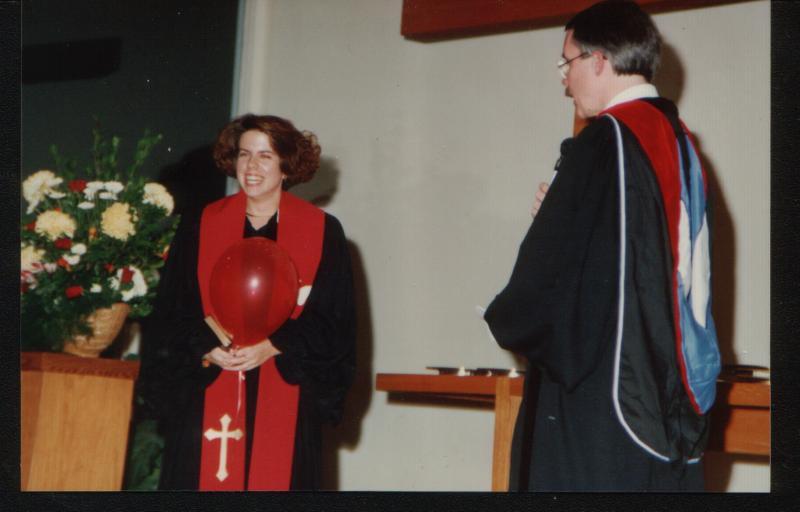
I hardly ate at all that whole day. I don't remember having breakfast before church that Sunday morning, and all I had for lunch was a bite of a pb & j, maybe a swig of milk. The ordination was at 5:00 p.m. with a reception afterward. I was so busy greeting family and friends that I didn't have a chance to nibble at the plate of food someone thoughtfully brought me. Then a select group of us adjourned to the Elks hall in Pembroke, MA for a dance with a dj, dessert, coffee and tea. Again, not a morsel passed my lips as we toasted, opened presents, and boogied the night away. The party broke up at around 10 p.m. but I was not ready to retire for the night. Two friends were headed for the Hard Rock Cafe in Boston and I asked if I could come with them. As we made our way toward the highway I asked if we could go through the drive-thru at Burger King; I was famished and could not wait until we made it to Boston. I did not go to bed until 2 a.m.!
I don't know if it was the Holy Spirit or pure adrenaline I was running on; perhaps a mixture of both. I do know that it was a great way to start the next chapter in my life. I wish everyone could have a day like that for the beginning of one's own life as an adult or when making a meaningful change: surrounded by friends and family, making promises and a commitment toward the future in front of God and everyone, and then a huge party afterward. It gives one the sense of being truly loved and of owing something back for all that has been received, a sense of being responsible in a joyful, giving way.
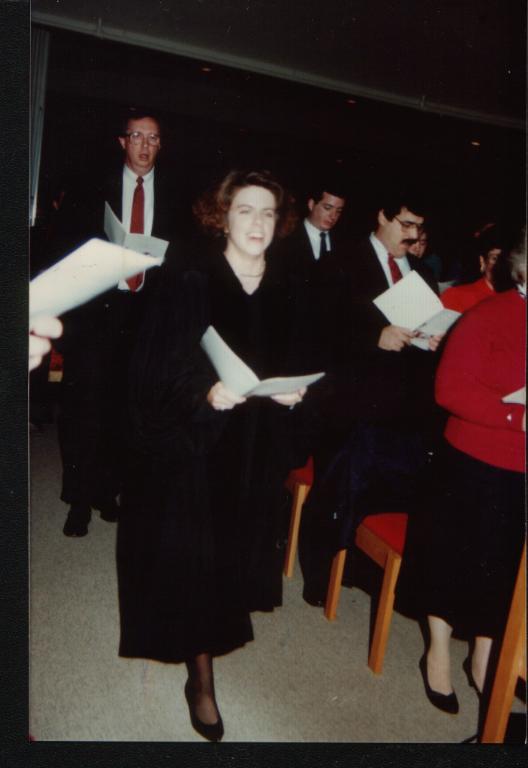
This was the opening prayer for the ordination service, written by Methodist minister/author Ted Loder. I return to it from time to time to remind me of who and where I came from and that God is still not finished with me.
Come, Lord Jesus,
expand me,
by your power, life-generating as the sea
to accept
and use my power
to do something I believe in
and be something more of who I mean to be
and can be;
to inspire me to dream and move,
sweat and sing,
fail and laugh,
cuss and create;
to link my passion with courage,
my hope with discipline,
my love with persistence;
to enable me to learn from difficulties,
grow in adversities,
gain wisdom from defeats,
perspective from disappointments,
gracefulness from crises,
and find joy
in simply living it all fully.
Release me through your power
to be a powerful person, Lord. Amen.
Thursday, November 16, 2006
"I'm Too Much!"

Couldn't you just die?!
The perfect desk ornament. Put both up at the same time or switch on and off, depending on your Yuletide mood. Usually I can't stand Christmas decorations before December, let alone Thanksgiving, but these were just too much to pass up.
Is it me or does Snow Miser look a lot like the Winter Warlock in "Santa Claus is Coming to Town"? Actually, now that I think about it, Heat Miser bears a striking resemblance to the Burgermeister. You'd think the creative team behind these Christmas specials could be a little more, well, creative.
You can find them here. Be the first in your office.
Tuesday, November 14, 2006
November
Remember
remember the dead
and those still
with us draw breath
Remember veterans
and armistice
reasoning for war
the wreckage of a man’s
and a woman’s
living, family, a nation,
a world, that it never ends
anything but life
Remember to vote
that fierce whisper
amid the chattering clamor
power to say enough
Remember
a thwarted gunpowder plot
all those who would tear
asunder that which is joined
Remember to give thanks
not eat too much
make room at the table
and that Advent is coming soon
Remember me, he said
whenever you break bread
and pour wine to share
Remember
students in Prague
and the Velvet Revolution
the golden queen’s
ascension and deathbed
remember the Compassionate
One enthroned in Tibet
yet to return
Remember the owl
her silent flight beneath
Orion's watchful eye
the cloistered bee
the beauty of bare trees
a carpet of russet and gold
not to be seen for another year
Remember
the seed, the sunken bulb,
the misplaced acorn and walnut
the promise of life
cycled within death
remember the dead
and those still
with us draw breath
Remember veterans
and armistice
reasoning for war
the wreckage of a man’s
and a woman’s
living, family, a nation,
a world, that it never ends
anything but life
Remember to vote
that fierce whisper
amid the chattering clamor
power to say enough
Remember
a thwarted gunpowder plot
all those who would tear
asunder that which is joined
Remember to give thanks
not eat too much
make room at the table
and that Advent is coming soon
Remember me, he said
whenever you break bread
and pour wine to share
Remember
students in Prague
and the Velvet Revolution
the golden queen’s
ascension and deathbed
remember the Compassionate
One enthroned in Tibet
yet to return
Remember the owl
her silent flight beneath
Orion's watchful eye
the cloistered bee
the beauty of bare trees
a carpet of russet and gold
not to be seen for another year
Remember
the seed, the sunken bulb,
the misplaced acorn and walnut
the promise of life
cycled within death
Monday, November 06, 2006
Leave me alone...I'M VOTING!

(I put in the cartoon just because it's so damn true.)
I'm tired of the political mailings, 4 to 6 of them a day, from various candidates and committees. The ads on TV may have to be registered on the list of dangerous substances as they can cause headaches, drowsiness, coma, and feelings of suicide. A PAC, one of the many who have tried to nail us down, called my husband, wanting to know which way he was going to vote on Tuesday and he replied, "Yes, I am going to vote, and how I will vote is a private matter (PC for none of your business)." My sentiments exactly.
P.S. My husband, David, came up with the title to this blog.
P.P.S. Since when was 'nevermind' one word?!
Tuesday, October 17, 2006
Redemption
I am a sucker for stories that turn my heart inside out and make me cry with joy. This video of Dick and Rick Hoyt, father-and-son marathon team, has as its soundtrack I Can Only Imagine by Mercy Me. In the popular listening of this song, the theology is extremely limiting. But listening to it through the experience of this incredible relationship gives it a whole new meaning. These two are savior to each other; they literally saved the other's life: Rick, from a motionless existence and Dick from possible heart failure. They have given each other eternal life, that is, the fulness of life lived now, redeeming the past, and recreating the future.
Rick's only wish is that one day he could push his dad.

Team Hoyt
Rick's only wish is that one day he could push his dad.

Team Hoyt
Sunday, October 08, 2006
Integrity
Job 1:1, 2: 1-10; Ps. 26; Hebrews 1: 1-4, 2: 5-12
***** United Church of Christ
October 8, 2006
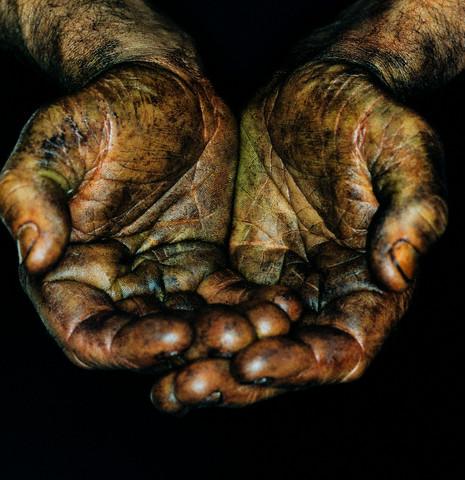
As I was preparing for this sermon, I searched the internet for a photo or a piece of artwork that would illustrate the theme of integrity. I post my sermons on my weblog, usually with an image that embodies the text of the sermon.
So I went to Google.com and typed in the word integrity, which Webster’s defines as honesty, incorruptibility or the state of being complete or undivided. I found hundreds of images: some were for business WebPages, some were for school and college websites; one was a picture of the residents and staff of Integrity House, a home for those with cognitive disabilities. I even found a billboard sign from New Zealand displaying the value of integrity in the community.
The most striking image for the word integrity was a pair of grimy, filthy, cupped hands: hands that looked like they hadn’t seen water in months. They were the hands of a man: somebody’s father, son, or brother. They looked like they had been used bare to dig for survivors for days on end at some ground-zero site, any ground zero: an earthquake, a plane crash, a bomb site, the mountain of rubble from the World Trade Center. Or hands used to dig through a city dump for a living and a few scraps of food. They could have been the hands of a homeless person, outstretched for a few coins and a little mercy. They could have been the hands of a soldier or an insurgent. They looked like the hands of someone who had suffered much and lost everything, yet could still form their hands into the shape of hope, hands waiting to receive yet able to give and be thankful.
They looked like the hands of Job. Here is a man who has, indeed, lost everything: his children, his livelihood and all of his livestock, and his good health. All he has left is a broken piece of pottery with which to scrape his sores, his wife who is ready to curse God (and who can blame her), and a few friends who come to sit with Job in his suffering and offer their fair-weather advice and religious platitudes. Eventually he rages against these friends and protests his suffering before God who comes to Job not in a vision bathed in light but in the eye of a violent storm, leaving Job’s knees quaking.
Yet at this point in the story, Job persists in his integrity, in his incorruptible faith. Even though he has nothing, still he says nothing against God. Even in his great suffering, Job is still faithful to God. He does not allow his suffering to alter his fundamental belief that God is in charge of the universe. He still has his hands offered as a cup, waiting on the mercy of the Lord. Job asks: How can we give God credit for the good days and yet curse him for the bad? Are we not then fair-weather friends of God ourselves? Yet how can we give thanks in all things, even in our suffering? How can we retain our integrity, how can we remain incorruptible, in the face of pain and anguish?
This is the same question that Israel must have been asking herself during and after the time of exile in Babylon: How can we sing the Lord’s song in a foreign land, in a place where our faith is mocked? It is estimated that the book of Job was written in an early period after Israel had returned from its Babylonian exile, a time of great suffering for the people of Israel. The city of Jerusalem had been destroyed and the temple along with it. The people had not been allowed to worship Yahweh in their captivity but had to worship the Babylonian gods instead. It was difficult to remain faithful and to keep one’s integrity, one’s guileless honesty before God. The story of Job is universal, in that it is the story of all those in relationship to God when in the face of suffering.
When all has been taken away from us, when all that is familiar and usual is gone, when we can’t even recognize ourselves as whom we used to be, how do we worship God? How do we meet God in the midst of our suffering?
All of us deal with suffering in our own way. Some of us retreat from the church, finding it difficult to be with our sisters and brothers in faith. Some of us become trapped in the belief that our suffering is equal to falling short in our faith; we don’t feel as close to God when we are in pain. We think of ourselves as different from others because of our pain and assume that no one can enter into it with us. Often our well-meaning friends can sound like the friends of Job, wanting to fix whatever situation we’re in, offering answers for questions that have none, further pushing us into the solitary confinement of our feelings.
Our culture teaches us to medicate our suffering, to cover it up or distract ourselves from it with any number of ways, by being a consumer and spending our money, indulging in pleasures and leisure activities, feeling good by looking a certain way, to more hurtful and self-destructive practices such as drinking and eating to excess, abusing drugs and keeping our pain to ourselves. There is no place for suffering in our culture, lest it become like a disease that is catching. We try to avoid suffering, but more often than not, it finds us regardless of our careful watching.
Suffering is an inevitable condition of the human experience. Perhaps there are days when it feels like God and the Devil are playing a game of chess with our lives. Suffering comes as a result of living in flesh and loving life and those around us with our whole heart. Jesus knew that.
The grace of suffering is not that we are to find God in it but that God finds us and meets us in our suffering. Through the life and death of Jesus, God comes to us and “shares our common lot, conquering sin and death and reconciling the world”. The author of the book of Hebrews tells us that through Jesus, we learn how to suffer and to keep our integrity as faithful people. By opening ourselves to suffering, not by our ego or through any false sense of piety, but by trusting in God’s grace we open ourselves to God and the possibility of transformation.
The most recent scene of great suffering that has transfixed all of us has been the lines of black horse carriages following hearses in Lancaster County, PA earlier this week. The suffering of the Amish people seems all the more poignant in that they have rejected our American gun culture and yet could not be safeguarded against it. Even more heartrending are the reports of the relatives of the young girls calling for forgiveness for the man who chose to suffer his rage and remorse upon the innocent. With courage that must have come from deep faith in God, the oldest of the girls asked to be shot first, hoping to spare the younger ones. Families of the slain girls have gone so far as to reach out to the family of Charles Roberts, realizing that they too have lost someone they loved. About half of the 75 people that attended Roberts’ funeral were Amish.
All of these actions are a witness to integrity in faith in the face of great suffering. The Amish have been depicted as traditional Christians that emphasize the importance of forgiveness, as if they are the only ones who believe that. I have heard others say that it is too soon for forgiveness. All of us who follow Jesus know of this radical forgiveness. From the cross Jesus forgave those who crucified him, saying that they did not know what they were doing. It is never too soon for forgiveness. What is astounding about the Amish is that they are acting upon the belief in radical forgiveness as a community that is rarely seen in other Christian quarters. Even in the midst of suffering, healing can be found through love, forgiveness, compassion, and the willingness to open our hands to God and to give thanks.
When we allow suffering to harden our hearts and close our fists, we allow ourselves to lose our integrity before God. We are no longer whole-hearted and undivided. Yes, we feel anger, sadness, and despair when we suffer but God is more than big enough to take it and to listen. When we open ourselves to our suffering and to the suffering of others in the presence of God, there is power to be transformed, to be made more of who we are, which is a child of God. We were created to be loving, compassionate, giving reflections of the One who made us. Our sufferings connect us to others in a mysterious way and remind us that all we really have is how we treat each other.
In the Buddhist faith there are what are called the Five Remembrances, five truths to remember about the human condition, and they are universal.
- I will grow old.
- This body will know sickness.
- There is no escape from death.
- Everything and everyone changes.
- All I have are my actions.
Suffering does and will happen. It is a fact of life. How we respond to it can mean the world of difference to the integrity of our souls and the lives of those around us. But we cannot do this alone nor are we meant to. Paul said in his first letter to the Corinthians that when one suffers, all suffer together; when one rejoices, all rejoice together. The gift of community is that we are absolved of the burden to be complete. You are complete; you have integrity because this church is in covenant to God and to other faith communities. I encourage you to nurture that covenant. It is through the completeness of this beloved family of faith that you are able to worship God in the midst of suffering. Through your actions with one another, even when you are in pain, you can communicate the deep love that God has for all persons.
How has this faith community remained incorruptible and kept its integrity in the midst of suffering? How have you allowed suffering to open you to God’s new possibilities? When have you, as an individual and as a congregation, kept your hands open to God and when have you closed them? How do you allow your own suffering to connect you others who are suffering and to the suffering of Jesus on the cross? How have you reached out to other faith communities in their suffering and rejoicing? What keeps you coming back, week after week?
The God of Job, the God of Jesus Christ, is the God who invites us to come and die as well as to come and live. God promises to be with us in the face of suffering, to suffer with us, and to welcome us on the other side. God calls us to integrity, to be incorruptible and honest in our faith, to love with whole and undivided hearts, to find our completeness in community, to keep our hands open: willing to receive whatever comes yet able to give and be thankful. Amen.
Tuesday, October 03, 2006
Revelation
The United Church of Christ has adopted the phrase "God is still speaking," and its attendant comma, to illustrate a core belief, that "[t]here is still more light and truth to break forth from God's holy Word" (Pastor John Robinson, 1620, before the Pilgrims set sail for the New World). I also believe that God speaks through other means, through persons and their creative efforts, whether in the arts, film, or the written word. In this way we encourage one another in our evolution as spiritual beings in a human experience. It is through our evolution that God still speaks, that "Ground of All Being" (Paul Tillich) in which we move and live and have our being (Acts 17: 28).
This is an incomplete list, in no particular order, of those books and films which have shaped my evolution as a spiritual being. In a way they have become like another bible, in that I return to them again and again for nurture, instruction, challenge, comfort and reproof. I invite you to share your own personal list of those sources that inform you how to be loving, compassionate, forgiving, generous, ethical, and open.
Books
The Education of Little Tree, Forrest Carter
Contact, Carl Sagan
A Wrinkle in Time, Madeleine L'Engle
Two-Part Invention, Madeleine L'Engle
Parable of the Sower, Octavia Butler
She's Not There, Jennifer Finney Boylan
Amazing Grace, Jonathan Kozol
Practicing Resurrection, Nora Gallagher
The Year of Magical Thinking, Joan Didion
Man's Search for Meaning, Viktor Frankl
Traveling Mercies, Anne Lamott
If Grace is True, Philip Gulley & James Mulholland
Beyond Belief, Elaine Pagels
The Gnostic Gospels, Elaine Pagels
Mutant Message Down Under, Marlo Morgan
A New Christianity for a New World, John Shelby Spong
Dance of the Dissident Daughter, Sue Monk Kidd
The Secret Life of Bees, Sue Monk Kidd
The Girl Who Loved Tom Gordon, Stephen King
The Road Less Traveled, M. Scott Peck
The Luminous Web, Barbara Brown Taylor
A Woman's Worth, Marianne Williamson
Living Buddha, Living Christ, Thich Nhat Hanh
Going Home, Thich Nhat Hanh
Ishmael, Daniel Quinn
Poetry collections
Given, Wendell Berry
God Went to Beauty School, Cynthia Rylant
Mules of Love, Ellen Bass
For Earthly Survival, Ellen Bass
Collected Lyrics of Edna St. Vincent Millay
Collected Poetry of Sylvia Plath
Collected Poetry of Robert Frost
Films
The Shawshank Redemption
Amadeus
Babette's Feast
Gandhi
Chocolat
Jesus of Montreal
Star Trek II, IV, VI
Star Trek: Generations, First Contact, Insurrection
The Song of Bernadette
Contact
After Life (Japanese)
Not One Less (Chinese)
Brief Encounter
The Matrix trilogy
Lord of the Rings trilogy
Chariots of Fire
Resurrection
Shadowlands
The Karate Kid
L.A. Story
G.I. Jane
Groundhog Day
The Joy Luck Club
Grand Canyon
A River Runs Through It
Phenomenon
Field of Dreams
Crouching Tiger, Hidden Dragon
The Right Stuff
Plus, there's a new TV series "Heroes" on NBC that's really got me fired up. This show, in addition to the lists above, help me know in more tangible ways that I am not alone, that there are others who are thinking and wondering and questioning many of the same things, what scientists call synchronicity. The power and the gift of revelation (the mystery revealed), in the context of community, is to know that we are not alone in this vast universe. This is our greatest fear, which I believe fuels most of the violence in our world. It is my hope that one day we will evolve beyond this fear, realizing the holy and the good within each one of us.
This is an incomplete list, in no particular order, of those books and films which have shaped my evolution as a spiritual being. In a way they have become like another bible, in that I return to them again and again for nurture, instruction, challenge, comfort and reproof. I invite you to share your own personal list of those sources that inform you how to be loving, compassionate, forgiving, generous, ethical, and open.
Books
The Education of Little Tree, Forrest Carter
Contact, Carl Sagan
A Wrinkle in Time, Madeleine L'Engle
Two-Part Invention, Madeleine L'Engle
Parable of the Sower, Octavia Butler
She's Not There, Jennifer Finney Boylan
Amazing Grace, Jonathan Kozol
Practicing Resurrection, Nora Gallagher
The Year of Magical Thinking, Joan Didion
Man's Search for Meaning, Viktor Frankl
Traveling Mercies, Anne Lamott
If Grace is True, Philip Gulley & James Mulholland
Beyond Belief, Elaine Pagels
The Gnostic Gospels, Elaine Pagels
Mutant Message Down Under, Marlo Morgan
A New Christianity for a New World, John Shelby Spong
Dance of the Dissident Daughter, Sue Monk Kidd
The Secret Life of Bees, Sue Monk Kidd
The Girl Who Loved Tom Gordon, Stephen King
The Road Less Traveled, M. Scott Peck
The Luminous Web, Barbara Brown Taylor
A Woman's Worth, Marianne Williamson
Living Buddha, Living Christ, Thich Nhat Hanh
Going Home, Thich Nhat Hanh
Ishmael, Daniel Quinn
Poetry collections
Given, Wendell Berry
God Went to Beauty School, Cynthia Rylant
Mules of Love, Ellen Bass
For Earthly Survival, Ellen Bass
Collected Lyrics of Edna St. Vincent Millay
Collected Poetry of Sylvia Plath
Collected Poetry of Robert Frost
Films
The Shawshank Redemption
Amadeus
Babette's Feast
Gandhi
Chocolat
Jesus of Montreal
Star Trek II, IV, VI
Star Trek: Generations, First Contact, Insurrection
The Song of Bernadette
Contact
After Life (Japanese)
Not One Less (Chinese)
Brief Encounter
The Matrix trilogy
Lord of the Rings trilogy
Chariots of Fire
Resurrection
Shadowlands
The Karate Kid
L.A. Story
G.I. Jane
Groundhog Day
The Joy Luck Club
Grand Canyon
A River Runs Through It
Phenomenon
Field of Dreams
Crouching Tiger, Hidden Dragon
The Right Stuff
Plus, there's a new TV series "Heroes" on NBC that's really got me fired up. This show, in addition to the lists above, help me know in more tangible ways that I am not alone, that there are others who are thinking and wondering and questioning many of the same things, what scientists call synchronicity. The power and the gift of revelation (the mystery revealed), in the context of community, is to know that we are not alone in this vast universe. This is our greatest fear, which I believe fuels most of the violence in our world. It is my hope that one day we will evolve beyond this fear, realizing the holy and the good within each one of us.
Subscribe to:
Posts (Atom)