Monday, September 29, 2008

Yearning for God

The content of this post is almost wholly due to Jan at her blog with the same title, which I swiped with no shame (or permission) whatsoever. I have also included some material from previous posts from this blog.


Exodus 17: 1-7; Philippians 2: 1-13
First Congregational Church of ******, CT
September 28, 2008

A couple had two little boys who were always getting into trouble. Their parents knew that if any mischief occurred in their village, their sons were probably involved. The boys' mother heard that an elder in town had been successful in disciplining children, so she asked if he would speak with her sons. The elder agreed, but asked to see them separately.

So, in the morning, the mother sent her youngest son first. The elder, a huge man with a booming voice, sat the boy down and asked him sternly, “Where is God?” The boy's mouth dropped open, but he made no response.

So the elder repeated the question in an even sterner tone, “Where is God?!!” Again the wide-eyed boy made no attempt to answer. The elder raised his voice and bellowed, “WHERE IS GOD?!” The boy screamed and bolted from the room, ran directly home and dove into a closet, slamming the door behind him.

When his older brother found him hiding, he asked, “What happened?” Gasping for breath, the younger brother replied, “We are in BIG trouble this time. God is missing, and they think WE did it!”

I had posted this story on my weblog a couple of years ago. When I went looking for it on my blog, I typed in the words ‘where is God’ and saw entry after entry that contained that haunting phrase; mostly sermons I’ve written and preached but also some reflections on faith. It is a very human question, one that we often ask in unsure and difficult times, both personal and communal.

It seems we are always on the lookout for God to show up, wondering when and in what way. And like Moses, we do not get to see God coming but only recognize the Holy One after the fact. We see the wake in the water, the clouds moving off in the distance, the sun coming out after rain, and like a point on the map of our lives, we say, “There! God was there!” Anne Lamott in her book Grace (Eventually) quoted one of her friends as saying that believing in God isn’t the hard part, waiting on God is.


It is in this waiting that we meet the Israelites in this morning’s lectionary reading from the book of Exodus. They are waiting for God to show up in answer to their thirst. But they are not only very thirsty; they want to know if God is still there for them and does God still care. In this passage physical thirst and spiritual thirst are one and the same. The Israelites have been journeying in the wilderness, the desert, for forty years, which means enough years for children to be born and for those children to have families of their own. In the plea for water in the desert we can hear the echo of the psalmist’s cry, “My soul thirsts for you, my body longs for you, in a dry and weary land where there is no water.”(1) The whole congregation of Israelites contends against God and against Moses: God who liberated the people from slavery in Egypt, Moses who led them to freedom. Yet when anxious and scared for their lives they have only a very human Moses at whom to hurl their anger and despair.

Sounds familiar, doesn’t it? When congregations are anxious and scared, it can feel as though we only have each other and our leaders at whom to hurl our anger and despair. Yet what we all thirst for, what we long for is the closeness of God, the reassurance that we will come through the wilderness of the unknown and still recognize one another as brother and sister.

Simply put, we all long for love: the acceptance of who we are with all our imperfections; comfort and strength in the midst of struggle; the peace that comes with belonging and being known. Psychologist Gerald May wrote that “[there] is a desire within each of us, in the deep center of ourselves that we call our heart. We were born with it, it is never completely satisfied, and it never dies. We are often unaware of it but it is always awake. It is the human desire for love. Every person on this earth yearns to love, to be loved, to know love. Our true identity, our reason for being, is to be found in this desire.”

But like the Israelites at Massah, meaning ‘test’ or ‘proof’, and at Meribah, meaning ‘contention’ or ‘argument’, we often want proof of this love and we try to prove it by testing God’s love; we argue about who God loves and whom we should love. We contend with one another and with God as to how this love is to be revealed to us and among us. In a way, we can sound like children squabbling over which child Mom and Dad love more, when, in fact, all of the children are loved very much, just in different ways.

In a scene from the movie Contact two of the main characters are discussing the fact that 90-95% of the world’s population believes in some kind of higher power or supreme being. Ellie Arroway, a scientist, does not believe in God because she needs some proof of God’s existence. Her friend, Palmer Joss, a theologian, asks her, “Did you love your father?” Ellie, whose father died when she was a young girl, replies, “Of course, very much.” Palmer jars her certainty with the reply, “Prove it.”

We cannot prove the existence of God, nor should we. Looking for proof is like chasing after wind, as foolhardy as science looking for a unifying equation that will explain everything. Author Joseph Campbell wrote, "We keep thinking of deity as a kind of fact, somewhere; God as a fact. God is simply our own notion of something that is symbolic of transcendence and mystery. The mystery is what's important." To me it seems that we yearn for God in the meaning of two questions, two mysteries, which as of now have no discernable answer.


The big picture questions are: How did this whole existence begin? How is it all going to end?


In the mystery of who we are, we ask: How did we as individuals come into existence? What happens to us when we die?


And a third that encompasses it all: How are we to live?


When I was in seminary I took a class in object psychology, the premise of which, as I recall, was this: when we are children, we treat everything around us, including people, as objects, as things we can manipulate to get what we want and need. Our development into mature people depends on how we are able to internalize those objects; that is, we learn to mother ourselves, father ourselves, befriend ourselves. We become able to take care of ourselves and help others, no longer needing to manipulate the world around us because we have become a part of it.


I have come to see our development, our evolution as human beings in a similar way. We objectify God because we are still learning how to live in the world. As I see it, we as a human species are somewhere in our adolescence. We still need our Parent to tell and show us how to live, how to be moral, ethical, loving, compassionate people, because in our development, we can be very much self-centered and self-absorbed; I know I was when I was a teenager. We try to break away from our Parent, but yet we don't know it all. As a species we're still very scared and anxious that one day we'll have to be grown-ups, be responsible and give up the unhealthy, often hurtful ways we try to fill our longing.


But one great day we will fully know what it means to be filled by God; we will have God's law of love written upon our hearts, we will have that same mind as Christ, we will be Spirit-led, having the same love for all people as we would want for ourselves. That is the day that the kingdom comes on earth. And as His Holiness the Dalai Lama has said, we don't need to believe in God in order to be compassionate and loving. We need simply to do these things every day.


But for most of us it's not that simple. We need reminders to practice our compassion and our loving. And that is why we need church, why everyone needs a community of some sort to be accountable to for their actions. We do not work out our salvation in a vacuum nor solely on our own. We’re always bumping up against someone and their notion of what constitutes not only a human experience, but also an experience of God. If anything, we need at least to be forgiving. And I don't know how anyone comes by that naturally.

The church in Philippi received such a reminder from Paul while he was in prison, for they were contending against one another, as ones in the desert straying from the source, the well of compassion and love. Hear this paraphrase of the Philippians passage from Eugene Peterson’s The Message:


“If you’ve gotten anything at all out of following Christ, if his love has made any difference in your life, if being in a community of the Spirit means anything to you, if you have a heart, if you care—then do me a favor: Agree with each other, love each other, be deep-spirited friends. Don’t push your way to the front; don’t sweet-talk your way to the top. Put yourself aside, and help others get ahead. Don’t be obsessed with getting your own advantage. Forget yourselves long enough to lend a helping hand.


“Think of yourselves the way Christ Jesus thought of himself. He had equal status with God but didn’t think so much of himself that he had to cling to the advantages of that status no matter what. Not at all. When the time came, he set aside the privileges of deity and took on the status of a slave, became human!
Having become human, he stayed human. It was an incredibly humbling process. He didn’t claim special privileges. Instead he lived a selfless, obedient life and then died a selfless, obedient death—and the worst kind of death at that: a crucifixion.


“Because of that obedience, God lifted him high and honored him far beyond anyone or anything, ever, so that all created beings in heaven and on earth—even those long ago dead and buried—will bow in worship before this Jesus Christ, and call out in praise that he is the Master of all, to the glorious honor of God the Father.


“What I’m getting at, friends, is that you should simply keep on doing what you’ve done from the beginning. When I was living among you, you lived in responsive obedience. Now that I’m separated from you, keep it up. Better yet, redouble your efforts. Be energetic in your life of salvation, reverent and sensitive before God. That energy is God’s energy, an energy deep within you, God himself willing and working at what will give him the most pleasure.”(2)

Our desire, our yearning for God is God willing and working within us, at what will give God the most pleasure, which is all creatures of this earth living as close to God as can be. As it is printed on the cover of this morning’s bulletin, all our love, our stretching out, our hope, our thirst, God is creating in us so that God may fill us. . . .God is on the inside of the longing.(3)

In all our yearning for God, do we as congregations, as the Body of Christ, have the desire, the longing to be in the same mind as Christ? What is the motivation for our life together? Is it that our own needs will be met or is it the needs of all? We all yearn for God’s gifts of healing, wholeness, forgiveness, purpose and meaning in our lives; we all yearn for love. Is there a way that we can be those things for each other and for any, thus allowing that Christ-mind to inhabit us and work through us? Are we ready to be filled with God and all that goes with that?


Even though we contend with one another and with God, even though we may frustrate that mind of Christ, even though God may not show up on our timetable, still God does come to us. God’s mercy is infinite. We need only await it with confidence and receive it with gratitude. God comes to us in the life-giving grace of everyday living, sustaining us in the wilderness of the unknown. This grace, this mercy draws us together into community that we might be revelations of the very real love of God for the whole world. Amen.


________________________________________________


Notes

1. Psalm 63: 1b, NRSV.
2. Eugene Peterson, The Message, (Colorado Springs, CO: NavPress, 2002), Philippians 2: 1-13.
3. Maria Boulding.

Friday, September 26, 2008

The floating Dutchman


If you're a pastor, or someone who goes to church or who likes to make fun of people who do, then you may have already seen this in your email. In 2006 Netherlands resident Johan Huibers built an exact replica of the ark as described in the book of Genesis. It's not a hoax; even the BBC covered this one.
My favorite part of the story is his wife's reaction. Being not very keen on the idea she told him, "Why don't you go dig wells in Ethiopia?" My feeling exactly, especially since the cost of the ark's construction was approximately the equivalent of $1.2 million U.S. I wouldn't doubt that like Mrs. Huibers (ironically no, we don't get her name either), Mrs. Noah also wasn't too fond of her husband's project.

Oops, she did it again!

from The Christian Century, October 7, 2008 issue:

Century Marks: Homework

Asked what she thought of the phrase "under God" in the Pledge of Allegiance, vice presidential candidate Sarah Palin said, "If it was good enough for the founding fathers, it's good enough for me." Palin might be surprised to know that the Pledge was written not by the founding fathers, but in 1892 by Francis Bellamy, a Christian socialist and Baptist minister, with the intent of pledging support for poor and excluded Americans. And the phrase "under God" wasn't added until 1954 during the cold war with the officially atheistic Soviet Union (eagleforumalaska.blogspot.com and Wikipedia).

Thursday, September 25, 2008

Read my lips: no more lies!

None of this Wall Street hullabaloo should be any surprise to us--at least to those of us who feel as though we have been hoodwinked in the last eight years. We have a leader who has lied to us, who has looked the other way when members of his administration have lied, and who will not admit it when he is wrong. Whether intentionally or not, he has created a culture in which this behavior is allowed or at least overlooked. By whom, you ask? By us, the American citizenry. Because we were also told that to question any of this was unpatriotic.

We have had corrupt politicians get caught with their pants down (or at least with their foot under the stall), scheming lobbyists go to jail, 401(k) plans and pensions go belly up, carried on our lives while young men and women die for what or come home maimed, body and soul, so why shouldn't our financial markets come hurtling down around our ears as well? Greed, lies and betrayal cannot uphold a society; they bring it down.

So for me, Barack Obama, in his promised efforts to rebuild this country, needs to tell me only three things: he'll tell the truth, his policies and administration will be transparent, and that when he's wrong, he'll admit it and find a way to make it right. If being dishonorable can bring this country down in eight short years, surely being honorable can rebuild it and soon.

Monday, September 22, 2008

Reunion


Matthew 20: 1-16
****** Congregational Church, Bridgeport, CT
September 21, 2008


Are you an underdog? Were you always picked last for the kickball team? Are the words ‘life is not fair’ your personal mantra? Are there behaviors in your past you’d rather no one ever knew about you? Do you consider yourself an eleventh-hour, Johnny-come-lately kind of believer, standing on the outside of the circle of faith? Then this Sunday’s gospel lesson is good news for you.

Are you a winner? Were you the one who got to pick the players for your kickball team? Are the words ‘life is what you make of it’ your personal mantra? Do you take pride in your accomplishments, perhaps indulging in a bit of boasting occasionally? Do you consider yourself a dyed-in-the-wool, womb-to-tomb, birth-to-earth kind of believer, standing somewhere inside the circle of faith? Then this Sunday’s gospel lesson is good news for you too.

Of course, these are simplifications. Most of us are somewhere in between, as in the Latin phrase, simul iustus et peccator: at once righteous and a sinner. But to the listeners of Matthew’s gospel, there was no gray area: either you were a sheep or a goat, a Jew or a Gentile, a Pharisee or a sinner, someone who got the message or someone who didn’t.

Strangely enough, Matthew, the disciple to whom this gospel is attributed, was one who lived in the gray. He was Jewish but he was a tax collector, dealing with the Romans who were Gentiles. To liken him to an IRS agent is a rather weak analogy: in essence Matthew worked for what amounts to the mafia, the Roman occupying force in Palestine, extorting from his Jewish brothers as much as he wanted as long as the Romans got their taxes.

He was also one the twelve disciples, someone who had experienced the saving grace of God as shown to him in the person of Jesus. When Jesus came to Matthew’s house for dinner, along with the disciples, other tax collectors and some additional unsavory characters, the Pharisees asked Jesus’ followers, ‘What kind of example is this from your Teacher, acting cozy with crooks and riff-raff?’ Jesus, overhearing, shot back, “Who needs a doctor, the healthy or the sick? Go and learn what this Scripture means, ‘I’m after mercy, not religion.’ I’m here to invite outsiders, not coddle insiders.”(1) Matthew knew first-hand the meaning and importance of God’s saving grace.

Throughout Matthew’s gospel, Jesus has been working up to the telling of the parable of the generous employer. In the Beatitudes Jesus blesses those who mourn, the meek, the merciful, those who are persecuted for his sake. He adjures his listeners to love their enemies and to not judge others. He cleanses a leper and heals a centurion’s servant, both considered outsiders. He turns the law on its head by declaring that it is not what goes into our mouths that defiles but the words that proceed from it. He tells the parable of the lost sheep, to leave the ninety-nine in search of the lost one. He advises his disciples to forgive, not seven times but seventy-seven times. He blesses little children, saying that the kingdom of heaven belongs to ones such as these. Over and over, using story and parable and action, he instructs his listeners to deny themselves, to take up their cross and follow him.

But now the stakes are mounting. Jesus is approaching Jerusalem and the hour when he will take up his own cross. The tension has been building throughout the gospel. Finally, in the chapter before our lesson, Peter has been listening to the exchange between Jesus and the rich young man, how he is to sell everything he has and to follow Jesus; he has seen the young man walk away from Jesus, grieving because he had too many possessions he couldn’t let go. He hears Jesus tell the disciples that it’s easier for a camel to go through the eye of a needle than for a rich man to enter the kingdom; listens as the disciples cry out ‘Then who has any chance at all?’ Then Jesus’ reply, “Only with God are all things possible” pushes Peter to the edge.

Peter, being the perfect foil, says, “Look, we’ve left everything behind to follow you. What do we get out of it?” And on the heels of that question comes the parable of the generous employer.

This is a paraphrase from Eugene Peterson’s The Message:


“God’s kingdom is like an estate manager who went out early in the morning to hire workers for his vineyard. They agreed [on the usual daily wage] (2) and went to work.
“Later, about nine o’clock, the manager saw some other men hanging around the town square unemployed. He told them to go to work in his vineyard and he would pay them a fair wage. They went.
“He did the same thing at noon, and again at three o’clock. At five o’clock he went back out and found still others standing around. He said, ‘Why are standing around all day doing nothing?”
“They said, ‘Because no one hired us.’
“He told them to go to work in his vineyard.
“When the day’s work was over, the owner of the vineyard instructed his foreman, ‘Call the workers in and pay their wages. Start with the last hired and go on to the first.’
“Those hired at five o’clock came up and were each given [the usual daily wage]. When those who were hired first saw that, they assumed they would get far more. But they each got the same… [They] groused angrily to the manager, ‘These last workers put in only one easy hour, and you just made them equal to us, who slaved all day under a scorching sun.’
“He replied to the one speaking for the rest, ‘Friend, I haven’t been unfair. We agreed on [the usual daily wage], didn’t we? So take it and go. I decided to give to the one who came last the same as you. Can’t I do what I want with my own money? Are you going to get stingy because I am generous?’
“Here it is again, the Great Reversal: many of the first ending up last, and the last first
.”(
3)

Some scholars argue that the workers who labored all day are symbolic of Jewish Christians who came to follow Jesus through their Jewish faith. The ones hired at five o’clock are thought to represent Gentile Christians who heard the saving message of Jesus and also wished to be included under the umbrella of grace and accepted as part of the worshiping community. Some interpret the first and last workers as Pharisees and sinners. In every faith community there are insiders and outsiders, sometimes the outsiders being invisible to those on the inside. But neither insider nor outsider truly understands the gift of grace being offered in the life and the love of Jesus.

For those of us who have always been a part of the circle of faith, the good news is that our salvation does not depend on our good behavior, how hard we work, or the sacrifices we make. The good news to those of us who feel like an outsider is that salvation comes to us even though we’ve made mistakes, even though we’ve been excluded, even though we feel like we don’t deserve it. This is not a parable about the workers; as with most things, it’s not about us. This is a parable about a generous employer who keeps gathering workers until all are hired. It’s about God who saves each and every human being.

And from what do we need saving? From ourselves, from being self-absorbed by our problems, our suffering, our pride, our arrogance, and most of all, our fears. God’s desire is to remove any and all obstacles between us and the experience of love, mercy, forgiveness and grace. God wants to be close to us, as close as can be. God also desires that we be close to one another, that we not divide ourselves as insiders and outsiders, as underdogs and winners, long-time workers and Johnny-come-latelys. God desires reunion. And whether we know it or not, it’s what we want and need too.

And so in the kingdom of heaven the first shall be last and the last first. There shall be neither outsider nor insider, Jew nor Greek, male nor female, slave nor free, for all are one in Christ Jesus, says the apostle Paul. Truth is, when it comes to our need of God’s saving grace, we’re all eleventh-hour Christians, prodigal sons and daughters, who need to acknowledge our dependence on one another and on the God who saves us from ourselves.

Who are considered the first and the last in this church? Who would have difficulty feeling welcome and at home in this congregation? What work, what ministry do you do to remove obstacles and barriers in the way of all experiencing God’s grace and love? How is the generosity of God lived out in your life together? How have you experienced the saving grace of God, as an individual and as a community of faith? Who among you needs to hear a word of forgiveness from your lips? Are there any old conflicts that need to be given up to God’s grace? How can you all work together to be a family of faith that reunites each and every week?

St. Jerome wrote in the 4th century that “[in] the end and consummation of the Universe all are to be restored into their original harmonious state, and we all shall be made one body and be united once more into a perfect [being], and the prayer of our Savior shall be fulfilled that all may be one.” This is also our prayer in the United Church of Christ, that no one be left out but all are welcome to experience the saving love of God. Amen.


_____________________________________


Notes

1. Eugene Peterson, The Message, (Colorado Springs, CO: NavPress, 2002), Matthew 9: 11-13.
2. Although Peterson uses the monetary amount of a dollar in place of a denarius, in order not to distract from the main theme, I used ‘usual daily wage’ from the NRSV.
3. ibid, Matthew 20: 1-16.

Friday, September 19, 2008

Saved from ourselves

A quote from one of my all-time favorite books, If Grace is True: Why God Will Save Every Person, by Philip Gulley and James Mulholland:

"Ironically, both the rejected and the righteous have misunderstood the grace of God. The rejected assume their 'sinful' behavior has removed them from God's affection and desire. The righteous conclude their 'goodness' has assured them God's love and favor. [I would also include those who have rejected God, who think they can live without God in various forms: church community, faith, unconditional love.] Both groups have defined their relationship with God by their behavior rather than by God's character and will. In that sense, both groups are self-absorbed.

"...Salvation comes with believing God loves you unconditionally. It is abandoning the misconception that you are rejected because of your bad behavior or accepted because of your goodness [or righteous because of your rejection of God and/or organized religion]. Only when we repent of this self-absorption and focus on God's love can this love alter us. Then and only then can God transform hearts darkened by sin and soften hearts hardened by self-righteousness. ...It is from this self-absorption that we must be saved."

Monday, September 15, 2008

from the Sunday bulletin


Find more videos like this on Monroe Congregational Church

This was from Sunday, Sept. 7, 2008. I'm front-and-center behind the communion table, singing with the church choir and guest vocalist Suzanne Vick, who reminds me of Rory Block in too many ways!

If the theology in this song were to be taken literally, I would find it quite offensive to my sense of reasoning. It brings up that cranky, difficult issue of theodicy--where is God in our suffering if God is all-powerful and all-loving? God is not about rescue but presence. When I think of 'delivered' I recall the midwives who companioned me while I gave birth. I was not spared the pain of labor, but I was graced with their care and faith in my ability to bring my children into the world. And if I am saved from anything, it is from myself. For me the meaning of this song is that we are not to give up hope, that we are companioned in all our sufferings, that God's grace is more than sufficient, and that mercy is God's ultimate power lived through our giving and loving.

He Never Failed Me Yet - by Robert Ray

I will sing of God's mercy
Every day, every hour he gives me power
I will sing and give thanks to thee
For the dangers, toils and snares
That he has brought me out
He is my God and I'll serve him
No matter what the test
Trust and never doubt
Jesus will always bring you out
He never failed me yet!

I know God is able
To deliver in time of storm
I know that he'll keep you
Safe from all earthly harm
One day when my weary soul is at rest
I'm going home to be forever blest
Trust and never doubt
Jesus will always bring you out
He never failed me yet!

Didn't my God deliver
Moses from King Pharoah
And didn't he cool the fiery furnace
For Shadrach, Meshach and Abednego?
When I think what my God can do,
He delivered Daniel, I know he will deliver you
Trust and never doubt
Jesus will always bring you out
He never failed me yet!

Wednesday, September 10, 2008

She said, He said


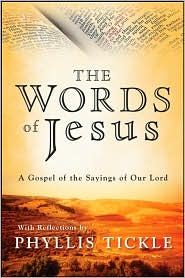
from Phyllis Tickle's The Words of Jesus: A Gospel of the Sayings of Our Lord:

"I just had never thought about Jesus being human at that level, of His being so subject to the same kind of innate human instincts and qualities that the rest of us are. Of course He presents and conducts Himself differently in different situations. Why ever wouldn't He? Once was the time I would have regarded such a discovery as close to irreverent and a threat to His godness. Now I embrace it with a kind of fond gratitude. It was, you must understand, the first place in the course of this work that He demanded I let Him out of my preconceptions."

I doubt that Ms. Tickle, a senior fellow of the Cathedral College of Washington National Cathedral, would consider herself a literal reader of the Bible. Yet she treats these 'Sayings' (yes, beginning with a captial 'S' as well as a capital 'H' whenever speaking of Jesus in the third person) as though they are historical fact. If Jesus is so human, aren't also those who supposedly wrote down what he said, incidentally, the first to do so approximately 40 years after he died? I don't really know if we can say beyond a shadow of a doubt that the historical person, Jesus of Nazareth, actually said any of these sayings. What we can say is that these sayings are attributed to him, which speaks to what his followers believed about him as much as who he really was.

What is important to me is that we have these sayings, these stories, public and private teachings, exhortations and laments, of a time and place and a person when it seemed that history and very human lives turned in another direction. For me, faith needs to include a healthy amount of skepticism, otherwise we might sound as adulatory as Anne Rice in Christ the Lord: Out of Egypt, an imaginative view of Jesus' unknown childhood.

I fell in love with Jesus myself when I was in high school. He was perfect in every way to me: a brother, a friend, a savior and healer of my deepest woes, the source of my joy. But in the best love affairs we mature and grow and so does our view of our beloved. It does not diminish the person but reveals the true self in all its beauty and imperfection.

It is not the sayings that are so important, or even who said them, but our response to them: how we integrate them in our lives and in our eternal beingness.

Monday, September 01, 2008

Always Go to the Funeral


Matthew 16: 21-28; Romans 12: 9-21
Congregational Church of ******

August 31, 2008

My youngest daughter Olivia, when she was about five years old, had already gained a piece of wisdom that we adults sometimes have difficulty with: do what you like least first and save the best for last. She came to this conclusion when having several things to eat on her plate. She chose to save the food she liked the most for last so she could end her meal with joy rather than with disgust at having to eat something she didn’t like. Now if we could just get her to apply this wisdom to cleaning her room…

It’s that age-old problem: if we did only what we felt like doing, not much would get done. Perhaps you’ve heard the one about the husband who came home from work to find the front door ajar, with dirty handprints all over it. As he entered the house the smells of burnt food and dog excrement assaulted his nose. Toys, games and puzzles were strewn about the living room. One child was making a finger painting on the refrigerator with baby food. Another child was covered in mud making mud pies on the kitchen floor, a bucket of wet dirt beside him. The contents of a box of cereal were scattered on and below the dining room table. The sink was full of dirty dishes and there was no dinner in sight.

The husband began to look for his wife with great anxiety, worried that something had happened to her. As he went upstairs the floor was carpeted with dirty laundry. In one of the bedrooms the third child was watching TV with her eyes glazed over. He opened the door to the master bedroom to find his wife on the bed, reading a magazine and eating chocolates, with the dog stretched lazily on the other side, his head on the husband’s pillow. By this point the husband had abandoned anxiety for anger. He sputtered at his wife, “What in the world happened here today?!” The wife replied, “You know when you ask me what did I do today? Well, today I didn’t do it.”

Do you ever wonder what would the church look like if we did not follow Jesus and his example, if we did only what we felt like doing and let the rest slide?

In a Newsweek/Beliefnet poll that asked the question “why do you practice religion”, 39% responded “to forge a personal relationship with God”. 30% replied “to help you be a better person and live a moral life”. Only 10% responded “to connect with something larger than yourself”. 8% said “to give your life structure and meaning”. And only 3% answered with “to be part of a community”.

It seems that in our country, or at least the people who answered the poll, folks are more concerned with having a personal experience of God rather than on how that experience could be gained by serving others, by putting aside one’s life for the sake of another so that someone else could also experience God in a way that would transform their life.

In 1983 the then Cardinal Joseph Ratzinger wrote that both “personal experience and the common faith of the church” are important, “[but] a dogmatic faith unsupported by personal experience remains empty; mere personal experience unrelated to the faith of the Church remains blind”. Seeking a personal experience of God as the main goal of faith, outside of community and the demands it places on us is a feel-good faith, one that when tested by trial and suffering will not sustain us.

In this morning’s gospel lesson we see the flipside of Peter’s confession of faith. In the verses before Jesus has just declared that he will build the church upon Peter’s humble conviction. Can you imagine Peter’s state of mind? Talk about a personal experience of God; you can’t get a more personal high than Jesus, God’s own son, slapping you on the back for the right answer which could only come from God, and guess what? You win the grand prize: head honcho of the fledgling, soon-to-be main God game in town!

Then right after this Jesus begins to tell the disciples that before it gets worse, it’s going to get worse. There will be no righteous Davidic king upon Jerusalem’s throne. There will be no just war against the Roman occupation. He tells them that he must suffer at the hands of the leaders of his own people, his brothers really, that he will be killed, and on the third day be raised. This was not exactly the kind of messiah the people of Israel were waiting for. Not only this, but Jesus was going to do this of his own volition. Peter thinks Jesus must be out of his mind to volunteer for such a suicide mission, to allow himself to be killed for no rational reason. Perhaps Peter is also thinking that Jesus’ death might lead to his own funeral. As one commentary put it, Peter and Jesus then get into a shouting match, out of which comes one of Jesus’ most difficult teachings.

“If any want to become my followers, let them deny themselves and take up their cross and follow me. For those who want to save their life will lose it, and those who lose their life for my sake will find it. For what will it profit them if they gain the whole world but forfeit their life? Or what will they give in return for their life?”

Who are we when push comes to shove? Jesus is asking his disciples and us, who are you in relation to the gospel? What exactly are you willing to give your life for, that life that has not been the same since Christ walked into it? Taking up our cross does not necessarily mean that we will be required to die for our faith but we will be asked to die to ourselves, to loosen our grip on the way we prefer things, what we desire, what we’re comfortable with, for the sake of the community of Christ. Henri Nouwen defined community as “that place where the person you least want to live with always lives.” Jesus is calling us out of ourselves that the common good would flourish, shaped by grace and the inspiration of Christ.

If it’s one thing we know about Jesus it’s that he’s always leading us to places we’d rather not go and teaching us about doing things we’d rather not do. Paul in his letter to the Romans exhorts his readers that because they are saved by grace their behavior should be changed in ways that are radically different from the ways of the world. “Outdo one another in showing honor.” “Bless those who persecute you.” “Do not repay anyone evil for evil.” “Live peaceably with all.” In other words, do not do what comes naturally; rather do the thing that comes the most difficult to you.

Deirdre Sullivan, a freelance attorney in Brooklyn, NY, in her essay for the NPR series “This I Believe”, put it this way:
“‘Always go to the funeral’ means that I have to do the right thing when I really, really don't feel like it. I have to remind myself of it when I could make some small gesture, but I don't really have to and I definitely don't want to. I'm talking about those things that represent only an inconvenience to me, but the world to the other guy. You know, the painfully under-attended birthday party. The hospital visit during happy hour. The Shiva call for one of my ex's uncles. In my humdrum life, the daily battle hasn't been good versus evil. It's hardly so epic. Most days, my real battle is doing good versus doing nothing. …In going to funerals, I've come to believe that while I wait to make a grand heroic gesture, I should just stick to the small inconveniences that let me share in life's inevitable, occasional calamity.”

As Christians who live in community with one another we find ourselves fighting the same battle: doing good versus doing nothing. The good that we do need not be some grand heroic gesture nor a small inconvenience but indeed an extravagant outpouring of ourselves. We do this not for ourselves but for the other, even the one that can appear to us to be an enemy, that they may come to know the saving love of Christ and know themselves as beloved sisters and brothers.

Paul then ends his exhortation with a quote from the book of Proverbs when he says “if your enemies are hungry, feed them; if they are thirsty, give them something to drink; for by doing this you will heap burning coals on their heads.” Burning coals is a metaphor for purification; when Isaiah answered God’s call to be a prophet, one of God’s servants touched Isaiah’s lips with a burning coal that he could then speak God’s truth with clean lips. When we offer the stranger, the outcast, the enemy the extravagant outpouring of ourselves, the burning coals we heap upon heads is the help of removing the barriers between them and God’s grace and by doing so, between us and God’s grace.

Dr. Martin Luther King, Jr. in his book Strength to Love called it a “double victory”. In his quest for equal rights for black Americans he was not satisfied with pressuring white Americans into giving in; he wanted more than mere retribution. He wrote,


“We shall match your capacity to inflict suffering by our capacity to endure suffering. We shall meet your physical force with soul force. Do to us what you will, and we shall continue to love you. Throw us in jail, and we shall still love you. Bomb our homes and threaten our children, and we shall still love you. Send your hooded perpetrators of violence into our community at the midnight hour and beat us and leave half dead, and we will still love you. But be assured that we will wear you down by our capacity to suffer. One day we shall win freedom, but not only for ourselves. We shall so appeal to your heart and conscience that we shall win you in the process and our victory will be a double victory.”


Who are you, Congregational Church of ******, in relation to the gospel of Jesus Christ? When push comes to shove, as it inevitably does in the Church, what are you willing to risk your life together for? For what or for whom are you willing to suffer? In what ways is God calling you to give an extravagant outpouring of yourselves? Who would be the person or people that would be difficult for you to see as beloved sisters and brothers in Christ? What moments come to your mind when you think of members of your church loving from the center of who they are, and discovering beauty in everyone?


We exist, we live not only that we may experience the living God but so that others may also be drawn to know God by the way we live our lives, by the truth that we proclaim: that in order to find our lives we must first lose them, that evil is not overcome by evil but overcome with good. Our ability to love in this radical way is not born out of our solitary life but in community; community that treats an enemy like a friend, that seeks to live not in agreement but peaceably, in harmony with all, community that is shaped by Christ and our participation in the cross and the resurrection. Amen.

Monday, August 25, 2008

Bound and Loosed


Matthew 16: 13-20; Romans 12: 1-8
****** Congregational Church, Bridgeport, CT
August 24, 2008


I have always been fascinated by the life of nuns and monks. I have watched movies such as The Song of Bernadette and Agnes of God and many others. I have read books and stories about their aesthetic life. I am intrigued by the human desire to unite with God so fully that one renounces worldly living for life in community, bound by sacred vows of poverty, obedience and chastity. These vows are presented as an offering to God, a sacrifice, not as a refusal of God’s gifts of fullness, free will and sexuality but as a surrender of these, as a gift to God, that the living of their lives may be transformed into something sacred.

One of my aunts on my mother’s side was not a nun per se but she did give her life in a similar manner to be a missionary in India for the Methodist church—for 37 years. Now in her eighties she believes God is calling her back to India.

Where does this single-mindedness, this single-heartedness, come from? Most of us struggle with the numerous demands placed on our love, our strength and patience, our money and resources, and our time. How does one focus so clearly on Christ that one is able to relinquish the struggle and give everything over to God?

Mother Theresa said that these vows of chastity, obedience, and poverty are given that one may serve and love Christ with an undivided love. Our love is often divided by loving others, loving self, loving money and possessions and many other concerns. There are times it is difficult to see that we can serve and love Christ through these other loves, that Christ is present in these other loves and works through them. Serving God as a nun or a monk or priest or, in our tradition, a missionary or a minister, is not a path for everyone. Yet God still calls us to love with an undivided love, to unite ourselves with God, to be bound to God and each other in such a way that we will not be conformed to this world but transformed by the living of our faith and by the renewal of our minds. As Paul says in his letter to the Romans we are called to present our whole lives, all of it, as a living sacrifice to God, that the living of our lives may be transformed into something sacred.

But how are we, whose tradition does not include sacred vows to serve God with our whole lives, to unite with God and with each other that we might begin to live our lives as a living sacrifice? Those who take sacred vows are bound by them. Two of the ways we know this is through the promises of marriage and church covenant. Some might argue that we don’t really think of ourselves as being bound by those promises, that they can be broken quite painfully and with great struggle and difficulty but they can be broken. We break the bonds of community, of covenant with one another and with God and other churches. We break the bonds of humanity with any who might be different than we are, who think differently, look different, behave, live, believe, vote, speak differently than we do. We are a covenant people and we are a covenant-breaking people.

Our nation began with a covenant: “We the people…”. Our faith began with a covenant between God and Abraham and Sarah, a covenant that has been renewed again and again. God gave us a new covenant in Jesus, that salvation, grace and forgiveness, the unconditional love of God would be given to all nations, all people.

When Jesus said to Peter, “Whatever you bind on earth will be bound in heaven”, the binding that he spoke of was to be something life-giving. It was not to be a bond like that of chains or handcuffs but to be in bonds as in knit together, tied together like a web, like a garment, like sinew to bone, like hand in hand, heartstring to heartstring.

In being bound to each other and to God we are not completely free. This has been a problem for humankind since time immemorial. Cain and Abel were bound by blood yet Cain killed his brother. The Israelites, who were once slaves in chains and set free by God, broke their covenant with God and worshipped a golden calf. Our nation, free from the tyranny of the British Empire, wrote the Bill of Rights to establish freedoms of speech and privacy and many others, yet these freedoms are often abused in the name of freedom and at the expense of the bonds we share with one another as citizens, friends, and neighbors of the same country. We think we can say anything because we have the right to the freedom of speech. But when that speech is hurtful, abusive, and violent we tear at and loose the bonds of community and covenant that hold us together.

These bonds of covenant to God and each other are to set us free to love one another, not to destroy one another. To loose is to destroy, to dissolve bonds. What we destroy, what we dissolve, what we loose on earth will be loosed in heaven, Jesus also warned us. We have been given freedom but it is to be a responsible freedom, a sacrificial freedom. It is a sacrificial freedom in that we sacrifice neither the individual nor the community at the cost of the other but both are a living sacrifice for each other, that is, they make each other sacred. We have been given the keys to the kingdom; we are co-creators of this kingdom with God; we are responsible for binding what needs to be bound and dissolving what needs to be dissolved. We need to dissolve our unwillingness to listen to those who disagree with us, even violently disagree.

“A man said to the universe: ‘Sir I exist!’ ‘However,’ replied the universe, ‘The fact has not created in me a sense of obligation.’” These lines written in 1899 by Stephen Crane, who wrote The Red Badge of Courage, suggest that the universe is indifferent toward us, that it does not owe us anything, nor are we bound to it, thus we are set free to create the destiny of our own choosing.

Perhaps if we believe the universe doesn’t owe us anything, then the universe can’t disappoint us. But imagine going to the government, to your senator or representative, to the president, or to your employer and receiving this response of indifference. Imagine going to a parent, declaring one’s existence and being given the answer, “That doesn’t mean I’m obligated to you or to your happiness.” The irony of this poem is that God is obligated to us and we ought to be obligated to one another—in our common bond of being a creature of this earth. The universe is really the community, the vast cosmic neighborhood we live in. To live in community is to be bound to one another, to be obligated to one another. In my view this poem is a response to individualism gone rampant, where the bonds between us and the universe have been loosed.

Our nation was built on the foundation of individualism but not at the expense of the community. Here is a definition of individualism from an online encyclopedia: “The individualist sees society as a large number of individuals working together to improve their welfare. The single person is not just a member of a greater unity. In fact, the individual is seen as the ultimate unity, and society is nothing more than a composition. The state is an organised form of society which ensures the individual's freedom by law. Thus, individualist policy tends to approve laws that protect or enhance the liberties of the citizen, but rejects laws that subordinate the individual to the collective.”


However, in the Church the individual and the collective or body are called to live in harmony. The members of the body are not subordinate to the body or to each other but to Christ the head of the Church and to the commandment to love God and to love one another as Christ has loved us. We are free as individuals but we are individuals bound to one another, whether we like it or not, which imposes a responsibility on this freedom we hold so dear.


The values of freedom and life, which our country prizes greatly, are worthy to be sure. But even if these are destroyed there is one thing left that still binds us together and that is love: love that seeks the good for all people on this earth and not just some. If we are not free in any other way we are still free to love and that is what it means to be set free from sin. We are free to love God with our lives, with our minds, with our hearts, with our breath. Even in death, as Jesus showed us, we can still love, even those who hurt us. The bonds of love can never be destroyed and that is why it is worthy of our devotion, our worship and our living sacrifice.


What is it that binds you to the Church? Is it the communion we celebrate? Is it your love for God lived out in the life of Jesus Christ? Is it the community of fellow disciples finding their own way of making Peter’s humble confession that Jesus is the son of the living God? We are not a credal church; our faith is not bound by a creed upon which all must believe. We believe that creeds and statements of faith are a place to begin. So what does it mean when we say that Jesus is the center of our lives and of our life together, when we say Christ is the head of the Church? What do we say of Jesus in the living of our lives? What does this faith community say about Jesus, especially to people who are new and those who are strangers and outcasts? What is the tie that binds you together? What is that bond that is able to transform you from a group of individuals into a body that presents itself as a living sacrifice to God?


The bonds we make, we make not hard and fast but in faith: faith in God, faith in Christ, faith in the Spirit, faith in one another and with humility. Peter confessed his faith in Jesus but it was a confession made by a very human being. Our statements of faith and our efforts to bind ourselves to God and to each other are tenuous, an attempt to name what cannot be named, to see what cannot be seen. It is God who binds us together, who reveals to us in everyday life who we are, to whom we belong, to whom we are obligated, who shows us the difficult, joyful, undivided way of love for all persons and creatures of this earth that all life might be transformed. Amen.

Tuesday, August 19, 2008

How religious fascism can begin

from Slate webzine

The Chick-fil-A Church

Megachurches that want to spread their 'brand' beyond their maximum zoning codes, with enough cash, uh, resources, can now have 'video venues': a meeting place with a screen, say an empty cineplex on a Sunday morning, where all the live worship stuff is done with a young pastor but the sermon is preached by a 'megastar pastor', projected on the screen. Or in some high-tech cases, a 3-D projection--a hologram.

"An estimated 2,000 to 2,500 U.S. congregations now operate multiple campuses, and many of them ... are so-called video venues. The Leadership Network, a Christian nonprofit that follows these multisite churches, says there will be 30,000 of them within a few years. Already, the most ambitious pastors are predicting that, thanks to video, they'll have branded outlets nationwide and more than 100,000 followers—twice as large as the country's biggest megachurch today. Gigachurches are the way that next-generation celebrity evangelists are building their empires."

These are churches that focus their loyalty, devotion, commitment to a charismatic leader. Which is why we hear about abuse, scandal, and corruption concerning some of these leaders--they're standing where Jesus should be. But even Jesus wouldn't be standing there. He told his disciples (and others) not to tell anyone that he was the Messiah: in fact, according to Jewish tradition and expectations as recorded by the prophets, he wasn't. He was a reformer of the Jewish tradition, a messenger who got confused with the message.

And when this happens, the message can get confused as well. In fact, it can become anything the messenger wants it to be. Coupled with the one-way communication of television, which is basically what this is, we have the recipe for propaganda, the primary tool in a fascist's bag of tricks.

I wonder if the IRS has gotten wind of these video venues. Do they count as a church? Are they incorporated? When they take a collection, excuse me, offering, where does it go? One can see how this could be abused for political ends, to give hundreds of thousands of people marching orders for whatever agenda some 'megastar pastor' deems important.

Do I sound a little paranoid? I got concerned when even my beloved UCC began an advertising campaign that 'sells' our 'brand'. (Another commercial is coming out this fall.) Our 'brand'? I thought following Jesus was less about declaring ourselves Christians and more about relationships, right ones (meaning righteous), covenant community, compassion, justice, peace--all that stuff the human species is supposed to evolve into. I thought that's how the message spreads, not through a TV commercial, like some 30-sec. politician.

What say you, blogfriends? Am I jumping off the deep end here?

Tuesday, August 12, 2008

from the Sunday bulletin

Yesterday I sang at a memorial service for a man who, for 30 years, was responsible for the wonderful parks in our town and the recreation activities for all ages. He was 56.

If Woody wrote a tune for this song, he never wrote it down. Musical artist Ellis Paul wrote one for it and recorded on his album The Speed of Trees. My pastor and friend Pete Allen sang it during the service.


God's Promise
by Woody Guthrie

I didn't promise you skies painted blue
Not all colored flowers all your days through
I didn't promise you sun with no rain
Joys without sorrows, peace without pain.

All that I promise is strength for this day,
Rest for my worker, and light on your way.
I give you truth when you need it, my help from above,
Undying friendship, my unfailing love.

I never did promise you crowns without trials,
Food with no hard sweat, your tears without smiles,
Hot sunny days without cold wintry snows,
No vict'ry without fightin', no laughs without woes.

All that I promise is strength for this day,
Rest for my, worker, my light on your way,
I give you truth when you need it, my help from above,
Undying friendship, my unfailing love.

I sure didn't say I'd give you heaven on earth,
A life with no labor no struggles no deaths,
No earthquakes, no dryspells, no fire flames, no droughts,
No slaving, no hungers, no blizzards, no blights.

All that I promise is strength for this day,
Rest for my worker, my light on your way,
I give you truth when you need it, my help from above,
Undying friendship, my unfailing love.

I promise you power, this minute this hour,
The power you need when you fall down to bleed,
I give you my peace, and my strength to pull home
My love for all races all creeds and all kinds.

My flavors my saviors my creeds of all kinds,
My love for my saviors, all colors all kinds,
My love for my races all creeders all kinds,
My saviors my flavors my dancers all kinds,
My dancers my prancers my singers all kinds,
My flavors my saviors my dancers all kinds.

Monday, August 11, 2008

Just popping in to let you know I'm a...

Your result for The Brutally Honest Personality Test...

Scumbag- ENFP

60% Extraversion, 60% Intuition, 20% Thinking, 40% Judging

I have a feeling you're not going to like this much. Do I care? No.
How do I know? It's because you hate criticism. You love to be loved and you'll do anything to be accepted.


Unfortunately for you, I can see right through your insincere compliments and over-the-top greetings. No matter what you do, I'll always hate you for what you are. An arrogant, unstable, overly enthusiastic scumbag.


I bet you're pretty proud of your accomplishments, huh? You seem to achieve at whatever you put your little mind too. Trust me. Nobody likes the person who is good at everything. NOBODY LIKES YOU.


This might also have something to do with the fact that you're a cheating machine. You're just not the type of person to make long-term commitments. You enjoy seeing "what could be", rather than being satisfied with "what is." This, of course, means you often leave others in the dust while you seek out another lover.


Well, at least you're not the one left in the dust.


Unfortunately, when you're the one lying in the gutter with a bloody knife in your back, you might think differently.


If you want to learn more about your personality type in a slightly less negative way, check out this.

The other personality types are as follows...


Loner - Introverted Sensing Feeling Perceiving

Pushover - Introverted Sensing Feeling Judging

Criminal - Introverted Sensing Thinking Perceiving

Borefest - Introverted Sensing Thinking Judging

Almost Perfect - Introverted iNtuitive Feeling Perceiving

Freak - Introverted iNtuitive Feeling Judging

Loser - Introverted iNtuitive Thinking Perceiving

Crackpot - Introverted iNtuitive Thinking Judging


Clown - Extraverted Sensing Feeling Perceiving

Sap - Extraverted Sensing Feeling Judging

Commander - Extraverted Sensing Thinking Perceiving

Do Gooder - Extraverted Sensing Thinking Judging


Busybody - Extraverted iNtuitive Feeling Judging

Prick - Extraverted iNtuitive Thinking Perceiving

Dictator - Extraverted iNtuitive Thinking Judging


Take The Brutally Honest Personality Test at HelloQuizzy

Thanks to MoCat for this one.

Wednesday, July 23, 2008

One cloudy day

In honor of the clouds and rain we're experiencing in southwestern CT (finally!) here's some wonderfully dark humor:

A truly desperate preacher

from the Indy Star:

Kokomo pastor crashes motorcycle in church

I heard this one on NPR during the half hour 'return' that they do, usually pointing out some short story about the crazy things people do. A pastor wanted to illustrate unity by showing his oneness with his dirt bike. And the thing got away from him during the third worship service in which he had used this unique illustration. Turned out no one was injured because, as in most congregations, attendees were seated a few rows back from the front. The pastor injured his wrist, some front pews, and probably his pride but not the opinion of his congregation. Read some of the comments below the article.

I guess it was a good thing he wasn't a wood-chopping enthusiast or a race car driver.

Monday, July 21, 2008

God loves us like crazy cakes

Genesis 28: 10-19a; Romans 8: 12-25
****** Congregational Church, Bridgeport, CT
July 20, 2008

It’s a story that’s so not so unusual anymore. A baby girl is born in China. An American woman travels to China so she can meet this baby girl and become her mother. Other families travel to China as well to meet their new daughter, in some cases, their new son. The baby girl and the American woman look at each other, one with big, dark brown eyes, and the other with blue eyes. The American woman whispers to her new daughter, “I love you like crazy cakes”. She wonders how such a perfect match could be made from so far away.

When they come home on the plane, there were aunts and uncles and grandparents and cousins and friends waiting to meet the newest addition to the family. The baby girl cried when others would hold her but would stop when they brought her back to her new mother. There was a room full of toys and stuffed animals and a new crib to welcome the baby girl to her new home. More friends came to visit. More flowers and cards and gifts came to welcome the baby girl. But the mother and the baby both looked forward to bedtime, when it was just the two of them, and the new mother would rock her new baby girl to sleep.

She holds her baby tightly, kisses her and cries; cries for her Chinese mother who could not hold her, who could not keep her. The new mother prays that she and her daughter will always remember this special woman and hope that she would know that her little one was happy and safe and loved.

The story is from a children’s book entitled “I Love You Like Crazy Cakes” by Rose Lewis. The author tells her own story of how her baby girl came to live with her from China. It is almost like a fairy tale, where the one sought and the one seeking find each other in an almost miraculous way, where it becomes difficult to distinguish between the one sought and the one seeking because both have been seeking, both have been found.

But not all adoption stories are so blissful. In some cases children do not attach or bond themselves readily to their new parents, no matter how much they are wanted, no matter how much they are sought after. They are afraid that they will be abandoned again. They have difficulty trusting anyone. They believe that they don’t really belong, that they aren’t anyone’s son or daughter. They act out their anger with their parents, their siblings, their teachers, with anyone they might feel tempted to be close to. It can leave parents at their wits end, knowing they have done everything to tell their child that they love them and that they are wanted.

But we can’t give back our children, nor do we really want to. All any parent can do, when their child is in pain, whether adopted or not, is to love that child even when they don’t deserve it; especially when they don’t deserve it.

It is this grace that God offers us, each one of us adopted as God’s child, as the apostle Paul puts it. Now, you may think it strange that God would adopt us when God, in a mystery yet to be made known to us, created us in the first place.

It is we who have not always behaved as though we were God’s children. It is as though we did not bond or attach to God in any way that was meaningful. Even though we may be baptized and in this way, attached and bonded to God, it is we who try to find meaning of some kind in that baptism. When we sin, when we believe ourselves to be different from God, that we are somehow separate from God and God’s love and power to heal, when we behave in such a way as to think we don’t deserve love, it is especially then that God does love us and adopts us, chooses us once more to be children of love and grace.

Adoption is more prevalent in our country today than ever before. According to the Evan B. Donaldson Adoption Institute there are over 1.5 million adopted children in the U.S.: over 2% of all children.

58% of Americans know someone who has been adopted, has adopted a child, or has relinquished a child for adoption. How many of us here are acquainted with adoption in some manner?

In 1992, the last year for which reliable data was available, there were 127,441 adoptions in the U.S. Some of these adoptions come about through foster care by foster parents, relatives, or adults to whom children have no prior relationship. Stepparents can adopt their stepchildren. A private adoption can be handled through an agency or independently, usually with a lawyer’s assistance. After World War II international and transcultural adoptions increased. Many were European and Japanese war orphans. Additional adoptions followed after the civil war in Greece, the Korean War, and the Vietnam War. Desperate poverty and social upheaval have also been factors in countries allowing their children to be adopted abroad, such as Africa, Latin America, the former Soviet Union, and Eastern Europe. In China, the abandonment of infant girls and overcrowded orphanages has encouraged many eager parents to adopt there. Between 1971 and 2001 U.S. citizens adopted 265,677 children from other countries, mostly from Asia.

Adoption is truly an act of grace. For whatever reason a mother or both parents are unable to care for a child, another mother, sometimes a lesbian couple, another father, sometimes a gay couple, or a heterosexual couple choose that child and say, “We will care for you. We will accept you as our child. We will love you your whole life long.” Imagine being abandoned by the world, orphaned from the family and perhaps country of your birth; then redemption comes in the form of an open heart of one who also felt lost until they found you.

It is like one of the slogans of the Still Speaking campaign that makes a wonderful welcome on the front of a church’s bulletin: No matter who you are or where you are on life’s journey, you are welcome here. We adopt each other and anyone who would come here seeking Christ and a deeper relationship with him. There are some who have suffered abandonment from the world, who have been orphaned from their family of faith, yet they desperately want to belong to a community that accepts them as they are, who would adopt them as they are, just as we have been adopted into this family of faith.

When we adopt others into our family, we too experience redemption and grace. When we extend the circle to include those who are excluded, our hearts are opened that much more to God’s grace. One of the most powerful adoption stories of grace and redemption that I’ve ever heard was in the movie “Gandhi”. During the terrible Hindu/Muslim riots that occurred after India’s independence, Mahatma Gandhi went on a hunger strike to end the violence. As he lay dying, a Hindu man stormed into his presence, crazed with anger and grief. He told Gandhi that a Muslim man had killed his son; he was about so high. The Hindu man, the boy’s father, in his anger and grief, killed a Muslim boy in retaliation. He shouted at Gandhi that he was going to hell. How could he find a way out of hell? Gandhi said he knew a way. He told the Hindu man to find a boy, about so high, the same age as his dead son, but he must be a Muslim boy and he must raise him as a Muslim. This was how he could find a way out of hell.

When we adopt those who are different from us and celebrate their differences and ours, we become something altogether loving and healing and wonderful. This is our hope in Christ; this is what we await for with eager longing, like an orphan child who awaits new parents. We, who do not always behave like children of God with one another and with this earth, await the day when all humankind, when all the earth will realize kinship with itself, when we will know ourselves to be sons and daughters of the One who made us in the divine image and claims us, chooses us even though we don’t deserve it and especially because we don’t deserve it.

Look at Jacob, one of our fathers in the faith. He certainly didn’t deserve the responsibility that God was giving him. He cheated his brother Esau out of his birthright and then lied to his father to gain Esau’s blessing. Later in the story he schemes against his father-in-law Laban, running away before he can be discovered. When we read about him in today’s scripture lesson he is on the run from Esau, fearful because Esau has vowed to kill him. Jacob himself has abandoned any sense of loyalty to his family, he has orphaned himself by his behavior, and he is not yet decided that he will adopt the God of his father and his grandfather.

Yet God sends him a vision of a ladder, a stairway to heaven, with angels going up and coming down from heaven. God tells Jacob that the promise made to Abraham and Sarah, Isaac and Rebekah will also be extended to him and through him he will bless all the families of the earth. God adopts him as a firstborn son, even though he was a cheat and a liar. God promises to protect him and to be with him always.

When Jacobs wakes from this vision, he realizes that he is never out of God’s presence, that even his sins are done in God’s sight. He knows he is in a holy place. His grandfather, when he was called Abram, traveled there, built an altar as Jacob did and worshipped there, already known as Bethel or Beth-El. You may already know that Bethel means ‘house of God’. But what you may not know is that the God of Abraham, Isaac and now Jacob is the adopted God of Beth-El, El being a Canaanite word for the generic name of God. God adopts the identity of El, adopts Abraham, Isaac, and Jacob as heirs of God’s promise and they, in turn, adopt God or El as their God, their only God. Here we have strangers in a strange land being led by God who is a stranger to them, all becoming family, the family through whom all families will be blessed.

How have you, ****** Congregational Church, this ‘house of God’, been blessed by all the families that have been and continue to be a part of this church? How are you a blessing to the families of this community? How can you extend the circle of grace and redemption to others? Who might have difficulty feeling like they would belong here? Whom can you think of in this neighborhood and the surrounding area who might be seeking a family to belong to? For what are you longing in your church, in your city, and in the world?

When we adopt God’s Spirit, God’s love and grace to live in us, we become “Beth-El”, the house of God. We become an extension of God’s love for us, of God’s love for the whole world, the whole earth. God loves us like crazy cakes; we are God’s children, born in blessing, adopted in grace. Adoption has the power to transform lives. As heirs of this life-changing transformation, let us also open our hearts to embrace new sisters and brothers with the love and grace of God. Amen.


Jacob's Ladder

Friday, July 11, 2008

I Want to Believe


If you're going to do a movie about the hidden history of aliens, the conspiracy to cover them up, and the team to uncover it all (take note, Spielberg), this is the paradigm in which to do it. Plus, the best sci-fi score since "Star Trek". I am geeking out all over! Saved from the usual summer blusterbocks at last!


Mulder and Scully together again.

Wednesday, July 09, 2008

From the Sunday bulletin

Most of our group in front of house #16; yours truly, in front on right.


It was a great trip. It being my third time down there I really don't have any more insights than the ones I have shared here in past years. Only that I really do need to live with less and focus more on the needs of others. And learn Spanish.

During our flight back from Mexico we put together our worship service. Parts had been assigned, i.e., reflections, prayers, Scripture readings, and we put our trust in the Holy Spirit. Jenn, our associate pastor, had already emailed certain worship details to the church secretary for the bulletin.

These are the lyrics from our communion hymn. The last line of the last stanza just about brought tears to my eyes, but getting to bed around 2:30 a.m. may have had something to do with that.


Children of God - words by John Greenleaf Whittier, alt.


Children of God, lift hearts to one another,
where pity dwells, the peace of God is there;
To worship rightly is to love each other,
each smile a hymn, each kindly deed a prayer.

For God whom Jesus loved has truly spoken:
the holier worship which Christ deigns to bless
Restores the lost, and binds the spirit broken,
and feeds the widow and the parentless.

Follow with reverent steps the great example
of Christ whose holy work was doing good;
So shall the wide earth seem a holy temple,
each loving life a psalm of gratitude.

Then shall all shackles fall; the stormy clangor
of wild war music o'er the earth shall cease;
Love shall tread out the baleful fire of anger,
and in its ashes plant the tree of peace.


That's me adding some embellisment to one of the houses at the dump.