Sunday, June 23, 2013

Kingdom, not fandom

1 Kings 19: 1-15a; Galatians 3: 23-29
Newtown Congregational Church, Newtown, CT
June 23, 2013
 
(My colleague and friend, Matt Crebbin, has been going full tilt and then some since Dec. 14, 2012.  Not only has he been caring for the members of his congregation, and with his wife, parenting their four active children, he's also been a strong, steady presence in the gun control movement, both here in CT and in Washington.  I'll be preaching at his church through July 14 to help give him some much needed rest.)
 
Lately, it seems, whenever a television show has an unhappy ending to its season finale, it’s a newsworthy occasion.  Earlier this year when Matthew died in a car crash on Downton Abbey, one could hear the collective “NO!” accompanied by tears, echoed on Facebook and other social media websites.  And just two weeks ago, HBO’s Game of Thrones shocked and disappointed most, if not all, of their fandom with more than its share of violent and unexpected deaths.

 
 
Downton Abbey
 
Do you know the word ‘fandom’?  If you live with teenage or any age fans of The Doctor or Avatar the Last Airbender or Star Wars, you know what I’m talking about.  Fandom is a combination of the word “fanatic” and “kingdom”.  Those who inhabit a fandom are passionate, from the smallest details to the overarching narrative and themes of the object of their focus.  They engage in ‘cosplay’, dressing up as favorite characters, paying attention, again, to every detail so as to look as authentic as possible.  They attend huge fandom gatherings, such as Comic Con or a Star Trek convention, form discussion groups on social media, throw thematic parties, and collect all the toys.  They are invested.
 
 
Where Great Stories are Massacred
Where great stories are massacred
 
They are especially invested in the story arc and the characters.  Whenever any of us reads a novel or watches a movie or TV show, we are invested in the outcome.    How many of you have ever felt betrayed by an author or screenwriter?  What was your expectation that was dashed? 
 
It seems we are geared for the happy ending, or if circumstances are bad, to expect the worst.  But life is lived in shades of charcoal, slate, and battleship.  In books, TV and movies we often seek to escape the way life is for a more hopeful or sometimes an even darker fiction.  We can put up with villains for a while, even suffer through a few heroes’ deaths, but only because we expect the villains to get their due and the heroes their redemptive victory in the end.  We expect a certain amount of justice and redemption, of fair play.  But a great many events in the past decade up to the past six months have given us cause to question that narrative.
 
Though it has been with us since the beginning, but especially since September 11, we know that evil, pain, and suffering can come down on anyone, anytime, anywhere.  Some of it is within our control but a lot of it isn’t.  Sometimes the hero wins, sometimes not.  Justice is our aim but oftentimes we miss the mark.  We’ve known for quite a while that fairytales are just that.  But now as a human race it seems we have begun to collectively wonder about the hero’s tale and does it still ring true for us?  There are times we are tempted, like one fan of Game of Thrones who tweeted, “I don't know if I'll ever recover from this.  No, I'm out. I quit. I'm done.”
 
Our hero, the prophet Elijah, has reached this point in his relationship with the God fandom.  He’s followed God’s storyline faithfully, he’s preached against the foreign god Baal, even ordered the death of the priests of Baal, and it’s got him in deep trouble with Queen Jezebel.  Prophets walk a fine line between hero and scapegoat, good-guy and outlaw.  In order to establish her cult to the god Baal, Jezebel had given orders that all the prophets of Israel be killed; Elijah thinks he is the sole survivor of that holocaust.  Now Jezebel wants Elijah dead.
 
So Elijah assumes that he’ll never recover from this, that he’s out, he’s quitting, he’s done.  He goes out into the desert, lies down under a tree, and asks God to take his life.  And like a good Jewish mother, perhaps God is thinking “When was the last time he ate?  Maybe he’s just hungry”, and sends an angel with some fresh bread, baked on hot desert rocks and a jar of water to nourish Elijah not just once but twice.  The journey will be long and God wants Elijah to live.
Ferdinand Bol, Elijah Fed by an Angel, (c. 1660-1663)
 
When Elijah reaches Mt. Horeb, he’s still sticking to the hero’s script:  “God, I’ve been passionate about you and your word.  Everyone else has either abandoned you or has been killed.  I’m the only one who’s left, and now I’m about to be killed off as well.”  God then tells Elijah that he is about to pass by.  Suddenly there is a violent wind, then an earthquake, and last a fire.  Yes, earth, wind and fire.  Knowing the Jewish narrative well, Elijah expects God to show up in one of these.  But no; rather, God arrives in a mighty silence.
 
We in the United Church of Christ proclaim that God is still speaking but there are times when it seems that God is strangely quiet.  Many a faith community has been closely following the script, passionate about the details, and yet even so, our numbers have been steadily declining for a decade, if not two or more.  The tale of our hero, Jesus, has not rung true for some folks.  Resurrection is not easy to come by.  Good people have stood faithful during the hard times and good, and have left church for various reasons, many of them hurtful.  “I don't know if I'll ever recover from this.  No, I'm out. I quit. I'm done.”
 
But none of this is really new.  Dietrich Bonhoeffer, a young German pastor arrested for conspiring to assassinate Hitler, wrote these words from prison in 1944:  “God as a working hypothesis in morals, politics, or science, has been surmounted and abolished; the same thing has happened in philosophy and religion.  …Anxious souls will ask what room there is left for God now.”
 
He continues, “So our coming of age leads us to a true recognition of our situation before God.  God would have us know that we must live as [those] who manage our lives without him.  The God who is with us is the God who forsakes us.  The God who lets us live in the world without the working hypothesis of God is the God before whom we stand continually.  Before God and with God we live without God.  God lets himself be pushed out of the world onto the cross.  He is weak and powerless in the world, and that is precisely the way, the only way, in which [God] is with us and helps us.” [i]
 
God doesn’t take control of the story, despite all that we have done to mess with God’s narrative of mercy and justice.  Rather, God works within the thwarted plot lines.  God uses us to accomplish a sacred purpose, even though our character is riddled with flaws.  When the inexplicable, the unthinkable happens, God comforts us in the faces of unexpected helpers.  And, with the patience of Job, God guides us through what we often cannot understand, even violence and meaningless death.  And time and again, it’s not our death or another’s that we’re afraid will be meaningless but our lives or the life of one cut short. 
 
We live in an unpredictable world, sometimes random and cruel, yet also fiercely beautiful and fragile.  We’re beginning to realize that maybe there isn’t a script to follow so much as we’re co-authoring a story, our story, each day.  And it’s full of contradictions, not just Jew or Greek, male or female, slave or free, but gay and straight and bisexual, transgendered and queer.  It’s extreme wealth, different kinds of middle class, working poor, and abject poverty; it’s seeker, believer, agnostic and atheist; not just Republican or Democrat but Independent, Libertarian, Tea Party, Green Party, and many others.  We are many colors, many voices, all inhabiting this one earth.
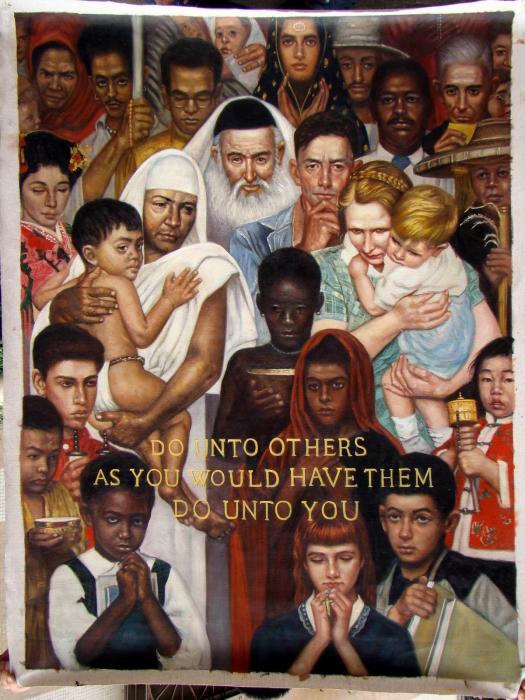
 
Norman Rockwell, The Golden Rule, 1961
 
God IS still speaking but through us and within our stories.  How invested are we in the outcome, not just of our own stories but of the story of our neighbor and the stranger and the enemy?  The ending will take care of itself if we are mindful of our character, our actions, decisions, and attitudes.  But it is up to us to choose each day whether we are going to hang in there, not with the fandom but the kingdom—God’s story of righteousness, mercy and justice.
 
There are times, I am sure, when we all have been in doubt that we would recover from a blow to our faith, when we thought we were through with church and were ready to quit.  What brought us back from that cliffhanger?  What is the story of this church and how has it changed your life?  What choices do you need to make in order that the outcome is one of mercy and justice?  Just how invested are you as one Body?
 
 
The story is ongoing, and we have come this far by faith.  May God grant us the courage to live out what we pray and profess, that in the end, love will win.
 
 Amen.


[i] Dietrich Bonhoeffer, Letters and Papers from Prison. (New York:  Collier Books, 1972) 360.

Saturday, June 01, 2013

Positively obsessed

(Almost six months ago I wrote a letter to the author Richard Russo in response to his memoir Elsewhere.  As yet, I have not received a response.  So consider this letter to be a book review of sorts.  And if you cannot tell from the letter, yes, I recommend this book wholeheartedly.)


December 12, 2012

Richard Russo
c/o Alfred A. Knopf Publishers
1745 Broadway
New York, NY 10019

Dear Mr. Russo:

Thank you for your courage and willingness to be vulnerable in the writing of your recent memoir Elsewhere. Though a book does not seem to be part of what is known as ‘call and response’, still I feel compelled to respond to what seemed to me, a prayer.

In the last paragraph of the chapter entitled “Unsettled” you come to understand that you possess some of the same tenacious qualities that plagued your mother. You describe novel writing as triage and obstinacy, then go on to use several metaphors to illuminate a rather dark process. Though you did not intend to, in those metaphors you also portrayed a life of faith and how I have come to experience what it means to serve the Church as ordained clergy. The Church is nothing if not obsessive, at least with its own survival if nothing else. If the Church is to survive, it must live with and welcome uncertainty, experiment again and again, welcome clutter, surrender a good idea for a better one, put one foot in front of the other, and so on. And one more thing: forgive.

I’m not sure that obsession is something to be cured so much as one needs to find meaning, a purpose in which obsession can thrive and accomplish something, a magnum opus. I have always felt the need, heard the call to participate in something larger than myself. Though many of us lead small lives in small towns or big cities, our dreams long to be made visible on a wider stage. My own mother struggles with OCD but as a hoarder; she has often felt the need to find a larger purpose other than wife, mother, sister, grandmother—which I know has not been enough for her, nor for many women or myself. I too recognize some of the same traits in myself, yet I do not believe it was only dumb luck or grace that expanded our worlds as you suggested.

You and I and countless others made a conscious choice to have a different life. We put our obsessive energies into something positive— resolutely we put one foot in front of the other. Some might call it evolution. We adapted. Author Octavia Butler wrote in her book Parable of the Sower, “Prodigy is, at its essence, adaptability and persistent, positive obsession. Without persistence, what remains is an enthusiasm of the moment. Without adaptability, what remains may be channeled into destructive fanaticism. Without positive obsession, there is nothing at all.” In the non-canonical Gospel of Thomas, Jesus is quoted as saying, “If you bring forth what is within you, what you bring forth will save you. If you do not bring forth what is within you, what is within you will destroy you.”

The journey for all of us is the congruency, the integrity of our inner life and our outward being, something I learned from Jenny Boylan. We were all given the ability to create, to make manifest, to bring into Being, but life has a way of thwarting us as much as it is the source of inspiration. You found the means by which your imagination, your persistence, your obsession could find a positive expression but with a good measure of humility, grace, and dumb luck, as well the choice you were compelled, perhaps called, to make: to be a writer.

Like many sinful saints before, that mystery that we name as God calls the obsessively compelled. I mean, who else is going to get the job done? Who else makes a story so engaging? We hope the pendulum is going to swing one way rather than the other but we know better and on the story will go. And on we go as well. Because we must. We can’t help it. The Bible calls it ‘steadfastness’. To me, that’s what faith is all about.

Peace be with you,

Rev. Cynthia E. Robinson

Wednesday, May 22, 2013

Nothing wasted (video)

This is a video of my sermon from April 21, 2013, the text of which can be found here.


Sunday, April 28, 2013

What dreams may come (expanded version)

Acts 11:1-18; Revelation 21: 1-6
Unity Hill United Church of Christ, Trumbull, CT
April 28, 2013


(This is an expanded version of a sermon I preached in 2010.  I first asked the congregation to draw a five-pointed star on a piece of paper, big enough to write a few words inside the pentagonal center. I explained that they would be reflecting and writing on the paper throughout the sermon, using the star as a focal point. [1])

If you’ve seen the movie “What Dreams May Come”, you were probably struck by the sheer glory of heaven that one man envisions from the canvases of his wife’s art. From her imagination and his devotion to her, we see realms of glorious color, wild fantasy, heartrending beauty and unspeakable wonder. In this vision of heaven, humankind’s role as co-creator with God comes alive with vivid scenes of splendor woven together from the imaginations of heaven’s citizens.


The reading from the book of Revelation gives us another view of the new heaven and new earth, and its center is the new Jerusalem, no longer estranged from the ways of God but now adorned for God as a bride for a husband. In this new Jerusalem, death and mourning and crying will be no more, for the first things have passed away. This is good news indeed for the Jerusalem of today and for all cities and nations whose citizens experience death and mourning and pain. Weighing upon our hearts in recent days and months is the city of Boston, the town of West, Texas, the nation of Syria, and any family that has lost a loved one to gun violence.

We all have images and dreams of what heaven will be like, of who we will see, what we might experience or at least from what we will be free. Over the course of human history, whenever the future has seemed bleak and bereft of hope, our dreams of heaven have been at their strongest. And we can only dream of heaven because none of us really knows what it will be like. Even that resurrected Jesus, doggone it, didn’t really say a concrete word about what heaven is like. You’d think he’d want to put our minds at ease. No. Instead, he wanted us to put our faith to work.

(Write inside the center of the star a fear or a dream that you have about your church or about the whole Church, the Body of Christ.)

Peter too has a heavenly vision, but it’s more about a new earth than a new heaven; perhaps more about heaven on earth. In this vision God reveals something that at the time was unimaginable, that salvation is not only for a few but for all, even for those who were thought to be unclean and unworthy. God’s big dream, the Spirit’s fervent hope, Jesus’ simple prayer, that they may all be one, means all and one. With God there is no equivocating, no loopholes, no hedge bets.


And no, it doesn’t and shouldn’t put our minds at ease. It puts our faith to work and demands that we dream big with God. How will we co-create this new Jerusalem, this heaven on earth, this new city of God, with one another and with God? How might you, Unity Hill United Church of Christ, be faithful to your traditions and history and yet leave a wide open freedom for the Holy Spirit, for dreams and imagination to give you a vision for your future? How might you be hindering God’s big dream for you?

(Write the words “Holy Spirit” at the tip of one of the points of the star.)

How often do we take time to dream with God, using our imaginations to envision what our community of faith could be and can be? Sometimes a congregation might do a visioning process, looking ahead for the next 5 to 7 years. Goals will be set, mandates given to boards and committees, maybe a purpose or mission statement might be written. But in that process we often keep our goals reasonable, our mandates not too burdensome, and our purpose or mission statement may or may not have the oomph to sustain us through the dry seasons, through the hard times.

When we dream with God, we are called to use ‘what if’ ideas, fearless wonderings, big hopes, even our smallest musings. Each of us has a slightly different picture of what our church could be, because, even though we have a shared experience of church, we also experience it individually. Some of you have been worshipping here for a few years; perhaps some of you have been here most of your adult lives. We all have different ideas of what makes for a ‘best church experience’.

(On another tip of one the star points, write a few words of a time when you felt most alive, most involved, spiritually touched, or most excited about your involvement at this church. [2])

What can be difficult about this dream of ‘all’ and ‘one’ is that we are a community of individuals, each of us with our own expectations, identity, values, hopes and fears, our own way of seeing events and situations. We love that verse in the gospel of Matthew that reads, “For where two or three are gathered in my name, I am there among them”, perhaps not thinking Jesus said that because he might have to break up an argument. It’s no coincidence that in the next verse a discussion follows about forgiveness. Matthew 18: 21-22 reads, “Then Peter came and said to him, ‘Lord, if another member of the church sins against me, how often should I forgive? As many as seven times?’ Jesus said to him, ‘Not seven times, but, I tell you, seventy-seven times.’” Though we may have a shared identity and values, we need to be aware and appreciate that others have their own, no better or worse than ours.

(On another tip of one of the star points, write something that you value about yourself in relationship to this church, i.e., “I’ve learned to be something I didn’t think I could do: Sunday school teacher, moderator, deacon, etc.” “I’m a good organizer.” “I like to do things behind the scenes.” “I like to welcome people and show hospitality.”)

And yet despite our differences we do manage to experience oneness, a feeling of belonging, that all of us make up this unique community we call the Body of Christ. When we are at our best, we realize that we need every part—every hand, every foot, every eye, every heart—if our church is to be the church we know and love. Though there may be times we find it difficult to live with one another, still our church would not be the same without everyone there. We begin to see that the incarnation means that God lives in everyone, including those who bother us the most and those we love easiest and those we have yet to meet. God’s dream is for everyone, that all may be one.

(Write on one of the tips of the star points what you believe to be the core value of your church; that if this value did not exist, would make your church totally different than it currently is.)

When Peter had his dream, his vision of heaven on earth, of God’s community of ‘all’ and ‘one’, it was not accomplished overnight or even in his lifetime and still not in ours. Change and growth take time. God’s dream of a new heaven and earth is still working its way into reality. But this is our hope and sometimes it is unseen, unheard: that God IS still speaking, that God IS still working, that God IS still dreaming and creating and renewing, that God is not finished with us yet. And so there are times we lose hope, we falter, we allow our dreams to be replaced with fear.

So now I invite you to write on that last star point a wish that you have for your church. It can be anything. Even the sky is not the limit. Imagine that you are fearless, boundless, that this Body of Christ can accomplish anything, that with God all things are possible.


Starry Night by Vincent Van Gogh, Saint-Rémy, France - 1889


Now examine that fear or dream that you wrote in the middle of your star. If you wrote a fear, I’d like you to transform it into a dream. If you’re afraid that one day the church will die, perhaps your dream could be that it will live again, be resurrected. And all our other fears feed that one big fear, do they not?

Look at the center of your star, and then see what surrounds it: the Holy Spirit, your best experience, what you value about yourself in relationship to this Body of Christ, the core value of this church, and the biggest wish for your faith community. Think of the center of your star as a tree and the points as its branches, as if you are looking down on it from above.

What is in the center feeds the tree, feeds the dreams, the values, the experiences, even how we know and experience the Holy Spirit. If our center is filled with fear, even what the Holy Spirit is doing in our midst will be experienced as a fearful experience rather than the fulfillment of a dream or a hope. If our center is filled with dreams, imagine then what dreams may come of the Holy Spirit working through us!

 I encourage you share your stars/trees with one another at coffee hour and to share them with your pastor and at committee meetings and at Council and in Bible study. See what comes from them. There is indeed yet more light and truth to break forth from God’s holy Word as it is lived through you.

Dream big, Unity Hill; dream God’s big dream, that dream of all and one. Through you, God has already begun to create a little piece of heaven on earth. How might you extend that piece of heaven to others who need to experience the good news of all and one? God has promised that the good work begun in you will be brought to completion. What a sweet dream indeed.
 

Dream God’s Dream! Holy Spirit help us dream
Of a world where there is justice and where everyone is free
To build and grow and love, and to simply have enough
The world will change when we dream God’s Dream. [3]

Amen.


[1] Star graphic idea taken from “Experience: The Heart of Transformation” by Tim Scorer in The Emerging Christian Way: Thoughts, Stories, & Wisdom for a Faith of Transformation (Kelowna, BC, Canada: Copper House, 2006), 34-46.

[2] The reflections for the next four points of the star are the Four Questions taken from the Appreciative Inquiry process (http://appreciativeinquiry.case.edu/intro/whatisai.cfm) by David Cooperrider.

[3] “Dream God’s Dream”, words and music by Bryan Sirchio.

Monday, April 22, 2013

Justin Case: A Fingers-Crossed-Behind-His-Back, Well-Meaning Christian (6)


Justin really enjoyed the sermon; some parts were very funny.  But the only time you hear him laugh is at coffee hour.

Sunday, April 21, 2013

Nothing wasted

Acts 9: 36-43; Revelation 7: 9-17
Saugatuck Congregational Church, Westport, CT
April 21, 2013


From the project The Victory Garden of Tomorrow by J. Wirtheim
 

Last Sunday I began an experiment of sorts. I planted some quick-growing grass seed in some makeshift terrariums. I used several of the plastic containers that house roast chickens that we have all carried home from the grocery store. I dug up some dirt from our vegetable garden, full of decomposed leaves, composted vegetable peelings, and the workings of earthworms. I scattered the seed on top of this fecund soil, watered it, fastened on the plastic lids, and put them up against a concrete wall, sitting on our blacktop driveway, as suggested by my husband. He thought they would stay warm enough there to germinate and grow at least an inch of tender green grass.

When I checked them on Friday, I could still see the seeds sitting on top of all that luscious dirt. Trying to figure out what had gone wrong (after all, the bag was labeled ‘quick-fix grass seed’), I asked my scientist-husband what he thought. “Well,” he began, “it’s an annual seed, which is why it would be quick-growing. But I thought it would need the varying temperatures of being outside in order to grow (I had said I wanted them inside to keep warm). Perhaps because it is an annual, it would need to be kept warmer.” Translation: he was wrong.

I had planned on bringing the grass terrariums with me to use in worship this morning, on Earth Sunday. They were going to be part of the children’s message, and I was going to have you all pass them around during the sermon, so you could see that beautiful tender green that we only see at the beginning of spring; so you could smell all that wonderful dirt and water and sunshine; so you could run your hands over the grass and forget for a few minutes that you’ll be mowing it for the next 6 months.


Now some of you might be thinking, “What a waste. All that effort and it turned out for nothing.” And it’s tempting to think that way whenever we experience a failure of some sort, when things don’t turn out the way we’ve planned or the way we want. It’s hard for us to admit even to ourselves when we’re wrong, when we’ve made mistakes, let alone admit it to others and to use a failure to teach and to learn.

And yet every Sunday we confess our failures, our mistakes, our imperfect attempts to create justice, love mercy and walk humbly with God. Imagine how much air we could let out of our collective ego, our church image, if we gave ourselves and each other permission to experiment and learn from the outcome; if we talked frankly and openly about our own hopes and shortcomings as a deacon, a Sunday school teacher, a trustee, a pastor, as a disciple of Jesus. Imagine if we held each other safely and serenely, knowing ourselves to be held equally so. We could celebrate our failures and our successes together. Nothing would be lost. Nothing wasted.

Sun is up, a new day is before you.
Sun is up, wake your sleepy souls.
Sun is up, hold onto what is whole.
Take up your spade and break ground.

While my grass seed was withering in the dirt this week, my oldest daughter and I traveled to Chicago, to eventually visit Purdue University. Tuesday morning, as we were waiting at the gate for our flight, we were told to evacuate the building with no explanation. After thirty minutes in the windy cold of spring, everyone with a nervous, tense expression on their face, news traveled through the crowd that someone reported an abandoned package but now discovered to be completely harmless. Everyone breathed a sigh of relief and headed back inside.

After my daughter and I were seated on the plane, it was then announced that the entire American Airline computer system was down and the flight would be cancelled. We then had to go to another carrier, purchase one-way tickets for both of us, and then finally got on a plane that took us to Chicago.

We had planned on renting a car and driving the 2 hours to Lafayette, Indiana. When we exited the terminal, looking for our rental company shuttle, we saw every other rental company shuttle except for ours. After asking an airport employee, we found out that the road to the car rental company was closed because of a derelict truck that was being treated as a bomb scare. But soon the bomb squad arrived, declared the truck safe, cleared the area and the road was opened. After securing a vehicle and getting on the interstate, we finally arrived in Lafayette at 11:30 that night.

The next day we enjoyed a walking tour of the Purdue campus. But, as we were leaving a large lecture hall, an ambulance, a fire truck, and a hook and ladder arrived with lights and sirens. Students were standing outside a building, texting on their phones, posting a status on Facebook, a buzz humming from the crowd. Yes, it was another bomb scare; thankfully again, only a scare. We ended our time on campus later that afternoon and then drove back to Chicago for our flight home on Thursday.

As we came into the common room of our hotel for breakfast the next morning, we were greeted with the news of the explosion of the fertilizer factory in the town of West, Texas; of the manhunt in Boston. It seemed as though the world was coming apart at the seams, bit by precious bit, as it has for millennia.


We are often tempted to think that our times are the worst of times, or the best, as the case may be. In the words of Dickens, “It was the best of times, it was the worst of times, it was the age of wisdom, it was the age of foolishness, it was the epoch of belief, it was the epoch of incredulity, it was the season of Light, it was the season of Darkness, it was the spring of hope, it was the winter of despair, we had everything before us, we had nothing before us, we were all going direct to heaven, we were all going direct the other way...”. We forget that there is a human history spanning tens of thousands of years, chunks of centuries with their own upheavals and uncertainties, terrorists and heroes, victims and survivors.

Martin Luther King said, “When evil men plot, good men must plan. When evil men burn and bomb, good men must build and bind. When evil men shout ugly words of hatred, good men must commit themselves to the glories of love.” Fred Rogers reminded us to look for the helpers, but Christ calls us to be helpers: to speak not only kind words, but words of justice and truth; to share with others what we have that they do not; to live out our faith statement: “You call us into your church, to accept the cost and joy of discipleship, to be your servants in the service of others, to proclaim the gospel to all the world and resist the powers of evil, to share in Christ’s baptism and eat at his table, to join him in his passion and victory.”

And so when we were standing in line for the security check at O’Hare, and a man who engaged me in conversation said that whoever was behind the bombing in Boston was ‘evil incarnate’, I reminded him that we all came into the world the same way: beautiful, helpless, imperfect, and good. The wall between ‘us’ and ‘them’ has been coming down for half a century; some day it will be an ancient ruin. There will be no distance between any of us. None of this happened so we could learn to be better, but it is such a time for us to be better human beings. Nothing need be lost. Nothing wasted.

Shake off your shoes, leave yesterday behind you.
Shake off your shoes, but forget not where you’ve been.
Shake off your shoes, forgive and be forgiven.
Take up your spade and break ground.

In the realm of God, nothing is wasted. In God’s world everything is composted and brings forth new life. Those who have gone through the great ordeal, that which they thought would destroy them, God will guide them to the springs of the water of life and wipe every tear from their eyes.

In the story of Tabitha we hear once again that, working with disciples, God brings forth life from death. From what looks like waste, God brings forth redemption. From failure on the cross, God creates grace, a power that never dies. 

Byzantine mosaic, Peter Raises Tabitha From the Dead
Palatine Chapel of the Norman Palace, Palermo, Sicily
 

We are geared to look for cause and effect, why things happen the way they do. We like the common wisdom of “everything happens for a reason”. Neither good nor bad happens for the purpose of learning from it, yet we are fools if we allow our experiences to simply fade into the past without having gained wisdom and humility from them. Knowing why anything happens may increase our joy but it certainly does not decrease our pain and sorrow. Giving thanks for it all and plunging our hands yet again into the dirt of life until we come up with worms keeps us faithful through all of it.

So, no, this isn’t your typical Earth Sunday sermon. We all know what we need to do take care of this earth and that it is part of our calling as Christians to do so. But how can we treat the earth better if we’re still holding onto the past, our former hurts, and inflicting new ones on each other, if we still think of people who do evil or wrong or make mistakes as a waste? God wastes nothing and no one. As God’s co-creators, what are we willing to take up and do differently that life may be brought forth from death, that failure may resemble grace, that nothing we do may be wasted but redeemed?


Give thanks, for all that you’ve been given.
Give thanks, for who you can become.
Give thanks, for each moment and every crumb.
Take up your spade and break ground. *

Amen.


* "Take Up Your Spade" by Sara Watkins, on her album "Sun Midnight Sun".


Tuesday, April 16, 2013

Darkness, fire, and a way to go

John 21: 1-19; Acts 9: 1-20
First Congregational Church of Stratford, CT
April 14, 2013


Paul on the road to Damascus
Saul on the road to Damascus

Conversion. Ironically we don’t speak much about conversion in church. Or anywhere else, for that matter. It’s something that happened to the disciples, to Paul and to others who came to know Jesus as the Christ. It’s what happens when someone decides to become Jewish or Roman Catholic or Buddhist or Hindu or Muslim. Maybe we had such an experience near or around our confirmation. I don’t think I’ve ever heard of someone formally converting to Protestantism in today’s world. This is where everyone lands when they’ve left something else. And it happens by default which denomination is chosen. Usually it’s not because of something doctrinal or some social justice issue or how the church is organized. It’s where we feel comfortable. Oddly enough, conversion is an uncomfortable event, when the reality of God enters into our lives in such a way that we cannot pay only lip service to it any more.


When C.S. Lewis wrote of his conversion from atheism to faith in his book Surprised by Joy, he said, “Total surrender, the absolute leap in the dark, were demanded. ...The demand was not even “All or nothing.” I think that stage had been passed, on the bus stop when I unbuckled my armor and the snowman started to melt. Now, the demand was simply “All.” ...I gave in, and admitted God was God, and knelt and prayed: perhaps, that night, the most dejected and reluctant convert in all England. ...The Prodigal Son at least walked home on his own feet. But who can duly adore that Love which will open the high gates to a prodigal who is brought in kicking, struggling, resentful, and darting his eyes in every direction for a chance of escape? …I didn’t go to religion to make me happy. I always knew a bottle of Port would do that. If you want a religion to make you feel really comfortable, I certainly don’t recommend Christianity.”


And so C.S. Lewis speaks of his conversion as a “leap in the dark”. Darkness can take on many forms in our lives. For some it is an addiction or compulsive behavior. For some it is a lost and wandering feeling. For some it is fear, anger, rage, feeling out of control or violent. For others it is grief and loss, depression, a “dark night of the soul” that shadows our days as well. For others it can be a sense of being alone in this vast universe, lonely for the One, anyone who understands what it means to be us, a unique person. And for those of us here this morning, darkness can have its own meaning, as individual as we are.   


We’ve all had some experience with, as Melissa Etheridge puts it, that “blackness that has seeped into my chest”. The psalmist calls it “the valley of the shadow of death”. I have even heard it called “existential loneliness”, that knowing that we are alone inside our flesh, that no matter how much we try to communicate who we are, no one will know us the way we know ourselves. When it comes to conversion, it usually doesn’t happen in a crowd. And even if it did, no two people would experience a conversion the same way. It is as if we are in room with the all the lights out.


The disciples probably felt that way after Jesus died, even though they were with each other. Without Jesus, they didn’t know who they were, what they were supposed to be, what they were supposed to do. So, in John’s gospel, a few of the disciples went back to the thing they knew first: fish. They went fishing at night. They had seen Jesus, but Jesus was not with them the way he used to be. Everything was different and thus, to the disciples, uncertain. It was a long night, a long night of no fish and no idea of what was next.


Their fishing nets were empty when they first saw the Lord.
All night they had been fishing in the waters by the shore.
The Lord said, “Go to deep waters, cast your nets once more.”
And because they obeyed, they would never been the same.

Go to deep waters, deep waters, where only faith will let you go.
Go to deep waters, deep waters, harvests of faith will overflow. Go.

Ogunquit, ME.  Taken by Rick Barber, Innkeeper at Moon Over Maine.
 
 
Then the dawn comes. Jesus calls the disciples “children” and it sounds affectionate. He uses the word gently, not chidingly. And then he gives them a gift. Not just some small sign that it’s him, but a boatload of fish. The disciple whom Jesus loved, the one who seems to have perfect faith, instantly recognizes Jesus, but it was Peter who jumped into the water and swam to shore, perhaps his loneliness made sharper by his denial of Jesus, his joy at seeing him again now no longer bound by his guilt. Peter was like a man loosed from chains.  
 
 
Paul’s conversion is much more of a contrast given his past life of persecuting the disciples of the Lord. The scripture says he breathed threats and murder. Paul’s was a darkness of soul, of violence and hatred and fear. And when the light of God’s glory broke in, he was then blinded. The contrast of God’s glory with the darkness of Paul’s life was so vivid it was like stepping from a dark cave into full sunlight; it blinded him. He needed to adjust to the light of God that was now compelling him to live his life differently. As C.S. Lewis said, not just all or nothing, but all.  
 
 
What does it mean to surrender all? How are we to live when our lives are turned around 180 degrees? What happens after the night is over and morning comes, when our grief is turned into dancing, our sackcloth is taken off and God has clothed us with joy? For Peter and Paul and the rest of the disciples there comes the Holy Spirit, the fire of God. Sometimes we get all fired up.  


Have you ever met someone who converted from one brand of Christianity to another? Or someone who has converted to Christianity for the first time? Some folks call it being “born again”. Sometimes they can be as if on fire. They can’t stop talking about their experience. And they want you to have the same experience, too. They want you to know Jesus the way they know Jesus. They can’t help themselves. It’s as if there is a fountain inside them and it just keeps bubbling over, the joy spilling out of their hearts, over their lips and out into the world.  
 
 
Sometimes it is thrilling to be a part of this, other times it can be, well, quite obnoxious. And that has as much to do with us as it does with them. We can take it as obnoxious perhaps because there is a fear inside of us, a fear of becoming just like them, a fear of letting go. Becoming some “holy roller”, someone whom it appears doesn’t think about their faith, just feels it intensely. Becoming someone who has dived in with wild abandon, like Peter. And look where that got him: on a cross of his own. 
 
 
In the last century or so, conversion has taken a trip north to the head, leaving our emotions in the dust. When it comes to belief, we want to be able to quantify it in some way, to prove it, to somehow make someone else’s spiritual experience believable to the rest of us. In the church one of the ways we quantify belief is through membership. And we strut our success or hang our failure on whether the numbers go up or down.  
 
 
When it comes to church membership the traditional path has been “believe, behave, belong”, as in, folks come to a church because they believe similarly in God; they then behave in a similar fashion as the rest of the members, i.e., they go to Bible study, attend worship regularly, give to the offering, volunteer for Sunday school or choir or a committee; and then they make a solid commitment—they belong, they join the church. In this traditional model, we assume the faith conversion took place many years ago, once and for all.  
 
 
In the last 50 years or so another path of faith has become the way for many who are un-churched, non-churched, or de-churched, which is “belong, behave, believe”. The first conversion experience is one of belonging, of feeling not only comfortable but needed, necessary, and purposeful. And it is that feeling of being necessary that indeed helps us not only with the uncomfortable parts of our faith but also compels us to participate in them, like that part about ‘not just all or nothing, but all’. Most of us are not looking for common beliefs but people we belong to and who belong to us.  
 
 
At first, Peter and Paul didn’t follow Jesus because they believed but because Jesus said to them, “Follow me. I claim you. You belong with me. I need you. I have work for you, and you’re the one to do it.” So they behaved like disciples: they surrendered. And it was then that they had their second conversion experience: they believed. They took the plunge. “He is the Son of God”.  
 
 
So when our faith is feeling dry, if we’re wandering around in the dark, we need to ask ourselves, “Do I feel like I belong? Are my gifts being used? What am I resisting? To what do I need to surrender?” Belong, behave, believe.   
 
 
The church itself is going through a conversion, its own dark night of the soul. The mainline church, sometimes now called the ‘sideline’ church, now has to ask itself the same questions: Where do we belong? How can our gifts be used to make a difference in the lives of others? What are we resisting? To what does the church need to surrender? As the Body of Christ, we too follow the same path of belong, behave, and believe.  
 
 
This is the task that is now set before the church, as it always has been: to offer to others a community of people to belong to, to cast the doors off their hinges, to go out into the world and declare boldly that the church belongs to the world. Like the disciples, Jesus calls us to surrender truly everything we have been holding onto—fishing boats, nets, the number of fish, all the ways we use to measure success and failure—and get fired up, step out into deep water, and believe, trusting that Jesus will continue to lead the church where it needs to go.
 
The Stevedores in Arles, Vincent Van Gogh (1853 - 1890)

 
They cast their nets and almost before they could begin,
Their nets were overflowing and they had to pull them in.
And though this was their greatest catch their fishing days would end.
For they abandoned all when they heard the master’s call.

Go to deep waters, deep waters, where only faith will let you go.
Go to deep waters, deep waters, harvests of faith will overflow.
Harvests of faith will overflow. Go. *

 
*Deep Waters by Pepper Choplin, Beckenhorst Press, 2002.

Tuesday, April 09, 2013

Note to self (1)

...where life states the obvious in a form I can comprehend, i.e., has the ability to get around the wall in my mind.


Friday, April 05, 2013

Word-made-flesh-made-film

In 2005, on Roger Ebert Day in Chicago, the renowned film critic said this about why movies are important: "If it's a great movie, it lets you understand a little bit more what it's like to be a different gender, a different race, a different age, a different economic class.  It helps us to identify with the people who are sharing this journey with us. And that to me is the most noble thing that good movies can do — and it's a reason to encourage them and to support them and to go to them."

In theological language, what Roger is pointing at is that great movies are incarnational.  They are 'word-made-flesh'.  They are transcendent and imminent.  They increase our faith in humanity, reveal our capacity for good and evil, and help us realize our own shortcomings and small victories.  They enlarge our hearts, expand our minds, and send us forth dreaming, even hopeful, which is no small feat in this often-jaded world.

The Sessions is one such movie.  I know I'm late in the game here:  Helen Hunt was nominated for best actress; the Oscars are over.  You've probably already seen it.  But I want to comment on it in a way you may not have considered or just not found the words for.  Because if you have seen it, you know the feeling I'm going to try and get at but with God-language.


This is a movie with sex in it that's not about sex, per se.  It's about living in a body, the one that was created for us and only us.  Each body is unique.  Some remind us of why we love Rodin and Michaelangelo, some of us look in the mirror and struggle to love what we find there.  Some of us are in great pain because of our bodies, like a boy named Nicky who has epidermolysis bullosa, a rare genetic skin disorder that causes extremely fragile skin, leading to numerous painful blisters all over the body.  Some of us live in bodies that have been abused, by someone else, by ourselves, or both.  Some of us live in bodies that get sick and don't obey our will, like Mark O'Brien, the main character in the film, and he wants to not just lose his virginity but to make love to a woman.

There's a lot of flesh in this movie, especially Helen Hunt's, but she is so brave and at home in her skin that what we see is not a naked woman or boobs or butt.  We see a human being, in the body that was created for her.  We see John Hawkes portraying a man whose body was permanently changed by polio but his spirit was not.  There is no shame in this movie; there is no shame in watching this movie.  Sex in the movies, even the most enlightened, passionate and love-filled, is usuallly portrayed with a sense of voyeurism, that we are seeing something we shouldn't but we are titillated nonetheless.

What we see here in The Sessions is the incarnation:  two human beings encountering each other on all levels:  spiritual, physical and emotional, with dignity, humor, and grace.  And when they are making love, we witness a sacrament.

And the best miracle of all:  we see a church that gives its blessing to the one we were graced with at our creation:  humanity, in all its fragility and weakness and imperfection, is good.

If I could get away with it, I would show this in church.  It is that holy.

Wednesday, April 03, 2013

Justin Case: A Fingers-Crossed-Behind-His-Back, Well-Meaning Christian (5)


Justin wasn't sure if he'd found the risen Christ, but then again, he couldn't remember where he'd hidden the last couple of Easter eggs either.  Still looking for both.  Keep your peeps open.