Tuesday, November 05, 2013

Children of Abraham

Luke 19: 1-10; 2 Thessalonians 1: 1-4, 11-12
New Ark United Church of Christ, Newark, DE
November 3, 2013
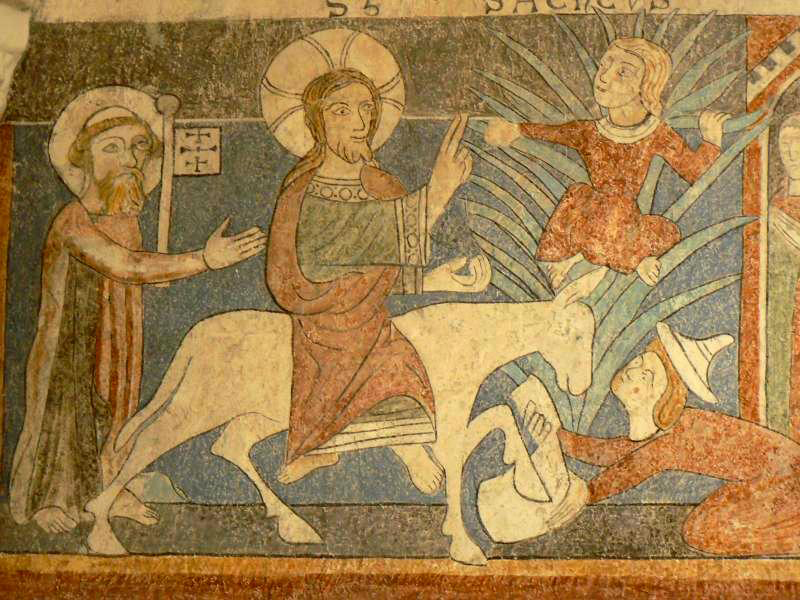


Story of Zacchaeus, circa 1275,
Keldby Kirche,
from Art in the Christian Tradition,
a project of the Vanderbilt Divinity Library, Nashville, TN.


One of the most publicized family feuds was in 1998, that of the controversy over whether or not Thomas Jefferson fathered one or perhaps all seven of Sally Hemings’ children.  For over two hundred years questions have been raised about their relationship and whether or not it produced children. 

 
Long story short, DNA from Jefferson’s descendants and those of Sally Hemings were compared.  Though the findings were not conclusive, they provided strong support to the supposition that Jefferson was the father of at least one of Sally Hemings’ children.
 
Thought it ranks high on the list, this quarrel is not entirely about racism.  A lot of it has to do with privilege:  being buried at Monticello, not far from where Thomas Jefferson was laid to rest; open and accepted membership in a prestigious founding family.  As a child, Shannon Lanier, a descendant of Madison Hemings, stood in front of his first grade class, stating that Thomas Jefferson was his great- great- great- great- great- great-grandfather.  His teacher told him to sit down and stop telling lies.  Ultimately this dispute is about inclusion, reconciliation, and a sense of legitimate belonging in this nation’s history.
 
So you can imagine what a family reunion it must have been.  Every year hundreds of Jefferson descendants, who comprise the Monticello Association, gather at the historical landmark after hours.  And after an invite from one of the association members, dozens of Sally Hemings’ descendants began attending, not as family but as guests, and with them, hoards of reporters and photographers.
 
But as we in the church well know, an invitation can be a far cry from a warm and hospitable welcome.  Some association members were in favor of the Hemings being in attendance but most were not.  Eventually a vote was taken to deny them full membership and to restrict their numbers at the annual reunion.  Since 2004 not one of the Hemings has attended the reunion; now they hold their own gathering at Monticello—at sunrise in a recently discovered slave cemetery.  It’s not much of a stretch to say that, in order to get a clear glimpse of Jefferson, Hemings’ descendants may have to climb a tree, the family tree, limb by limb.
 
Zacchaeus knew what it was like to be excluded because of who he was.  From the text we read that he was rich, he was short in stature and he was not only a tax collector but the chief of them all.  These all have the appearance of strikes against him.
 
And yet, according to the Jewish wisdom tradition, being rich was not an evil thing; in fact, it was a sign of God’s blessing and favor, that one must be wise and righteous in the eyes of God.  Wealth was not an end in and of itself; it was vehicle for expressing one’s faithfulness to God and to neighbor.  Was one generous or greedy, giving or withholding?  And as for short of stature, the Greek words for this phrase translate as ‘small in maturity’, that is, the crowd was treating him like a child.  They had formed a human wall between Zacchaeus and Jesus, deciding who had access to Jesus and who did not.  A tax collector who worked for the Romans and the chief one at that?  According to the crowd, Zacchaeus was definitely out.
 
This story has usually been read and interpreted as a man who once cheated folks but for having received Jesus into his home now repents and changes his ways.   But according to biblical commentators wiser than I, there’s more to this story about Zacchaeus than meets the eye.
 
In verse 8 the Greek verb “to give”, didōmi, has been translated in the New Revised Standard Version in the future tense:  “Look, half of my possessions, Lord, I will give to the poor; and if I have defrauded anyone of anything, I will pay back four times as much.”  But in the Greek and in other translations it is in the present active tense:  “I give…”, “I repay…”, implying that Zacchaeus is already giving to the poor and repaying any fraudulent transactions.  If citizens could produce the receipt given to them, tax collectors, by law, were required to repay the defrauded amount plus 20%.   A faithful Jew was also required to give to the poor.  Zacchaeus is not only faithful but goes beyond the law, giving half to the poor and repaying any debt plus four times as much.  In fact, the name ‘Zacchaeus’ in Hebrew means “pure” or “innocent”.
 
Zacchaeus is a rich man in the classic Jewish tradition, in that he is more than faithful, but because he is the chief tax collector working for the treacherous Romans, the crowd grumbles and assumes Zacchaeus is a crook.  Yes, he admits he sometimes cheats; essentially he’s admitting he’s human.  Salvation has come to Zacchaeus’ household not because of anything Zacchaeus has done but because Jesus chose to lift up one who’s honest about his flaws but who doesn’t brag about his generous nature, who is also a child of Abraham.
 
Last week our Muslim brothers and sisters at the Islamic Society of Delaware suffered an act of vandalism on their property.  Fenceposts and a sign were torn down and their electronic sign was pelted with rocks.  What may have made this most hurtful of all was that the vandals fashioned a crude cross out of two of the fenceposts.  Eventually it was discovered that three juveniles were behind this and it was chalked up to criminal mischief.  But to our friends it was yet another hurtful wound in a family feud that has lasted, on and off, for more than a thousand years.
 
 We know that Jews, Christians, and Muslims are all descendants of Abraham.  But there are those who, by their actions, try to deny that Abraham was the father of nations, promised by God who is the God of all nations.  Abraham was an immigrant, an alien in the land of Canaan, originally from Ur, a city-state in ancient Sumer that would later come under the control of the Babylonian empire, the empire that would one day destroy the temple in Jerusalem and send Israel into exile.
 
And though we may not be the ones hurling rocks, none of us can claim legitimacy for ourselves.  Just as Jesus insisted on coming to the home of Zacchaeus, legitimacy is a gift we bestow on one another.  It is when we reach out to ‘the other’, even the vandal, and say “You are my sister, my brother, I claim you as family, and this whole earth is our home.”  When we are able to do this, then we will have reconciliation; then we will have peace.
 
But peace and reconciliation require that we become small and pure in heart, like Zacchaeus.  If salvation is to come to this house we call Earth, and it must come, it begins with this nation acknowledging our safe distance from the poor and others who live on the margin.  It begins with taking inventory of ourselves and if we have cheated anyone of forgiveness, compassion, or justice, we restore to them not only what is due but even four times as much.  Ultimately, the story of Zacchaeus is about not only inclusiveness but about the expansive love of God.
 
We cannot claim any greatness except that of God working through us, and even that is a dubious claim when one examines our track record with God.  Yet God’s merciful cup overflows.  God’s passion for us is a stubborn love and God remains steadfast.  God claims all of us as children, as one family, that none would be lost, that all would be sought and found.  And may God’s people say, Amen.

 
When Jesus got to the tree, he looked up and said, “Zacchaeus, hurry down.
Today is my day to be a guest in your home.”


Tuesday, October 29, 2013

Ninety-five tweets

Joel 2: 23-32; Luke 18: 9-14
New Ark United Church of Christ, Newark, DE
October 27, 2013 – Reformation/Reconciliation Sunday


Earlier this week, I was driving on Main St. with the intention of doing an errand. As I was trying to find parking, and driving around the block, I saw a young man holding a large sign, as big as a sail for a small boat. He was standing on the sidewalk near the green on Delaware Avenue. His sign read on one side, “Turn to Jesus, not ‘churches’”, with ‘churches’ in quotes; the other side read “Come to the Living Jesus – ‘churches’ are a joke”.

Now I have to admit my heart stung a bit at the words “‘churches’ are a joke”. It’s my first week on the job, and everything is new. I feel as though I am making my way out of a cocoon into the world. And I am a curious person. After all, maybe he could be part of some post-emergent group, a get-back-to-the-original-Jesus movement, ‘spiritual but not religious’. So I walked over to where he was standing.

Hardly anyone was stopping to engage him in conversation. Most people just walked on by or crossed the street. I greeted him and asked him what his message was. He told me that Jesus cannot be found in the church, that churches are corrupting the message of Jesus by instituting a system of salvation, and by that he meant the prayer by which we must admit that Jesus is our personal Lord and Savior. He told me that all that is necessary is to spend time alone reading the New Testament and the words of Jesus, that Jesus is alive, is real, and that Jesus wants our hearts.

Now some of that I could get with. Yes, the Church with a big ‘C’ has done much over the centuries to warp Jesus’ message of love, compassion, forgiveness, and justice. Many people have left church because they have been hurt or some would say because of the apparent hypocrisy of its members. But I also wanted to present another point of view to him, because like any human being who knows with all certainty that they are right, he was generalizing.

So I stuck my foot in it and introduced myself as “Reverend” Cynthia Robinson (something I rarely ever do), pastor at the New Ark United Church of Christ down on Main Street. Go ahead: shake your head and groan, put your face in your palms, roll your eyes. I told him that the church saved my life, a particular church that he knew nothing about; a group of people who showed me who Jesus is and that he loves not only me but everyone unconditionally.

Then he started in on me like any reformer would. The church cannot save you; only Jesus can. You have no authority over anyone. By your own words you have condemned yourself. Only Jesus can save. I tried to engage him around community, that the church is a community where we come to know the living Jesus. I asked him if he had community—friends, people he studied the Bible with. He shook his head ‘no’, telling me that there was no one who sponsored him, that he travels the country and the world, telling people about the living Jesus. After a time he at least shared his first name with me: Abraham.

After we had parted ways, and I was driving down S. College Ave. I saw another young man holding another similar large sign. Of course Abraham does not work alone. Like any good follower of Jesus, he has a compatriot, someone with whom to share the difficult yet joyful path of discipleship. And maybe a network of some kind printing the tracts he was handing out.

After some research on the internet, I learned that Abraham is part of a family of eight, the Woronieckis, who travel the world sharing their message of sola scriptura, sola fide, sola gratia, solus Christus and soli Deo Gloria: Scripture alone, faith alone, grace alone, Christ alone, and glory to God alone. Though my friend Abraham would probably not use these terms, like Martin Luther before him, only these can save, only these have the power to transform a human life. And so thus began the Great Reformation roughly 500 years ago.

comic
 

Many scholars are declaring that every five hundred years or so, not only Christianity but the western world goes through what Anglican bishop Mark Dyer calls a giant rummage sale—tectonic shifts in politics, culture, economics, society, and religious belief, practices, and organization. In 1517 it was the Great Reformation; 1051, the Great Schism between eastern and western Christianity; roughly 500 years before that, the Fall of Rome, the papacy of Gregory the Great and the Benedictine Rule of monastic life; and then the Great Transformation, when we moved from before Christ into the common era. The time we are living through now is being called by some as the Great Emergence.

Author and Anglican Phyllis Tickle writes that every time there has been a gigantic shift in thinking and organization of western Christianity and civilization, there has been a central question: by what authority do we live? At the heart of Luther’s reformation it was the Bible. The Bible, not the Church, not the priests, was the authority in a Christian’s life.

In today’s world the Bible no longer holds such pride of place. In fact there are accepted practices in the Bible that we now have deemed unacceptable: slavery, the inequality of women and children, the exclusion and denigration of love between same-gender persons. The dominant Christian, primarily white voice in this country will no longer be the majority in a few short decades. We are a nation, we are a world of many voices, many understandings of how to navigate this ocean of tremendous diversity in which we are all one. And most of the time, we tend to think our way, our view is right.

In this morning’s gospel lesson, Jesus tells a story to us, about us, who trust in ourselves more than we trust God’s saving grace. We cannot receive the over-abundant pouring-out from God that the prophet Joel describes if our heads are upright with solely our own sense of what is righteous. When we are bowed in humility, trusting not only our own understanding but relying on God’s grace, it is then that we are drenched in God’s love, soaked in God’s gift of self-acceptance, and we can be filled to overflowing with compassion for every sister and brother, every creature on this mystery-suffused earth. It may not be sola scriptura anymore, but we do not live solely for ourselves. If the only answer we have now to the question ‘By whose authority do we live?’ is “Not solely my own, not solely our own”, we may be, maybe, not far from the kingdom.

And so relying on God’s grace, what are your hopes and dreams for this church, for the Church, for the world, as we wait and see and work through this Great Emergence that we are living through? What about church do you want to see into the future? What do you think needs to be left on the table at the giant rummage sale? What do you celebrate about the church right now as it is? What would be the 95 tweets of the New Ark United Church of Christ? To put things into perspective, Luther’s 95 theses were actually a notice to the Church regarding what needed to be discussed, the beginning of a conversation that has lasted almost 500 years. So let’s not get ahead of ourselves.

To get you started, I asked a few people these questions and I heard these responses:

• Should we grow larger?
• We need new energy.
• How can we be authentic and trust each other?
• More opportunities for outreach.
• How can we resolve the question and come to understand what is the role of children in church?
• Wouldn’t it be nice to not have to beg for CE teachers every week?

(The following is from the children and the congregation gathered this morning, 10/27/13):

Why do I love my church (from the children):

1. The people.
2.  God is here.
3.  Because my Mom loves to come here.
4.  Communion.
5.  Youth group.

And the congregation's responses to the questions above, including "Why do I love my church?"

1.  That we care for the Earth.
2.  We use inclusive language.
3.  Make sure our hearts are in the right place.
4.  We are not only for ourselves, but for our community.
5.  We are a voice for justice.
6.  Love our neighbors, which means everyone.
7.  Love that we share ideas.
8.  We need energy to do new things.
9.  Our church is a place for spiritual growth.
10.  Music is very important.
11.  We support each other and the youth.
12.  We explore questions, not always rushing to answers.
13.  We're a family.
14.  The congregation is the village in which we raise our children.
15.  We want to grow with young families.
16.  Build bridges with differences.
17.  Live God's extravagant welcome.
18.  We teach Our Whole Lives curriculum.
19.  God is still speaking.
20.  There have been times when we have not supported each other as we could have.  We can always improve.
21.  Walk the walk - we try to practice what we preach.
22.  Important that we communicate clearly with one another.
23.  Be authentic.
24.  People feel truly cared about.
25.  Do justice, and to love kindness, and to walk humbly with God.  (Micah 6: 8)

Above all, let us remember that whatever we do, we do so in covenant with one another and with God. And so I’d like conclude with some words taken from scripture that are part of the United Church of Christ’s inclusive order for marriage: “Be merciful in all your ways, kind in heart, and humble in mind. Accept life, and be most patient and tolerant with one another. Forgive as freely as God has forgiven you. And, above everything else, be truly loving. Let the peace of Christ rule in your hearts, remembering that as members of one body you are called to live in harmony, and never forget to be thankful for what God has done for you.”

And may God’s people say: Amen.

I saw her standing there

Today is my oldest daughter's 17th birthday!  I can't believe that seventeen years have passed since this awesome, beautiful creature came into my life.

Tuesday, October 22, 2013

Holding on and letting go

Genesis 32: 22-31; Luke 18: 1-8
New Ark United Church of Christ, Newark, DE
October 20, 2013 
Jacob and the Angel, Anthony Armstrong


About three weeks ago, at the beginning of the government shutdown, Susan Thistlethwaite, former president of Chicago Theological Seminary, published an article in the Washington Post entitled “Why Republicans Long for a Debt Apocalypse”. In it she quotes a Washington Post/ABC poll in which 66% of Republicans want their representatives to cause an economic catastrophe. She writes that this is something more than just crazy talk. She goes on to remind us of Freud’s theory, that when human beings are overwhelmed with fear and anxiety, the psyche, individual or collective, can induce a death wish, what the Greeks called thanatos.

The citizenry of the United States has been living with the “War on Terror” for 12 years, as well as wars we fought in Afghanistan and Iraq, and an economy in recession since 2008. All of this has been occurring during a period of immense social, climate, and technological changes, some of which happen faster than some of us can adapt to them. According to Thistlethwaite, all of this pent-up anxiety and fear has produced within our political culture a desire to ‘just crash the whole thing’.

As I was preparing to move here, I found it increasingly difficult to leave decisions open-ended, or I would wed myself passionately to a particular option. I have not lived alone for 20 years. I have not moved for 15 years, the longest I have ever gone without changing my address. As the anxiety escalated within me, I was frightened that living apart from my family could have the power to separate us for good. There were times I was crabby, tense, and difficult to live with. And when I read Susan Thistlethwaite’s article, I realized that I too was exhibiting my own version of the urge ‘to just crash the whole thing’.

Yet even when I became aware of this very human urge toward implosion, later that night I had a waking dream in which I rose out of bed, ready to fight some dark threat, my heart beating as if I were confronted by a burglar. It was as if my unconscious mind was saying, (pull out Darth Vader mask) “You don’t know the power of the dark side. You can’t end the turbulence within so easily. Hang in there, keep wrestling until you receive the blessing.”

Since humanity has been able to reflect on itself and human beings have perceived themselves as individuals and not just as a member of a group, the question of why do we move toward self-destruction, why do we act on our darker impulses has persisted. We have been wrestling with God on this point for millennia and we have not come any closer to an answer that gives us any peace. We have witnessed the power of prayer in times of inner and outward conflict and yet we have also experienced its apparent failure, when it seems the dark side has won.

How do we pray and not lose heart sometimes? We are all shades of light and dark, sunshine and shadow. Often, in the midst of change and transition, it can be daunting to trust the unknown, seeing only one step at a time. God never promised us a rose garden. God offers no guarantees; that’s why it’s called faith. And so, does the efficacy of our prayers depend on our faith or how frequently we pray? Is it how we word our prayers, how specific or general our requests? Would things have turned out the way they did anyway, regardless of our prayers?


In my experience, it seems to me that, in the American Christian experience of faith, too easily we grasp onto God and too easily we let go. The idea of God is something we should approach with fear and trembling as much as with comfort and release. The same could also be said about letting go of the idea of God. Too often, in the emptiness that our fear or anger or despair creates, we latch onto God as a cosmic cure-all, in a desperate attempt to assuage our very natural, very human dark side. We also tend to let go of God in that very same emptiness, when the God of our perceptions fails us.

There are two fundamental questions at the core of our human experience that as yet have no once-and-for-all, satisfactory answer: one, where did this existence we live in come from? How was energy transformed into matter? What started all of this? And two, where is all this headed? What is the purpose of the universe? To put it in terms of human experience, where did we come from, how did each of us unique persons come to be? And what will happen to us when we die? Any of those questions has the power to create an aching emptiness that often we can be so desperate to fill.

The majority of human beings have come to believe that there is some sort of higher power at work in this world, that there is something beyond what science and our five senses can tell us. There is a mystery beyond our present capacity to understand. Author Joseph Campbell wrote "We keep thinking of deity as a kind of fact, somewhere; God as a fact. God is simply our own notion of something that is symbolic of transcendence and mystery. The mystery is what's important." But how do we encounter the mystery, the unanswerable, the ineffable?

Ironically, we generally avoid these existential questions at church. Ron Brown, one of my Connecticut colleagues, says that there’s not a great deal of wrestling in the church. There’s plenty of what he calls ‘rassling’: arguments over small details, tussles over relatively unimportant matters. But what the church needs is more wrestling. For instance, what about wrestling with the push and pull of the Holy Spirit and how we are called to be church not only today but in the future? What about wrestling with how to be like Jesus in our daily lives? What about wrestling with forgiveness and self-acceptance?

In these days it’s too easy to hang on to a feel-good faith or to let go of it when it runs empty. It’s hard hanging on to that mystery called God when what we’re wrestling with is the poverty or oppression of our neighbors or the cancer eating away at our life or an addiction compelling us to fill that emptiness inside us or the darkness seeping into our souls. It’s hard hanging on to God when we’re feeling spiritually hurt, especially when the church has been involved. And it is then that a lower power can take the place of our higher power.

Jacob had the nerve to hang on until the blessing came, and we are challenged to do the same. Yes, he came away with a limp, but God never promised us a struggle-free life and certainly not struggle-free community. God did promise to help us and to remain faithful and love us unconditionally—forever.

Jesus dares us to be persistent, even nagging, in our need for justice. God’s mercy is not of the quick-fix variety or a security blanket or a bulletproof shield protecting our bodies from all harm. Luke’s gospel was speaking to early followers of Jesus—Jews and Gentiles—around the time that the Romans destroyed the Second Temple in Jerusalem. Few, if any, of Luke’s readers may have known Jesus; most did not. They were hopeful of his return but also despairing over their circumstances of persecution and what appeared to be permanent exile. In this parable, Jesus is telling his present disciples and those through the ages that God’s mercy will come quickly.

But how quickly, they and we wonder? People were perishing; communities of faith were growing weary, the power to transform seemingly ebbing away from them. Sounds familiar, yes? And so Jesus compels the disciples to engage in a spiritual discipline that is the same for disciples of the 21st century: to pray always and to not lose heart. And it is possible to pray always and not lose heart because prayer is a team sport.

Prayer that sustains us is more, though, than talking to God and a list of our requests. Rabbi Harold Kushner writes that prayer is “to come into the presence of God in the hope that we will be changed by doing so.” In prayer we persevere with God, we wrestle with God, and we hang on until the blessing comes, until justice is done and mercy is granted. Prayer does not take us out of the world but brings us face to face with it and with God’s dream for the world: that blessed community of peace and righteousness for the whole of creation. In prayer we hang onto God for dear life and we let go of the outcome, trusting that God has not only our best interests, but the wholeness of all at heart.


The Serenity Prayer and the Lord’s Prayer are ones we can say through the day to help us not lose heart, to help us not let go of our hearts. I’d like to introduce you to another prayer to take with you, one that has power, like any other prayer, to bring change and healing: “Holy Spirit, if this direction or course of action is right for me (or for our church), let it become more firmly rooted and established in my life (or in our life together). If this is wrong for me (or for our church), let it become less important to me, and let it be increasingly removed from my life (or our life together).”

Are we ready to hang on for love and healing and understanding? Are we ready to let go of the schedule, the timeline, the expectation, the outcome and trust God? Are we ready for blessing, for justice, for mercy? Are we ready to be saved from ourselves? Are we ready to go deeper with God that we would be raised to new life? And may the people of God say, “Amen”.


[1] Flora Slosson Wuellner. Prayer, Stress and Our Inner Wounds. Nashville, TN: Upper Room Books, 1985, pg. 78.

Monday, September 30, 2013

Enough is enough

Our self-worth has nothing to do with anything other than we draw breath!


Tuesday, September 24, 2013

The Church Improv

General Association of Ministers in Connecticut
Silver Lake Conference Center, Sharon, CT
Sept. 23, 2013

(Every year since 1709 the clergy of the Missionary Society of Connecticut - now the Connecticut Conference of the United Church of Christ - have gathered for renewal and to conduct business.  This gathering is called, with no sense of poetry, the General Association of Ministers in Connecticut. It is even said that when the Congregational Church was linked with the governance of the state, that it was this body that nominated the governor!

Since its inception, the gathering now includes educators, members in discernment [those considering the ministry as their vocation], and church musicians.  This year I was asked to be on the planning committee and to give the Moderator's address.  The term 'moderator' simply means 'the one on the pointy end of  the ship'.  Anyway, here are the words I shared with my colleagues in ministry.)


Of the almost 22 years that I’ve been ordained in the ministry of the United Church of Christ, 16 of those have been spent in temporary ministry settings so that I could be home with my two daughters. I’ve served as an interim, filled in for colleagues on sabbatical, and offered pulpit supply in 24 churches in the CT Conference, not to mention a small handful in the OH Conference. I’ve had to remain light on my feet, be flexible, and willing. Maybe we ought to pronounce it ‘pulpit supplely’. You might say my ministry here has been a bit of an improvisation.

Our keynoter, Kirk Byron Jones, will be speaking about, among other things, stillness, awareness, and playfulness. Playfulness is something I can really groove with. A couple of years ago I read Tina Fey’s memoir Bossypants, in which she recalls her days as a member of the Second City improv theater in Chicago. Did you know that there are rules for doing improvisational comedy? You wouldn’t think so to look at it. There’s no scenery, no props, and no script; it’s just made up as the actors go along.

Even though the Christian faith has a script (holy scriptures—what we call the Bible), some fabulous scenery (the whole of creation and the living of our lives), and a few props (the cross, bread, juice, the waters of baptism), the religious establishment is sometimes accused of making it up as it goes along. Indeed there are some tenets of Christian doctrine that seem as though they were conjured from the human imagination: original sin, the virgin birth, even the resurrection. For hundreds of years there have been rules about what is orthodox belief and what is heresy; rules about what makes a faith community the Church rather than just a social club.

Thankfully, church life has loosened up some over the years. Indeed there are some who would say it has loosened up too much. In the United Church of Christ there are no tests of faith, no creeds we must adhere to. We recognize that everyone is on a journey of faith, that every relationship with God and with the church is unique. Yet there is also an ancient tradition that goes all the way back to Jesus and his disciples, and it is this faith and this community that we strive to emulate.

If I didn’t know any better, I’d think that Jesus knew the rules of improvisational comedy. Not that he was ever trying to be funny, sometimes I wish he was, but according to the comedy law laid out by Tina Fey, it seems like Jesus lived by these four simple rules. The rules of improv would also make for some interesting by-laws for what it means to be the church.

1. The first rule is to agree, to say yes to whatever is being created. So if your partner says “Freeze, I have a water pistol,” you can’t reply with “No, it’s not. It’s your finger,” because then the scene has come to a stop rather than going forward. This rule reminds us to keep an open mind to what is going on around us. Jesus is God’s big “yes” to creation. “This is my son, the Beloved, with whom I am well-pleased.” And Jesus kept echoing that ‘yes’ throughout his ministry: yes to justice, yes to peace, to healing, to the poor and the marginalized, to women and children, to foreigners and strangers, to tax collectors and prostitutes, yes to the incarcerated, yes even to death on a cross and to those who died with him. And then that huge ‘yes’ to life and love on Easter morning.

And so we can experiment in church, we can say yes to what is being created and take a chance, risk looking foolish because we just might be surprised by the Holy Spirit, who is the queen of sacred improv if ever there was one. “Keep an open mind and remain supplely” helps us to be able to respond to the Spirit with a light heart.

2. The second rule to is to add something of your own, to say ‘yes, and’, to agree but to also go on with what has been handed to you. If I say, “Gee, it sure is humid,” and you say, “Yeah…”, then there’s really no where to go. But if you say, “What do you expect from living inside a giant rice cooker?” or “Yeah, it’s so humid even my wrinkles can’t hold out” or “I told you we shouldn’t have crawled into the belly of a whale”, then we’ve got somewhere to go. When Jesus says to Thomas ‘put your hand in my side’, Thomas doesn’t say “Eew, yuck! No, thanks!” Rather, he adds his ‘yes, and’, his confession of faith: “My Lord and my God!”

So someone suggests that the youth group hold a car wash to raise money. No, not very original. But what if instead of saying no, we said “Yes, and we’ll all dress up in costume or wear funny hats and take flyers to work, I know someone who could DJ, we could do a cookout too.” “Yes, and” allows the creative energy to flow.

3. The third rule is to make statements. If we ask questions all the time, we put pressure on our partner to come up with all the answers. If we point out all the obstacles, it then becomes up to our partner to solve them. Whatever the difficulty is, we need to be part of the solution rather than add to the problem. People were always asking Jesus questions, expecting him to have the answers. Sometimes he would ask a question in return but he usually would follow it up with not only a statement but a story. A story that left his hearers sometimes in a quandary, that is, having received an answer that sounded more like a mystery. Jesus reminds us that faith is not about what is certain but what is uncertain. Improvising is all about uncertainty and not knowing what is going to happen next. Which sometimes can turn all that vision planning on its head.

4. Finally, there are no mistakes, only opportunities. The disciple Thomas, who always gets a bad rap, wasn’t there the first time Jesus appeared to the rest of the disciples: rather than a mistake it was an opportunity for Jesus to teach and to help his friends understand what it means to believe and to be in community with those who may have doubts. Jesus and the disciples could have chastised Thomas for missing out the first time. Instead we have a beautifully improvised scene in which those who doubt are included and we receive the blessing of the words “come to believe”, illustrating that faith and living in community are not a place to arrive at but a journey, a process, an improvisation.

Like any good improvisation, Jesus worked with what he had and created something new. He had fishermen, tax collectors, zealots, a woman healed of her demons, sinners galore, and he made community out of them, community that would not only survive his horrific death, but would proclaim him risen from that death. He had some bread and wine and from them came a meal to whet our appetite for justice and righteousness and to remind us that we do not do this alone. He had a death that looked like a monumental mistake, the biggest failure history had even seen, but was actually a transformational opportunity for rebirth and the galvanization of a movement that has not seen its equal.

But do we leave room for improvisation in our faith communities? I often wonder if our expectations for worship and leadership have gotten a bit out of whack. We want to fill our spirits, what Anne Lamott calls our ‘God-sized hole’, but nothing ever seems to be enough. It feels like we keep upping the ante, increasing our desire for the transcendent experience of God, when the immanent is right in our face.

Worship is often more like a thoroughly-scripted performance, and when it’s not, we get nervous. We strive for perfection, when the Greek word for perfect is better translated as complete, and it is God who completes our improvisation, working with us like a jazz master. If we really want to have an experience of God in our worship, then let us be willing to tell the truth about ourselves and accept one another and ourselves as we are; let us forgive one another as God has already forgiven us; and if we really want to step up our game, let us love our perceived enemy for surely we have been a thorn in someone else’s side. Jesus heals us and sets us free to leave the armor and the weapons and the façade at the door and then abandon them after our worship.

God is the one who completes our improvisation. If we want God to play with us, we have to leave some wiggle room, some room for stillness, some room for playfulness, to just be. Which makes it possible for us to become aware that the love of God has always been shining, just waiting for us to come out and play.

Thursday, September 12, 2013

Choosing God


Deut. 30: 15-20; Jeremiah 18: 1-11
New Ark United Church of Christ, Newark, DE
September 8, 2013


(This was my candidating sermon for the New Ark United Church of Christ in Newark, DE.  They voted unanimously to call me as their next settled pastor.  I begin there on October 15.)


My oldest daughter Andrea has a standard phrase whenever she teases me and pushes my buttons:  “I couldn’t resist, Mom!”  Then I give her ‘the look’, she laughs at me, and so it goes.

One day I realized that she was making a choice, that we both were, and that, if we wanted to, we didn’t have to do the same old thing every time.  She said, “Oh, I couldn’t resist, Mom!”  I replied, “Oh yes you could.  There were two paths in front of you.  One was rather ordinary and plain, the other bright and shiny as a penny and you chose the bright and shiny one, you did!”  And we both laughed.

Every day such choices and possibilities exist before us.  Some feel like old habits and ruts, others like a warm, comfortable piece of clothing, some like that bright, shiny penny, others seem empty of any kind of thrill or joy.  If we take time to think about it, our whole reality is created, moment by moment, by our choices.  What we think, what we feel, what we do.  What our attitude will be, what kind of mood we’re in, whether or not we’ll be hurt or annoyed or just amused by someone’s actions.  And from these choices come a myriad of possibilities that affect not only our reality but others’ as well.

We’re convinced that we’ve been conditioned in some way to respond, to choose the way we always have.  We were raised a certain way, with certain values, a mix of good and bad experiences.  Sometimes it’s hard to see a way through our present situation, to choose another course.  Most of the time, we don’t like knowing that we possess the ability to be co-creators of our reality.  It would mean we would have to take some responsibility for shaping the way things are.

John Calvin, a 16th century theologian and Protestant reformer, believed that before the creation, God predestined the fate of the universe; that some of God’s creation was made for grace and salvation and some of it was not.  Yet humankind was also given free will and the option to reject that saving grace.
 

In the readings from both Deuteronomy and Jeremiah, God’s people are given a choice, between life and death, good and evil, blessings and curses, listening to God’s messenger or ignoring him at their peril.  It hardly sounds like free will.  Life or death?  That’s a no brainer!  And yet listen to the next verse in the reading from Jeremiah: “But they'll [God’s people] just say, 'Why should we? What's the point? We'll live just the way we've always lived, doom or no doom.”

Fear has never really worked as a coercive to get us to choose the next right thing.  It’s also given the God of the Hebrew scriptures a really bad, undeserved rap.  Actually, Deuteronomy and Jeremiah were written during and after the Babylonian exile, after the bad choices had been made, after the doom had happened.  God’s people, in retrospect, realized that their stubbornness and their unwillingness to be shaped by God led to their destruction.  And yet God continues to reach out to God’s people, again and again, offering life, blessing and goodness when we would rather die than surrender.

It’s words like surrender, obedience and repentance that make faith leave a bad taste in our mouths.  In the words of the poet William Ernest Henley, we like to think that we are the masters of our fate, the captains of our soul.  We are when it comes to our attitude and our outlook on life; no one can choose that for us unless we give them that power.  But resisting God will do us no good.  Though we may be able to master our moments, God is the master of all space and time and we do indeed ignore that life-giving wisdom at our peril.

God is the master-potter, an artist working with an ever-changing medium called the creation.  God is still discovering how to work with us earthen vessels, still shaping us, still creating us and creating through us.  There are still possibilities untold: everlasting peace, the end of hunger, poverty, violence and oppression, a new heaven and a new earth but also destruction, torment, death, extinction.  What will we choose?  Which path will we take?  What do our choices about how we live speak to the God to whom we still need to surrender?
 

All it takes is one step: one step toward life, one step toward blessing, one step toward God.  In any twelve step program one does not agree to do all twelve steps—just to begin with the first one.  And that first step is all about surrender, that God knows better than we do how to end the insanity and how to begin to live.  Author and Quaker Parker Palmer wrote that faith is less about taking a big leap and more about taking one more step.  It’s all about doing the next right thing, whatever that may be.

Humanity’s relationship with God is changing, evolving, as it always has been.  In our faith tradition, in the beginning and ever since, God demands loyalty, obedience, and covenants were built upon that foundation.  “I am the Lord your God; you shall have no other gods before me.”

With Jesus we are invited to follow, to go, to live as Jesus lived, to pick up our cross and die to ourselves.  In the death of Jesus on the cross, in our baptism and affirmation of it, and whenever we break bread together, we are given the covenant of community, of belonging, of being loyal to each other.

It is said that we are now living or making the transition into the Age of the Spirit.  Not just what astrologers might call the Age of Aquarius, which is typically associated with, among other things, democracy, freedom, humanitarianism, Idealism, modernization, rebellion, nonconformity, veracity, and perseverance.  These qualities are certainly part of the Age of the Holy Spirit as well, but I am speaking of something more.

The Age of the Holy Spirit is one of transcending differences and opposites, an age of oneness, connectedness, relationship, and kinship to all living things through a living Spirit.  In the Age of the Spirit there is no longer “us” and “them” but only “us”.  It is a loyalty that transcends tribe and culture, race, skin color, gender and sexuality, creed and belief.  This Age of the Spirit doesn’t mean that we are chucking God, that we leave behind Jesus.  It means we make room.


NAUCC symbol

All these folks who say (and there are probably some in this room) that they are spiritual but not religious—there is probably a very good reason why they say this.  We all want to feel close to God and to each other, close to the holy, the sacred, close to the Spirit living in me and the Spirit living in you.  Religion is just as much about binding ourselves to each other as it is about faith.  But living in community can be hard work, really hard.  Author Henri Nouwen said that “community is that place where the person you least want to live with always lives.”

The covenant now is still about community but more about belonging, about kinship, about, as Father Greg Boyle would say, “creating a community of kinship such that God might recognize it …moving ourselves closer to the margins so that the margins themselves will be erased.”  The covenant of the Holy Spirit is one of vulnerability, authenticity, flexibility and malleability.  It’s about being ready for the Spirit to enter, to speak, to reveal: anytime, anywhere, through anyone or anything.  It’s less about programs and more about being light on our feet.  It’s less about success or failure and more about going where the Spirit leads.  It’s less about belief or unbelief and more about being real and accepting each other as we are. 

What is the next thing toward which the Holy Spirit is calling you, the next step toward God, that you need to take in your life and in your life together (and I'm not talking about whether or not you will call me as your next pastor)?  In what ways do you still resist the Holy Spirit and God’s desire to be in relationship with you?  Though God may not be necessary for a life lived for good, why not live with spiritual companionship that accepts us as we are and yet prods us off ourselves?  What are some habits, some old ruts that need to be replaced with spiritual practices such as service, study, prayer, and giving?

Our choices shape who we are and whose we are.  Will we put ourselves into God’s hands and allow God to mold us and use us or will we resist and grow hard and unmalleable?  When we choose God and God’s community of kinship and compassion, of justice and peace for all and not just some, we are shaped into a vessel that can be used toward that blessed community.  Every time we choose God, God’s blessed community becomes more than a possibility.  It becomes more and more visible, more and more a reality.  And all it takes is just one step, one choice at a time. 

Amen.


Sunday, July 21, 2013

Guess who's coming to dinner?

Genesis 18: 1-10a; Luke 10: 38-42
First Church of Christ UCC, Woodbridge, CT
July 21, 2013


O Lord Jesus, put us in touch
with the joy of your presence, mercy, and grace,
and let it disturb us to life.
Amen.


You've got to give a little, take a little,
and let your poor heart break a little.
That's the story of, that's the glory of love.


And with those words, the movie Guess Who’s Coming to Dinner begins. It debuted in 1967 but its themes are still timely today. It’s about a young couple, head-over-heels in a whirlwind romance who come to the girl’s parents’ home to give the big news: that they’ve fallen in love with someone of a different skin color and they’re going to be married.

The girl, Joanna, is bright, happy, and fearless. She is as her parents raised her: colorblind. Her fiancé, John, a handsome widower and a brilliant doctor, is more cautious and guarded, unsure that Joanna’s liberal parents’ ideals will hold up when confronted with the reality of a black son-in-law. The evening gets even more complicated when, upon hearing that their son has found a girl to marry, that he feels alive again, John’s parents decide to jump on a plane to join the dinner party, not knowing that their future daughter-in-law is white. Enlivening the mix is a forward-thinking Catholic priest, a family friend who holds Joanna’s father’s feet to the fire of his convictions.

It’s a story of upending expectations and cultural norms. Everyone finds themselves on shaky ground. And everyone knows what the right thing to do is, yet each one has their own difficulty accepting it and owning the courage to do it.


You've got to win a little, lose a little
And always have the blues a little
That's the story of, that's the glory of love.


The same could be said for Abraham and Sarah. Unexpected guests for a meal were thought of as a blessing and were indeed a cultural norm. One could not survive in the desert without the hospitality of strangers. Yet Sarah and Abraham did not expect that these would be holy visitors, or that they would bring news of a son, a child in their old age. At this shocking, upending revelation, a few verses later, Sarah laughs, perhaps nervously, realizing the immanence of God, even in the intimacy of a longtime marriage. It’s as if God is saying, “How do you know what to expect with me? I am God. I am always doing a new thing.”

We in our post-modern world think that God doesn’t show up anymore the way God used to, and perhaps that’s because we’re so sure what that would look like. But God is not about fulfilling expectations so much as making sure we’re paying attention to the upending that God is doing in everyday lives.

Kurt Walker, a UCC pastor in Indianapolis, posted a story on Facebook the other day about how God works. Kurt had found an abandoned bicycle in some bushes near his house. He didn’t know if the bike had been stolen or not but decided to bring it with him to the church and call the police to file a report.

Later than morning an officer came to the church to interview Kurt and write up the report about the bicycle. As they were finishing their conversation, the officer, whose name was Ralph, pronounced as ‘Rafe’, as in Ralph Vaughan Williams the famous English composer, asked if the church had an organist, curious because Ralph played the organ. Kurt was a bit skeptical, asking “Did you go to school for that?” To which Ralph replied, “ Yes, I studied under a professor that once taught at Notre Dame. I used to play up-state way back when but it’s been a long time. I’ve been on the force for twenty years so I primarily play for fun now.”

Kurt was brought up a bit short by this; even more so as he listened to Ralph talk about how his father was worried that playing the organ would never pay the bills and that Ralph should get a ‘real job’. “Oh”, Kurt replied, feeling sheepish about the sarcastic thoughts he’d been having a moment earlier: a police officer who’s a closet organist? Kurt was then reminded that he himself was a second-career pastor, having had to deal with his own worries about paying seminary bills in a line of work not famous for its lucrative income.

After chatting about whether he’d be interested in being a substitute organist some Sunday, Ralph asked, “What kind of organ do you have, anyway?” The church secretary invited Ralph to go take a look, while Kurt offered to turn on the organ if Ralph would like to “take it for a spin”. A former Roman Catholic, Ralph paused on the bottom step. Kurt gestured and said, “Come on up and take a seat.”

What happened next was one of the most grace-filled moments Kurt had ever experienced. Ralph sat on the bench, swung his legs over the side toward the pedals, in full uniform and belt with handcuffs, service piece, and radio, and proceeded to play Bach’s Toccata and Fugue in D minor from memory.


Kurt said that every few minutes the two would make eye contact and smile, knowing that God had just upended both their worlds and created something new. After he had finished about half of the Bach, Ralph then moved over to the Baldwin classical piano he had admired and played the Adagio Cantabile from Beethoven’s Sonata Pathetique, from beginning to end, again from memory.


Kurt wept tears of joy and thanks. Both men stepped out of themselves and into the presence of God and were nourished. And what a meal it was.

We’re not always ready for the presence of God to show up. And perhaps it’s better that way, because it always seems that God’s surprises are better than what we’ve planned for. But such upendings can also be challenging, because we often get very attached to our plans, our expectations, and the way things have always been done.

We find our sister Martha in such a situation. This story has been classically interpreted as ‘those who are human doings and those who are human beings’, urging us disciples to achieve some sort of balance between the two. Many who thrive at doing have felt slighted by this explanation, defending their way of being by declaring “Well, nothing would get done if we didn’t do it!” And oftentimes, that’s very true.

But I don’t think that’s what this story is really about. Jesus has come to dinner and by his presence he has upended the whole dinner party and everyone’s expectations. Martha is upset, not because Mary is not helping, but because she’s not behaving like a good Jewish girl should. Rather, by sitting at the feet of Jesus, Mary is behaving like a rabbinical student, something that was only allowed for boys and men. The better part that Mary has chosen is not a contemplative life but freedom. Freedom from the way we think things are supposed to be; freedom to be and to do that new thing that God is creating. And that new thing is a relationship with Jesus: a relationship that will upend our lives in fresh and challenging ways, if we allow it.


Notice that this depicts Mary with her head uncovered.


Right now your life as a community is being upended. Where do you see Jesus offering you a closer relationship, a deeper connection in that upending? What freedoms do you now see that were previously hidden? What is the next right thing that you need to do, as a church and as a disciple of Jesus?

When we’re in the midst of an upending, when we’re on shaky ground and trying to scare up a little courage, we need to remember that what’s being offered is new life, yet another second chance, the freedom to love as God loves.

You've got to laugh a little, cry a little
Until the clouds roll by a little
That's the story of, that's the glory of love.


Amen.

Sunday, July 07, 2013

Daughter blogger


My oldest daughter wants to be a commercial airline pilot.  She has one more year of high school, which means we've been visiting colleges.  Purdue University and Bridgewater State University in Massachusetts are two schools where she can get a 4-year degree in Aviation Science and be trained to fly.  I insisted that she get a liberal arts education as well as flight training.  A well-rounded pilot is a better one, in my opinion.

Part of her high school education requires that she research a project that deals with her future career.  So this summer she's working on getting her private pilot's license.  I suggested that she start a blog, because she needs to keep a journal as one of the requirements.


So go on over and make her feel welcome, friends!

http://renaeroplane.blogspot.com/

Monday, July 01, 2013

Justin Case: A Fingers-Crossed-Behind-His-Back, Well-Meaning Christian (7)


About every other day, Justin is ready to chuck church and go the way of the heathen.  What happens on the other days, you ask?  That's what he'd like to know too.