Sunday, August 03, 2014

Giving when we have nothing


Matthew 14: 13 – 21
New Ark United Church of Christ, Newark, DE
August 3, 2014


            Over the years, whenever I have been preparing a sermon, I read again and again the scripture that will be the focus of the message, and invariably that text will become the lens, the filter through which I experience everyday life the week prior to Sunday.  News stories, posts on Facebook, events in my life and in the lives of others, songs on the radio, even overheard conversations at the grocery store—all act like a megaphone for that focus scripture.  I call it “God following me around”.  Drives me nuts when she does that.


            This scripture was no different.  I had thought that I would reflect on the theme of forbearance, patient self-control—something I’ve wanted to preach about for a while.  Those disciples seemed to have no patience with a crowd of hungry people.  Send them away to find their own food!  Never mind that some of them had been sick and had followed Jesus on foot, many of them thirsty, tired, and mostly likely poor as well as hungry.  So I thought about forbearance and then went on vacation.


            What did God do with that?  The universe then served up as many opportunities as possible for me to learn how to be forbearing.  I went to get my first pedicure in about a year, and without warning, the woman serving me began telling me with a thick Korean accent how badly she was treated when she came to this country.  That brought me up short.  Driving back from Connecticut to Delaware took about six hours, including a stop for lunch and gas.  Weeding crabgrass.  Even waiting for cantaloupe to ripen before I can trap the groundhog who views our garden as his personal salad bar taxes my patient self-control.  (By the way, Cynthia: 2, groundhog: 0)


            The need for forbearance never takes a holiday.  No one knew that better than Jesus.  That thing that he heard was the death of his cousin John at the hand of Herod Antipas, hence the need to go to a deserted place by himself.  But the crowds heard about it too and followed him to where he was.  Even though they were feeling poorly, these people wanted to be there for Jesus but also to hear a word of good news, that Jesus would carry on John’s mission.  However drained and grief-stricken he was, Jesus couldn’t help himself.  He loved them and healed them.


            In my moments of self-righteousness, I’ve wondered if the recipient of my forbearance is aware of the gift I am giving: not honking my horn when someone cuts in traffic, listening patiently even when I can only understand every other word.  Forbearance is usually required when someone is solely focused on their own need, not realizing that others may be tired, hungry and thirsty too.


            And this is where forbearance can get tricky.  It doesn’t mean we’re supposed to be a doormat or to forgo our own needs in order to fulfill someone else’s.  Forbearance isn’t about being a martyr or keeping score of how many times we’ve had to bite our tongue and count to ten.  It’s not something we can do on an empty stomach nor do we have to do it on our own.


            These disciples in the gospel of Matthew haven’t heard Jesus say “I am the bread of life”, so perhaps they’ve forgotten who they’re talking to when they say “We have nothing here but five loaves and two fish.”  Jesus simply says, “Bring them here to me.”  We are to bring what we have, tired, hungry, thirsty though we may be, even if we feel like we have nothing to give.  Our nothing will be lifted up, blessed, then broken open and shared, and yes, a miracle will occur.  We will all be fed, with leftovers to spare.


            Jesus isn’t asking solely for forbearance but for whatever love we have, even if we have to scrounge for it.  For as much as we may grow weary in our forbearance of others, there are those who have patiently listened to us, forgiven our self-absorption and our faults, who have allowed themselves to be broken open for our sake, who have had to sometimes scrounge within their own hearts that we would feast on something rather than nothing at all.


            We fervently wish, we hope, we desperately pray that Israelis and Palestinians would learn to forbear with one another, that they would take their nothing and lift it up, bless it, and break it open and share with each other; that American citizens on the Mexican border would forbear with Central American children; that those who fear a diverse, free American citizenry would forbear with LGBTQ sisters and brothers and those of color; that Congress would learn to forbear with one another and with President Obama.


            But it begins here with us, in this workshop for the kingdom of God, this Body of Christ.  It begins here with this simple meal, blessed, given thanks for, broken and shared, that all may be fed and not just some.  It begins with us bringing what we have, even if it feels like nothing, so that Jesus can multiply it and put it to work, not for our sake but for the sake of making that beloved community visible, palpable, “thy will be done on earth as it is in heaven”.


            Even if it means we must forbear with God who demands of us, “They need not be sent away.  You give them something to eat.”


            Thy will be done, O Lord, not mine.  Amen.


"(I'm Gonna Sit at the) Welcome Table"

Thursday, July 17, 2014

Farmer church

Isaiah 55: 10-13; Matthew 13: 1-9, 18-23
New Ark United Church of Christ, Newark, DE
July 13, 2014


I am a sucker for a pretty looking weed. In the spring, David would mow around buttercups and dandelions, wild violets and spring beauty so the girls would have flowers they could pick. Our front yard looked like a meadow rather than a lawn.

But it has to be pretty, you see. Yes, I think dandelions are pretty—up to a point. And the greens can be tasty. But I have no patience for wild mustard, clover, and a whole host of other weeds I can’t begin to identify that can take over a flower bed. But as we all know, weeding takes time and constant vigilance. If only weeds were more pleasing to the eye, I would have a garden full of them. And I wouldn’t mow ever again.


In the first years of our marriage when David and I lived in Ohio, we would go on a wildflower hike the first weekend in May, held at a local state park. Before we split into groups according to the strenuousness of the hike, our guides gave a slide show illustrating the various species of wildflowers we would be seeing. The first slide was invariably a dandelion. You could almost hear the inward reaction of disgust and frustration for these pernicious, proliferate yellow bombs. But then we would hear these words: “A weed is a wildflower with poor public relations.”


I think that if Jesus were telling the parable of the sower today, he just might champion the ungracious weeds of our gardens. Weeds are true underdogs, the bane of every landscaper and master gardener, and yet are they not also part of God’s creation?


My roots go down
Down to the earth
My roots go down
Down to the earth
My roots go down
Down to the earth
My roots go down
 

I would think that Jesus would want the word of the kingdom to be as rampant as a weed, like fluffy dandelion seeds on the wind—the lowly dandelion as a sower, as an image of God.


I am a dandelion blowing on the wind
My roots go down


I get it that this is a story about where the seed falls—the path, on rocky ground, among the thorns, or on good soil. Jesus had probably been talking his head off, wondering if anyone was paying attention. “Let anyone with ears listen! I’ve got kingdom words, seeds for a new life, God’s good news!” But this is also a story about the sower, about the One who is scattering these seeds of new life. The sower who goes out to plant seeds does so with prodigal abandon. The seeds are not solely tossed on perfect furrows of dark earth but everywhere: on the path, on the rocky ground, even amid the thorns.


Words of hope and grace and justice thrown on Israeli and Palestinian rocky ground—won’t take root there? God would have us do it anyway. Seeds of kindness, compassion, and care sown in the thorny lives of migrant children isn’t popular? UCC congregations in the Southern California Nevada Conference, New Mexico, and Oklahoma are doing it anyway. Filling up the gas tank of a deaf man with almost no teeth at 8:00 Thursday night during a worship committee meeting? For a brief moment he and I were on the same path, and God’s seeds of kindness fell upon that path. Maybe those seeds will break open and grow. Hopefully they’ll make a difference, maybe not. But I did it anyway. 


I am a wildflower pushing through stones
My roots go down 


Sometimes God gets great returns, some a hundredfold, some sixty, some thirty. Sometimes the word goes out, God is still speaking, but it looks as though no one is paying attention. Yet God does not give up.


"Just as rain and snow descend from the skies
and don’t go back until they’ve watered the earth,
Doing their work of making things grow and blossom,
producing seed for farmers and food for the hungry,
So will the words that come out of my mouth
not come back empty-handed.
They’ll do the work I sent them to do,
they’ll complete the assignment I gave them."


Most of the time, when we speak of church growth, we think about the returns: how many people in worship, how many folks participating in education and volunteering for mission, how many new folks joined this year, how much money we give away, how much is in the bank. And those are all good things to keep track of, but they don’t define spiritual growth, which what Jesus is speaking of, of the word taking root in our lives, setting us free from worry.


I am a pine tree on a mountainside
My roots go down


What if we focused more on the seeds we plant and a little less on where the seeds get planted and what comes of it? What if we sowed seeds of kindness, compassion, peace and justice with the same prodigal abandon and left the returns to God? What if we offered words of invitation, welcome, and extravagant hospitality, each and every one of us, to any and to all, not for any reason other than all our lives might become whole and complete for the sake of the gospel? What if, at the beginning of the day, we asked God to make us like the mighty dandelion, sowing seeds of grace wherever we go, and at the end of the day, reflected on how it was that we were used to plant seeds for the kingdom, the beloved community of God? 


“So you’ll go out in joy,

you’ll be led into a whole and complete life.
The mountains and hills will lead the parade,
bursting with song.
All the trees of the forest will join the procession,
exuberant with applause.
No more thistles, but giant sequoias,
no more thornbushes, but stately pines—
Monuments to me, to God,
a living and lasting witness of God.”


My roots go down 
Down to the earth
My roots go down
Down to the earth
My roots go down
Down to the earth
My roots go down


Amen.


"My Roots Go Down", words and music by Sarah Pirtle, © 1979 and 1989 Discovery Center Music BMI 


Monday, June 30, 2014

Mules of love

Matthew 10: 40-42; Romans 6: 12-23
New Ark United Church of Christ, Newark, DE 

June 29, 2014


He didn’t even have a name when he was found as an infant on the steps of the Abbey of St. Ambrose nestled in the mountains of Switzerland. So Brother Justin named him Columbo, after the Irish missionary who brought Christianity to Switzerland and because Columbo meant dove, the gentle bird of peace. Brother Justin could tell by his big bones and large hands and feet that Columbo would grow to be a huge man.


Columbo indeed grew to a lumbering size but he was also slow of mind and speech. Because his body was growing so fast, Columbo was often clumsy and would frequently break the eggs he was sent to gather every morning. So he was given the job of carrying firewood, for he could carry three times as much as one of the monks. And when he was old enough to wield an ax, Columbo split the firewood as well.


But in many other ways Columbo had difficulty fitting in at the Abbey. His singing in worship was so off-key that the monks suggested that he go sing with the birds, which Columbo took to heart. The other boys at the Abbey made fun of Columbo because of his large size, clumsiness, and slow wit.


The place where Columbo fit in best was with the animals. One in particular, a white ox named Ben, would follow Columbo wherever he went, as if it were a pet dog. That winter the other ox died of sickness. In the spring there was plowing to be done but the monks only had Ben. Columbo volunteered to plow beside Ben, taking up the other side of the yoke. That summer Columbo used his tremendous strength to save Ben from sinking in quicksand at the edge of a bog. Word of his strength spread. An abbot from France came to visit St. Ambrose to meet the famous strongman of the Abbey. When he went to meet him, the abbot found Columbo in the barn playing with a nestful of mice and laughing.


Though Columbo was now considered one of the holiest monks at the Abbey because of his simple way of understanding, the other monks still had trouble finding meaningful work for Columbo that he could do on his own. He still chopped and carried the firewood but this was not enough. An idea came to Brother Justin. Every year many pilgrims came to St. Ambrose on their way to Rome or the Holy Land. To get to the Abbey they had to cross a river, wading through sometimes treacherous waters. Columbo was given the task of carrying the pilgrims on his back across the river. He was delighted with the job.


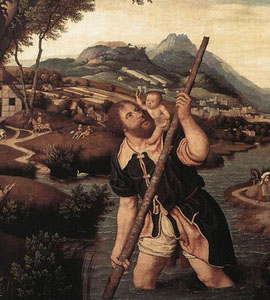
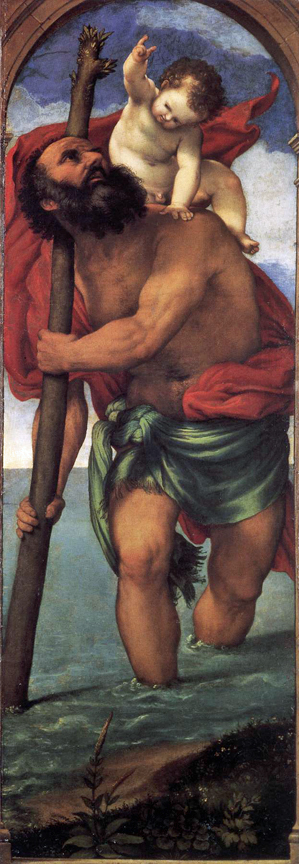
One night Columbo was called the edge of the river, which had risen considerably with the melting spring snow. He crossed to the other side to find a small child waiting by himself. He reassured the child that everything would be alright, put him on his shoulders, and started across the river. With every step that Columbo took, a great weight began to press upon him. He gasped for breath, his heart pounding. His knees began shaking as the weight grew heavier and heavier. He feared his knees would buckle under him, not for himself but for the child he carried on his shoulders. He went slowly, placing his feet firmly on the stones at the bottom of the river before taking another step. As he neared the other side, the weight became lighter until it was gone. Brother Columbo gently placed the child down and sank to the ground. Brother Justin, who had been waiting on the other side with a lantern, came running to help. 


Bewildered, both monks turned toward the child. He was almost glowing, a circle of light around his head. Brother Justin gasped, “It is the Christ-child!”  The child said to Columbo, “For what must have seemed like an eternity to you, dear Columbo, you bore the weight of the world’s sin and grief on your shoulders, that which I bear all the time, for the suffering of the world is also my suffering.” Brother Columbo asked, “Lord, why choose me? I am big and slow and can’t do anything right.” The child said, “That is not what matters most. What matters most is love and not thinking of oneself first all the time. Whenever there is suffering you reach out in love, which lightens the burden that I carry. From now on you will be known as ‘Christopher’, which means ‘the Christ-bearer’.”


The child blessed Columbo and Brother Justin, then smiling brightly he walked into the night, the light fading until he could be seen no more. When news of this miracle reached Rome, a delegation was sent to learn all the details of the story. Columbo was later declared St. Christopher, patron saint of all travelers.


Brother Columbo was a slave of righteousness, as the apostle Paul put it. He was willing to bear the burden of love for others. But sometimes it is difficult for our 21st century minds to think of ourselves as slaves. In Paul’s way of thinking we are slaves to one master or another. We think we are masters of our own destiny, that we choose what we will do, what we will say, where we will go, what we will believe. “I am the master of my fate. I am the captain of my soul.” But we are always looking for guidance of some kind. And we have also been conditioned so well by culture, parents, friends, religion, hungers, desires, education, our past, our emotions, and so many other factors that we don’t even realize that some of our choosing is a conditioned reflex, a habit, an addiction. We may think we are hungry when really what we are feeling is empty. We may think we are justified, or righteous, in our opinions or feelings or beliefs but they aren’t any more valid than the next person’s. We may think we can’t change the course of our lives when really what we fear is the unknown.


We are all slaves to something. We all submit to different lordships of different kinds. Money is a master we’d rather not talk about in church, and just by that attitude, money maintains its lordship over us. Fear of failure, that little voice in our heads that tells us we can’t do something or that we have to be perfect, is another. The church is slave to many masters, not just the one we proclaim: our history, the way we’ve always done things, our tradition, and many others. Some of these are good things, like history and tradition, but when we give them power over us, they then take pride-of-place over our primary faithfulness and obedience to Christ and this is what constitutes our slavery to sin.


The hymn “O Master, Let Me Walk with Thee” was changed to “O Savior, Let Me Walk with You” in the New Century Hymnal precisely because we have difficulty with the idea that Christ is our Lord and Master. Such masculine, heavy-handed terms rankle our sense of righteousness and equity. But this is not our sense of righteousness we’re talking about but God’s. Perhaps if Jesus had been a woman we would call her our Lady and Mistress, but regretfully these carry little weight and power. Yes, Jesus is our Savior, but we are saved from our sin when we acknowledge the mystery that Jesus, crucified and risen from the dead, is our Lord. Naming Christ as our Lord and Master is as subversive as it was 2000 years ago, as it was 150 years ago. Plantation slaves were required to call their owners by these titles but worshiped Christ as their true Lord and Master, being his slaves rather than slaves to an evil system created by human beings. 


We who are slaves to so many things, we too need the subversive power of calling Christ our Lord and Master. We who have difficulty with surrender and obedience and submission, though we do it everyday with other lordships, need to be reminded that we are slaves but for Christ, the One for whom we bear the burden of love for others. When we realize who we are and whose we are, our lives are never the same. One example that sets this so clearly is when we become parents. Before, we were a couple who could eat dinner at any hour, go away for the weekend when we chose, spend money more freely, work long hours, not have our sleep or anything else interrupted, and so on. But when that baby arrives everything changes in an instant. I remember the exact moment it hit me. It wasn’t until the middle of the night in the hospital, when David and I were asleep with our baby Andrea between us. She woke up crying, needing her diaper changed. I was awake immediately and went straight to it. It was then I realized that love requires more of us than we will ever understand, that love will continue to require even more of us as time goes on.

Hear these words by poet Ellen Bass in her poem to her daughter Sara on her 21st birthday: 


When they laid you in the crook
of my arms like a bouquet and I looked
into your eyes, dark bits of evening sky,
I thought, of course this is you,
like a person who has never seen the sea
can recognize it instantly.
They pulled you from me like a cork
and all the love flowed out. I adored you
with the squandering passion of spring
that shoots green from every pore.
You dug me out like a well. You lit
the deadwood of my heart. You pinned me
to the earth with the points of stars.
I was sure that kind of love would be
enough. I thought I was your mother.
How could I have known that over and over
you would crack the sky like lightning,
illuminating all my fears, my weaknesses, my sins.
Massive the burden this flesh
must learn to bear, like mules of love.


Thirty-five years ago there were those of you willing to take on more, willing to love more than perhaps you thought was humanly possible, by starting this church. And this happens to us in many other ways: in marriage, in friendship, in loving our parents, in our work, in our giving and serving. As Christians, though, it is Jesus who requires the most of us in all of these and much more. When we are set free from our slavery to sin we can then choose willingly, joyfully to be a mule of love, to be a slave of righteousness, to bear the burden of love for others. We become a slave to our true nature, which is love, and Christ who is the Lord of love. 


But sometimes being free from our prison of sin, with its own set of habits and routines, it can be difficult to shift to life-giving habits and routines. We can be so accustomed to a way of life, even one that is painful, that we find it difficult to change. Sometimes our master’s voice can be annoying, intruding, challenging—at times a downright pest. Like a child who asks for a cup of water for the umpteenth time, Christ calls us to put ourselves aside and to offer ourselves up to what is needed of us, even demanded of us.


How is Christ calling us, the New Ark, to be slaves of righteousness, to be mules of love? What burden of love are we being called to carry on behalf of others, others who may not be a part of this church? What might be preventing us from carrying that burden of love?


How could we have known that over and over Christ would crack the sky like lightning, illuminating all our fears, all our weaknesses, all our sins? Massive the burden this flesh must learn to bear, like mules of love. Thanks be to God, for this burden of love we bear for the sake of Christ our Lord. Amen.


Tuesday, June 24, 2014

Family, genus, species


Genesis 21: 8-21; Matthew 10: 34-39 
New Ark United Church of Christ, Newark, DE 
June 22, 2014


Hagar and Ishmael in the wilderness


I can’t begin to explain or understand the sectarian violence that is occurring in Iraq right now. I do know that conflicts between Iraqi Sunnis, Shi’ites, and Kurds have been ongoing for quite some time, and that the U.S. military presence for the last 10 years did not help to resolve any of it. Though this present conflict is not thought to be an echo of any ancient rivalries, and though Israel is not involved but certainly watching, in this conflict we can still hear the story of Isaac and Ishmael.


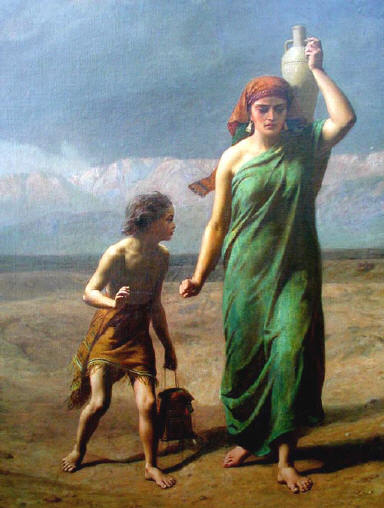
Whenever there are riches, goods, and power to be had, it seems we human beings can be sure to at least argue and likely fight for them, sometimes viciously. Let us not forget that Ishmael came into this world because of rape. Just because Sarah gave her slave to Abraham so that she might conceive a son through Hagar does not mean Hagar went willingly. Out of fear that she would not conceive, Sarah tried to force God’s hand. Then, having succeeded, and with Abraham washing his hands of it, Sarah threw Hagar out of the house, because Hagar ‘held her in contempt’—a nice way of saying “I could kill you”. But God brings Hagar back, promising to take care of her and the baby she is carrying.


A few years later, seeing her son Isaac playing with his older brother Ishmael, Sarah again is fearful. What was promised by God, a nation of descendants, and closer to home—Abraham’s legacy—would have to be shared between the two sons. A whole pie is more desirable than having to divide one, so again, Sarah throws Hagar and now also Ishmael out of the house. At least this time, Abraham is distressed about this, because of his son.


Yet God allows all of this behavior to play out. God does not try to get this disjointed family to live together. God does not condemn any of them. Rather, God deals with them separately, individually, as a parent would discipline siblings. Though this family is divided against itself, God’s care of them is not. In our eyes it would appear that God’s loves are conflicting, but with God it is all one love.


An Israeli soldier and a Palestinian man.


In the reading from Matthew’s gospel it would appear that Jesus wants his followers to divide themselves against their families. Yet from a Middle Eastern or Semitic perspective, a result was viewed as the purpose as well. The division of families was indeed a reality, a result of the Jesus movement within Judaism. The religion of the head of the household dictated the religion of the whole house: spouse, children, servants—everyone. If anyone chose to follow Jesus and to break with this tradition it caused great strife in the household. The thinking was: if families are divided then this must have been Jesus’ purpose.


Some may have thought that division was the purpose of the United Church of Christ when the delegates at the Central Atlantic Conference meeting last weekend voted to boycott the Washington Redskins and to join the Oneida nation in New York State in its “Change the Mascot” campaign. Monday of last week I received an email from a woman who was distraught, saying that she couldn’t understand why ‘your church’ would be involved in such a decision.


In my response I gave a bit of a polity lesson. I respectfully asked her that when she referred to ‘your church’, was she referring to the national denomination, to the Central Atlantic Conference, or to this local church. I informed her that though the delegates of the Conference, both lay and clergy, voted in favor of this resolution, the decision in no way dictates the position of the denomination nor of the 185 local churches in the conference. Any part of the United Church of Christ may speak to the church, not for the church. This is what it means to be in covenant.


I let her know that there are members of the New Ark United Church of Christ who are lifelong Redskins fans, as she is, and that this decision in no way dictates what they will do nor how I will preach. I also invited her to join us for church some Sunday, because how seriously do we take this: no matter who you are, or where you are on life’s journey, you are welcome here. I love our United Church of Christ but I also love our New Ark United Church of Christ and all of us individuals who claim this faith community as our own. Though there are times we must choose one side over another, there are also instances where we must allow our loves to conflict. Because in truth, love is big enough to be one love.


A few years ago I took Olivia and Andrea and my mother to a Red Sox game. This was a big deal for two reasons: one, my mother would take my brother and me to Red Sox games when we were in middle school, in the days of Fred Lynn, Jim Rice, Carlton Fisk, and Carl Yastrzemski. I wanted to share that tradition with my girls. Two, Andrea is a Red Sox fan and Olivia is a Yankees fan. Asking Olivia to go to a Red Sox game was like asking a vegetarian to eat red meat. She gave in gracefully, albeit a bit begrudgingly. In the end, she was happy because they lost, and for me it was like old times.


The next summer Olivia asked if I would take her to a Yankees game. Normally this would be like asking a Boston construction worker to watch their language. I too gave in gracefully, albeit a bit begrudgingly. But I decided that if this was going to happen, it would be a teaching moment not just for me but for a few Yankee fans as well.


I wore my Red Sox cap to a Yankees game, and to their credit, I got just a bit of guff from two fans: a catcall in the crowd as we were making our way to our seats and another as we were scootching out of our row to get some snacks. But it was the couple in front of us who finally begged the question in typical New York style: “Hey, so what’s with the hat?” I told them that though I love my Red Sox, I love my Yankees-daughter more. I allowed my loves to conflict, because in the end, my love is big enough to be one love.


We make a big deal out of the tribes and families we belong to, for it is well and good that we celebrate these ties that bind. The root word for religion is ligare, ‘to bind’, as in ligament: religion is to re-bind, to join back together that which humankind has torn asunder. But as we know, religion has been used as one of the many ways we tear each other apart. We compete with each other, kick each other out of the house, leave others behind in the wilderness, vulnerable, to fend for themselves, and as a species we are the weaker for it.


We classify biological forms into hierarchies and ranks, and yet to me, the most important two to remember are the beginning and the end: life and species. We human beings all desire abundant life, and we all are of the same species, and yet we are also beautifully diverse and too often violently conflicted.


In the midst of this story, God shows us how we can not only allow our loves to conflict, but how our loves can be one love. For God so loved the world that God gave the Beloved, Jesus, that whoever believes in him, whoever picks up their own cross and follows, shall not perish but have life eternal, shall not lose their life but find it. All this was and is done in order that the world might be saved through the Beloved.


Thanks be to God. Amen.
 

Thursday, June 12, 2014

Justin Case: A Fingers-Crossed-Behind-His-Back, Well-Meaning Christian (10)


Justin wore a red tie for Pentecost Sunday.

His pastor asked him if he would tell the history of their church in worship, and he said "yes".

He even put a few dollars in the collection plate for that new church start offering.

But he can't help waiting to see which way the wind will blow.


Tuesday, June 10, 2014

Seized!


Acts 2: 1 – 8, 11b – 21 
New Ark United Church of Christ, Newark, DE
June 8, 2014 – Pentecost Sunday


Pentecost Dance by Glenda Dietrich


Though I’ve had multiple courses in French and Italian, I can only speak a little of each and understand about as much. The only Spanish I have is from mission trips to Mexico when I played the card game Uno with orphans who were fluent in their second language, Spanish, their first language indigenous to their native people.


So when, as a young seminarian, I visited my friend Heike in Germany, with no German to speak of, literally, it was rather like wearing earplugs, as though I was submerged in a pool of water and everyone else was on the patio.


It was during Holy Week and the Easter holiday, when all of Heike’s brothers and sisters were home. Having a guest in the house meant even more special foods and family outings. After Easter dinner, I was treated to a museum that was once the ancestral home of a local prince. We had toured one part of the house and were waiting in a courtyard for the second half of the tour. Heike, her younger sister Simone, and I were looking at a guide of the museum and speaking English to one another.


We were so engrossed in our conversation that we did not hear Heike and Simone’s father trying to get their attention…in German. Imagine in your mind’s eye a tall, balding German man, about 250 lbs., whose first name is Helmut and his last name is Pitz; who has not spoken one word of English since I arrived, who seldom speaks even when his whole family is gathered for a holiday. Before we were aware of it, he had walked over to our little threesome. He ducked his head in between Heike and Simone and said with a thick German accent and the driest wit I have ever heard, “You understand me when I speak German, yah?” Heike and Simone’s mother was laughing so hard, her face was beet red, tears streaming down her face.


Have you ever been so absorbed, so in the grip of something, that your attention was fully focused, to the exclusion of all else?  Worship is to be such a time, when we are invited out of time and space and our lives and into the kingdom of God; that for a temporary moment, heaven and earth meet.  I know that when I am reading a good book or creating art it seems as though all time has stopped and I am completely in the moment.


Years ago I was on a silent retreat in Gloucester, MA. Our retreat leader, a Jesuit priest, informed us that if we were grooving with God, if we were in the Spirit, to by all means stay with it, to not interrupt a sacred encounter with the Divine only to attend one of his talks. Later that afternoon I found myself in such an experience. I was down by the water, on the edge of a 12 ft. drop while the tide came in, huge explosions of waves crashing against the small cliff. As the water erupted into fountains of saltwater spray, I whooped and hollered and thundered my joy into the air. Before I knew it, two hours had passed.


If someone asked you when was the last time you had been in the grip of something, to the point that you had no choice but to surrender, would you be thinking of a positive or a negative experience? When we hear the words ‘in the grip of’ and ‘surrender’ and ‘seized’, they tend conjure images of being powerless, of having no control, perhaps under the power of an addiction, overcome with emotions like fear, anger, or grief.


But aren’t we in the grip of, seized, surrendered when we fall in love? Or on a roller coaster or a water slide? Whitewater rafting, skiing, or sledding? Making music or a rock concert? When Andrea wanted to go to her first rock concert, she chose a three-part concert of Night Ranger, Foreigner, and Journey. So of course there were plenty of folks there who were my age and older. Five or six rows in front of us was a man with more hair on the sides of his head, all of it gray, and a shaggy beard. During the entire concert he stood, both arms in the air, waving back and forth. He was in the grip of the music, seized by the lyrics and the driving beat and good memories, leaving him no choice but to surrender to all of it.


Is this a rock concert or Pentecostal worship?


Pentecost was such a moment for the disciples. It’s why Pentecostals are called Pentecostals. Pentecost was the day in the life of church where the disciples experienced direct contact with God through the baptism of the Holy Spirit. Pentecost was the festival when Jews celebrated the giving of the law to Moses from God. Now the law would be written not on tablets but on human hearts, God’s law of love lived out in human lives and in community. God would no longer dwell solely in a temple but in relationship with humankind and all of creation.


It was a transcendent event, unpredictable, mesmerizing, when all those gathered were in the grip of the Holy Spirit, seized by a power greater than themselves, and they surrendered to it. It required a letting go of ego and the remembering of an old promise as told by the prophet Joel.


Are there promises of God that we cling to, that we would surrender to if we found ourselves in the grip of them? Does God still have the power to astonish us, in big and in small ways that we may overlook or discount? Our brains have become accustomed to special effects and constant technological upgrades that we have come to not only expect them but to be even more wowed the next time, and find ourselves in the grip of frustration when they fail us. Technology has become a prominent means by which we human beings transcend our circumstances. There are times that technology takes on the role of a god, a god who is at once both rational and logical, and fleeting and capricious, and its temple is the Internet.


If heaven is to meet earth, which is what temple meant to those Jewish disciples, is not the first place we would witness this miracle is in our own lives and in our life together? Our culture sells us on the false promise that to transcend, to be seized is to experience a high, to get high, feel a rush, to be drunk with power or drink, to buy more and more, faster is better, busy is the best, and to get it all on camera, to post it on the Internet.  Usually this is harmless.  We try to keep our balance.  Sometimes though we get seized.


Remember when the YouTube video series “I’m Schmacked” came to the university campus last fall. It was a perfect storm of opportunity, mob mentality, and the desire to be seized, in the grip of something larger, more powerful than oneself, and surrender to it.  I can understand the yearning, the hunger of events like these.  Most of us live ordinary lives, extraordinary ordinary lives, and yet there are those of us who yearn for something more, to live this one wild, precious life and live it large. If this is the only life we’ll live, we want our years to mean something, make a mark, leave an imprint.


But fame is fleeting. Today’s viral video is replaced by countless more. New lasts only a few minutes. Yet this temple, the one we live in and the one we worship with, this community, is where heaven and earth meet, and this is the promise Jesus leaves us. We are not left orphaned, we are not alone, nor will our lives ever be the same again, for our lives and our life together are temples of the Holy Spirit, the indwelling presence of God. Lord Jesus Christ, take our hands and work with them. Take our lips and speak through them. Take our minds and think with them. Take our hearts and set them on fire with love for you and for all your people, for your name’s sake.


How does that grab you?


Amen.


OnBeing with Krista Tippett:  May 29 broadcast of interview with Ellen Langer and the science of mindlessness and mindfulness