Isaiah 58: 1-12; Matthew 6: 1-6, 16-21
******** United Church of Christ
March 1, 2006 – Ash Wednesday
Fasting is a spiritual discipline that is lost on most people today. The only time we fast these days is when we have to have some kind of medical test for our blood sugar or cholesterol or something more invasive. After the test or procedure is completed we may be ravenous but we are hardly starving for nutrition. When my kids are hungry and declare that they are starving, I remind them that they know nothing about “starving”; only being hungry. Then we talk about where people are starving and what we can do, if not to help directly, then how to be responsible with what we have.
The season of Lent is a season of fasting. The period of forty days, not counting Sundays, mirrors the forty days that Jesus spent fasting in the desert, with Satan challenging him in a tempting battle of wits. Jesus emerges triumphant, though perhaps not unscathed, as angels minister to him afterward. He is now ready to begin his ministry with a well-disciplined spirit.
The phrase “spiritual discipline” is another concept, like fasting, that leaves a bad taste in our mouths. I prefer “spiritual practice”. I go to a yoga class three times during a good week, once a week at the very least. It’s called a yoga practice because our bodies are different every day, allowing us to do as much as is possible on any given day. We do our best in our practice and come back the next time and practice yoga again. We never actually get it right; the important thing is showing up, giving it what you have, and being thankful for being able to do what we can.
I read an article recently that referred to motherhood as a spiritual practice, which instantly lifted my spirit and deepened my thought at the same time. Though the government and social structure may not acknowledge all that mothers give to society, it does not matter; motherhood is a spiritual practice of not only raising caring, loving young men and women but also using our passion to create a better society. And if motherhood, then why not all of life as a spiritual practice? What if everything we did, our work, our families, the choices we make each day, we did as a spiritual practice? I think this is the true purpose of Lent: to realize our lives, all of it, as a spiritual practice, an offering to God and to God’s world.
In Lent it’s not that we have to give up something or take on something, but that we get to do this spiritual practice. We get to unburden ourselves from whatever monkey (or King Kong!) we’ve been carrying on our backs. We get to do something for others that can make a real difference in someone’s life. We get to turn away from the noise of our lives and turn toward God and God’s desires for us. In wondering what to do for Lent, there is the question to ask: what is God’s desire for us these forty days?
Choosing our own sacrifice or devotion for Lent really does seem a little too undemanding. The other night on NPR a Catholic priest, Father James Martin, told the story of how his Jewish friend from college named Rob, calls each year on Ash Wednesday to tell him what he must do for Lent. In college Jim Martin’s Jewish friends were fascinated with his Catholicism. He would teach them about genuflecting, the confessional and how to put the kneeler back without creating a commotion. One evening at a local pub the subject of Lent came up. His friends said that self-imposed sacrifice was too easy; how about if they chose his penance?
And so the deliberation began. After a heated discussion it was resolved that beer was an impossible choice. So the decision was that Jim would give up orange soda, which he consumed in copious amounts when studying on those long nights. Since then his friend Rob has made some interesting choices. Some years it has been certain spices. One year Rob made him give up oregano, which seemed pretty harmless at first until Jim realized he wouldn’t be eating pizza for the next six weeks. Jim feels that having someone else choose for him keeps him honest. Because it is not within his control, it feels more spiritual than automatic. The things beyond our control are the most difficult to deal with; they are a cross that ultimately needs to be accepted. As a priest said to Jim when he was dealing with a difficult illness, it wouldn’t be much of a cross if you wanted it.
Whatever we choose to do this Lent or someone else chooses for us, it is not intended that we accept this fast, this cross with the sound of “ugh” on our breath, slumped shoulders, and a broken spirit. This is the other part of the fast, that we do it quietly, privately, without show, as though it were a little secret between us and God. And this is where the smile comes in. We smile because it is between us and God; because we get to do, give up, take on, and conspire with the Almighty, as subversives for God’s kingdom of righteousness; we smile because we get to practice being like Jesus, which what being a Christian is all about. Being like Jesus means the cross but it also means resurrection, and there is not one without the other. Thanks be to God. Amen.

Wednesday, March 01, 2006


Tuesday, February 28, 2006
Parable of the Talented
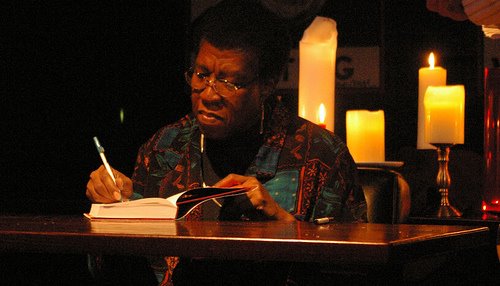
What do you do when your favorite author dies an untimely death?
Science fiction author Octavia Butler dies at the age of 58
You read all of her books again, which is what I'm going to do.
Fledgling (2005)
Lilith's Brood (2000)
Parable of the Talents (1998)
Bloodchild and Other Stories (1995)
Parable of the Sower (1993)
Imago (1989)
Adulthood Rites (1988)
Dawn (1987)
Clay's Ark (1984)
Wild Seed (1980)
Kindred (1979)
Survivor (1978)
Mind of My Mind (1977)
Patternmaster (1976)
This woman was a genius, even though she would deny it. I got hooked when I read Parable of the Sower. I dare you to read one of her books without wanting to read any of the rest.
You don't start out writing good stuff. You start out writing crap and thinking it's good stuff, and then gradually you get better at it. That's why I say one of the most valuable traits is persistence. It's just so easy to give up!
— Octavia Butler, 2000
Monday, February 27, 2006
A Time to Teach
Weekly sermons are not only an opportunity to witness to faith, to empower worshipers, or to challenge assumptions and long-cherished opinions; it is mostly a time to teach, especially about the Bible, a mysterious book if ever there was one. Many folks who come to church do not know many of the stories therein or the traditions that surround them. The following sermon is an effort toward that end.
Revealed
2 Kings 2: 1-12; Psalm 50: 1-6; Mark 9: 2-9
******** United Church of Christ
February 26, 2006 (Transfiguration Sunday)
Elijah was one of the greatest, if not the greatest, prophets in Israel. A prophet was someone who was chosen to read the signs of the times of his people and then proclaim to the king and to the people what would happen in their relationship with God if events continued to unfold, what could happen if they changed course; the kind of preaching that happens when one has a Bible in one hand and a newspaper in the other, as William Sloan Coffin puts it. Elijah was prophet to the people and to the kings of the northern kingdom of Israel in the 9th century BCE. Because of the miracles he performed and the miraculous events that followed him, his fame grew beyond legend to the point of being regarded as the one who would usher in the Day of the Lord, the end of time when God and righteousness would reign.
Now we join his story at its end, after he has walked the length and breadth of Israel, when he is to be taken up into the heavens. He is with his disciple and chosen successor, Elisha. Both know somehow that Elijah’s time has come, but neither of them will speak of it. Even so, their emotion is palpable; even though it is not stated outright we can glean a sense of how close their master/student relationship has been. Elijah gives Elisha (and perhaps himself) a way out this painful goodbye three times; three times Elisha vows to stay with Elijah as long as he lives. It is a scene reminiscent of Ruth and Naomi, when Ruth promises to go with Naomi to a foreign land to be her daughter.
When they finally reach the Jordan River and cross over, imagery we now use for passing from this life into the next, Elijah grants Elisha a final gift of their friendship. By his answer we can hear what he is not asking for: “I’ve learned everything I can from you about being a prophet, a leader, how to turn the people toward the Lord, except how to be a prophet without you. I can’t beg you or the Lord that you should stay. I’ll ask for the next best thing.” Elisha asks for a double-share of his spirit. A son would normally receive a share, a third of the father’s possessions as an inheritance; to double that might put the rest of the family in jeopardy. It is a hard thing for Elijah to grant for it is not up to him to decide; God will make the decision if Elisha is to receive this.
As they go, a chariot of fire and horses of fire separate the two of them and Elijah is caught up in a whirlwind on the hot breath of God. Elisha calls out to his beloved master “Father! Father! The chariots of Israel and its horsemen!” When he could no longer see him, Elisha performs an act of mourning and tears his clothing in two. Having seen his master taken into heaven, we now know that Elijah’s spirit is with Elisha. In the next verse he picks up the mantle that was Elijah’s and carries it, wears it as his own.
I wore my father’s robe when I was ordained about 14 ½ years ago. I’m wearing it today. But he was not the example of prophetic ministry to me in the way that Elijah was to Elisha. My father was an alcoholic and was asked to leave his position as a minister of Christian Education. He was not very happy as a minister because he was not a happy person. When I told him that I was thinking about going into the ministry, he said why would I want to do that to myself. I think he went into the ministry as a way of healing the pain in his life. Within a year of leaving ordained ministry he quit drinking and began a crisis counseling center in the church where we had begun worshiping, the church I would eventually be ordained in. But his body had already taken enough abuse from drinking and smoking and buried sorrow that the counseling work took its toll and he left ministry altogether. He died of a heart attack when I was nineteen.
To say the least, my mother was concerned when I told her of my plans to attend seminary, not to mention the same seminary my father attended. She was afraid that I was trying to live out my father’s life, to redeem it somehow by following in his flawed footsteps. Later she came to see that indeed I was happy in the ministry and enjoying my vocation.
What I did not realize until I was older is that I did receive a portion of my father’s spirit. In reading reports that he wrote while in his intern year I saw that he was passionate about the kingdom of God and justice for all people. So am I. He questioned authority. So do I. He was a person of deep feeling to the point of wearing his heart on his sleeve sometimes when it came to caring for others. So do I. Though he was not an ideal example, I still learned from him, both about myself and about what kind of minister I wanted to be.
All of us, leaders, parents, teachers included, are formed in the crucible of our experience. We learn not only in the light, but in the dark as well. God is revealed not only in the bright light of the transfiguration, a mere glimpse of the resurrection, but also in the darkness of the cross.
In the gospel lesson we see that Peter is beside himself, terrified at the sight of Jesus and the sound of God’s voice. Like Elisha, he seems to know what is being asked of him by being allowed to witness such an event. With Elijah and Moses present, it is a sign that the Messianic Age is at hand, that the end times are near. When the moment is over, they are alone with Jesus again, signaling that it is Jesus who is the harbinger of the Day of the Lord, that Jesus is the new Elijah, the new Moses of God’s people.
But then Jesus tells them not to say anything until the Son of Man has risen from the dead. There is an even greater glory to come but at the cost of the cross. God’s greatest love is revealed not only through healing but also through pain; not only through life but also through death.
It is easy for us to associate light as a gift of God, as well as love, healing, peace, and life. It is much more difficult for us to see darkness and pain and death as gifts or as having anything to do with God. We love to learn from good examples but shun or ignore the bad or painful example. Yet God is still with us in the darkness, in pain and in death, and none of these can separate us from God’s love. God’s love is still at work, revealing to us how far God will go to keep us close.
One of the most well-known and most-beloved sayings of Jesus is said by him at night, in the darkness, when he reveals who he is to Nicodemus the Pharisee when he says “For God so loved the world that he gave his only Son, so that everyone who believes in him may not perish but may have eternal life. Indeed, God did not send the Son into the world to condemn the world, but in order that the world might be saved through him.” It is not only through Jesus’ life and teachings that we learn the depth of his love but much more so through his death on the cross.
The Church came into being because Mary Magdalene and other Easter morning witnesses, the disciples, the apostle Paul, and many others were captured by the story of the events of Holy Week; of how one man sent by God, preaching justice and the forgiveness of sins, was arrested, tortured, crucified, was buried and rose on the third day to live again. Their imaginations were so enraptured that they were willing to suffer pain to remain a part of this salvation story and to share it with others.
Reinhold Niebuhr, one of the great Protestant theologians of the 20th century, said that it is not easy to resist the offer of a gospel of success, an invitation to “a kingdom without judgment through a Christ without a cross.” In the movie “The Last Temptation of Christ”, Jesus has a vision while being crucified of climbing down off the cross to settle down with Mary Magdalene, to have a family, live out his days, and die an old man. But in the end he realizes that the cross is inevitable, that it cannot be escaped. The only way to escape darkness is to take part in the light, to love, but there is no love without pain in this world. And the only remedy for love is to love even more.
The life of the Church is where love and pain, where darkness and light meet, in the shadows. We are called to go to those who live in the shadows. U2’s lead singer Bono put it this way: “God is in the slums, in the cardboard boxes where the poor play house. God is in the silence of a mother who has infected her child with a virus that will end both their lives. God is in the cries heard under the rubble of war. God is in the debris of wasted opportunity and lives. And God is with us, if we are with them.”
The bright light of the transfiguration reveals the darkness of the cross, creating a long shadow that extends through all life, showing us the depth of God’s love and the path for God’s people. What are moments of insight, when you as a church both saw God’s glory and heard God still speaking to you, calling you to the path of discipleship? What are the shadows, the challenges that face you as a congregation as you strive to be the church in the world? What are the gifts, both painful and healing, that have helped you be the church you are now? How has God been revealed to you in Epiphany, this season of light? What are you going to do this Lent to keep God’s presence so very real in your every day life?
Let’s keep our eyes and ears and hearts open these forty days of Lent. When we see and feel pain, let us look also for the healing that Christ gives. When the darkness creeps in, may we turn and find the light of God’s glory poking through a crack. When we hear of war and rumors of war, let us also witness to peace and justice and hope. When we reflect on our past, as a church and as individuals, may we have grace enough to learn from painful lessons as well as from times of joy. Let us be on the lookout, that when God is revealed in this wide wonderful, crazy world, we will be there as witness, that we too may become a revelation of God’s love in Jesus Christ. Amen.
******** United Church of Christ
February 26, 2006 (Transfiguration Sunday)
Elijah was one of the greatest, if not the greatest, prophets in Israel. A prophet was someone who was chosen to read the signs of the times of his people and then proclaim to the king and to the people what would happen in their relationship with God if events continued to unfold, what could happen if they changed course; the kind of preaching that happens when one has a Bible in one hand and a newspaper in the other, as William Sloan Coffin puts it. Elijah was prophet to the people and to the kings of the northern kingdom of Israel in the 9th century BCE. Because of the miracles he performed and the miraculous events that followed him, his fame grew beyond legend to the point of being regarded as the one who would usher in the Day of the Lord, the end of time when God and righteousness would reign.
Now we join his story at its end, after he has walked the length and breadth of Israel, when he is to be taken up into the heavens. He is with his disciple and chosen successor, Elisha. Both know somehow that Elijah’s time has come, but neither of them will speak of it. Even so, their emotion is palpable; even though it is not stated outright we can glean a sense of how close their master/student relationship has been. Elijah gives Elisha (and perhaps himself) a way out this painful goodbye three times; three times Elisha vows to stay with Elijah as long as he lives. It is a scene reminiscent of Ruth and Naomi, when Ruth promises to go with Naomi to a foreign land to be her daughter.
When they finally reach the Jordan River and cross over, imagery we now use for passing from this life into the next, Elijah grants Elisha a final gift of their friendship. By his answer we can hear what he is not asking for: “I’ve learned everything I can from you about being a prophet, a leader, how to turn the people toward the Lord, except how to be a prophet without you. I can’t beg you or the Lord that you should stay. I’ll ask for the next best thing.” Elisha asks for a double-share of his spirit. A son would normally receive a share, a third of the father’s possessions as an inheritance; to double that might put the rest of the family in jeopardy. It is a hard thing for Elijah to grant for it is not up to him to decide; God will make the decision if Elisha is to receive this.
As they go, a chariot of fire and horses of fire separate the two of them and Elijah is caught up in a whirlwind on the hot breath of God. Elisha calls out to his beloved master “Father! Father! The chariots of Israel and its horsemen!” When he could no longer see him, Elisha performs an act of mourning and tears his clothing in two. Having seen his master taken into heaven, we now know that Elijah’s spirit is with Elisha. In the next verse he picks up the mantle that was Elijah’s and carries it, wears it as his own.
I wore my father’s robe when I was ordained about 14 ½ years ago. I’m wearing it today. But he was not the example of prophetic ministry to me in the way that Elijah was to Elisha. My father was an alcoholic and was asked to leave his position as a minister of Christian Education. He was not very happy as a minister because he was not a happy person. When I told him that I was thinking about going into the ministry, he said why would I want to do that to myself. I think he went into the ministry as a way of healing the pain in his life. Within a year of leaving ordained ministry he quit drinking and began a crisis counseling center in the church where we had begun worshiping, the church I would eventually be ordained in. But his body had already taken enough abuse from drinking and smoking and buried sorrow that the counseling work took its toll and he left ministry altogether. He died of a heart attack when I was nineteen.
To say the least, my mother was concerned when I told her of my plans to attend seminary, not to mention the same seminary my father attended. She was afraid that I was trying to live out my father’s life, to redeem it somehow by following in his flawed footsteps. Later she came to see that indeed I was happy in the ministry and enjoying my vocation.
What I did not realize until I was older is that I did receive a portion of my father’s spirit. In reading reports that he wrote while in his intern year I saw that he was passionate about the kingdom of God and justice for all people. So am I. He questioned authority. So do I. He was a person of deep feeling to the point of wearing his heart on his sleeve sometimes when it came to caring for others. So do I. Though he was not an ideal example, I still learned from him, both about myself and about what kind of minister I wanted to be.
All of us, leaders, parents, teachers included, are formed in the crucible of our experience. We learn not only in the light, but in the dark as well. God is revealed not only in the bright light of the transfiguration, a mere glimpse of the resurrection, but also in the darkness of the cross.
In the gospel lesson we see that Peter is beside himself, terrified at the sight of Jesus and the sound of God’s voice. Like Elisha, he seems to know what is being asked of him by being allowed to witness such an event. With Elijah and Moses present, it is a sign that the Messianic Age is at hand, that the end times are near. When the moment is over, they are alone with Jesus again, signaling that it is Jesus who is the harbinger of the Day of the Lord, that Jesus is the new Elijah, the new Moses of God’s people.
But then Jesus tells them not to say anything until the Son of Man has risen from the dead. There is an even greater glory to come but at the cost of the cross. God’s greatest love is revealed not only through healing but also through pain; not only through life but also through death.
It is easy for us to associate light as a gift of God, as well as love, healing, peace, and life. It is much more difficult for us to see darkness and pain and death as gifts or as having anything to do with God. We love to learn from good examples but shun or ignore the bad or painful example. Yet God is still with us in the darkness, in pain and in death, and none of these can separate us from God’s love. God’s love is still at work, revealing to us how far God will go to keep us close.
One of the most well-known and most-beloved sayings of Jesus is said by him at night, in the darkness, when he reveals who he is to Nicodemus the Pharisee when he says “For God so loved the world that he gave his only Son, so that everyone who believes in him may not perish but may have eternal life. Indeed, God did not send the Son into the world to condemn the world, but in order that the world might be saved through him.” It is not only through Jesus’ life and teachings that we learn the depth of his love but much more so through his death on the cross.
The Church came into being because Mary Magdalene and other Easter morning witnesses, the disciples, the apostle Paul, and many others were captured by the story of the events of Holy Week; of how one man sent by God, preaching justice and the forgiveness of sins, was arrested, tortured, crucified, was buried and rose on the third day to live again. Their imaginations were so enraptured that they were willing to suffer pain to remain a part of this salvation story and to share it with others.
Reinhold Niebuhr, one of the great Protestant theologians of the 20th century, said that it is not easy to resist the offer of a gospel of success, an invitation to “a kingdom without judgment through a Christ without a cross.” In the movie “The Last Temptation of Christ”, Jesus has a vision while being crucified of climbing down off the cross to settle down with Mary Magdalene, to have a family, live out his days, and die an old man. But in the end he realizes that the cross is inevitable, that it cannot be escaped. The only way to escape darkness is to take part in the light, to love, but there is no love without pain in this world. And the only remedy for love is to love even more.
The life of the Church is where love and pain, where darkness and light meet, in the shadows. We are called to go to those who live in the shadows. U2’s lead singer Bono put it this way: “God is in the slums, in the cardboard boxes where the poor play house. God is in the silence of a mother who has infected her child with a virus that will end both their lives. God is in the cries heard under the rubble of war. God is in the debris of wasted opportunity and lives. And God is with us, if we are with them.”
The bright light of the transfiguration reveals the darkness of the cross, creating a long shadow that extends through all life, showing us the depth of God’s love and the path for God’s people. What are moments of insight, when you as a church both saw God’s glory and heard God still speaking to you, calling you to the path of discipleship? What are the shadows, the challenges that face you as a congregation as you strive to be the church in the world? What are the gifts, both painful and healing, that have helped you be the church you are now? How has God been revealed to you in Epiphany, this season of light? What are you going to do this Lent to keep God’s presence so very real in your every day life?
Let’s keep our eyes and ears and hearts open these forty days of Lent. When we see and feel pain, let us look also for the healing that Christ gives. When the darkness creeps in, may we turn and find the light of God’s glory poking through a crack. When we hear of war and rumors of war, let us also witness to peace and justice and hope. When we reflect on our past, as a church and as individuals, may we have grace enough to learn from painful lessons as well as from times of joy. Let us be on the lookout, that when God is revealed in this wide wonderful, crazy world, we will be there as witness, that we too may become a revelation of God’s love in Jesus Christ. Amen.
Monday, February 20, 2006
Sermons, She Wrote
This week I wrote two sermons but preached only one. This particular Sunday all ages were in church, so it was supposed to be a briefer service and a shorter sermon, one that everyone could relate to. The first sermon, "Immediately", uses some material from a sermon I wrote three years ago (the lectionary readings are on a 3-year cycle). But I didn't think it was one for all ages. So I wrote "Fuhgeddaboutit!" which is about saying sorry, forgiving others, and being forgiven, something the whole world could use a dose of.
Immediately
Isaiah 43: 18-25; Ps. 41; Mark 2: 1-12
******** United Church of Christ
February 19, 2006
We live in a culture of impatience. We want whatever it is that we want, and we want it right now. Having to wait is a waste of time for us. So we invented cell phones, Palm pilots, hand-held video games, DVD players in cars, and any number of items to insure that we are not wasting our time by waiting. In Carrie Fisher’s book Postcards from the Edge, about Hollywood life, the since-famous mother says to her troubled daughter in a drug rehab that she’s too impatient, that her fuse is too short, that’s she’s only interested in instant gratification. The daughter glibly responds, “Instant gratification takes too long.” That’s our culture in a nutshell. Immediately, or even “I want it yesterday”.
Immediately: we think that’s a word that can’t be quantified. “Immediately” means “without interval of time”. That’s a human definition of the word from a dictionary. I think God has a different way of viewing “immediately”.
Take for instance the speed of light. The speed of light is 671 million miles per hour or 300,000 kilometers per second. A light year, the distance light travels in a year, is about 6 trillion miles or 9.5 trillion kilometers. Light, coming from quasars, can travel as far as 12-15 billion light years to reach us here on earth. It takes 12-15 billion years for the light of a quasar to reach Earth. We also have a measurement of interstellar space called a parsec. A parsec is 3.26 light years or 19.2 trillion miles. Then we also have a kiloparsec, which is 1,000 times as far as a parsec. Or a megaparsec, which is a million times as far as a parsec. Whoever said science has nothing to say about God? Even the speed of light, which seems immediate, is not instantaneous. It takes time for light to get from one place to another. Even with God, it takes time to do what God will do.
In Mark’s gospel, the word “immediately” is used more often than in any other gospel or book of the Bible. It shows up 17 times in Mark, with Luke a close second at 13. Let us remember, though: the author of Luke, when writing his gospel, had a copy of Mark in his hand. The use of “immediately” is found in many of the healing stories in Mark. And Mark is also not only the shortest gospel, but also the most expedient in terms of Jesus’ ministry. Mark starts immediately with John’s preaching and Jesus’ baptism and moves on from there. There truly is an immediacy to Jesus’ ministry in the gospel of Mark. What can I say—he’s on a mission from God. Other gospels use birth stories, genealogy, and even a theological spin on the creation in the gospel of John to instruct us, the readers, about the authority of Jesus. For Mark, the authority of Jesus rests in his baptism and his ministry—simple as that.
“Immediately” has more to do with Jesus’ authority than it does with our expectations. Don’t we all wish we could find that job immediately, be healed from a chronic illness immediately, get out of debt immediately, immediately find that faith that sustains in bad times as well as good ones, that all this war and violence and terrorism would just resolve itself immediately. But the “immediately” in this story comes about as a result of what Jesus does, not the expectations of the paralyzed man and his friends.
Or does it? Perhaps not their expectations, but certainly their actions have something to do with this healing happening “immediately”. Certainly the man would not have been healed at that moment in time if it had not been for his friends who carried him to Jesus when his own two legs could not. Certainly if it had not been for his fast-thinking friends, the man would not have been lowered down through a hole in the roof by the pressing crowd. Certainly if it had not been for the faith of his friends who believed that if not Jesus could do something for this man but at least in their friendship with the man, we are left wondering what faith would this man have on his own.
God’s “immediately” happens in God’s time, but also in the community of faith, wherever that may be found. The authority of Jesus to do as God wills is to act in the community of faith, to free it from its paralysis and its sin so that it might proclaim the good news to the world, the good news that we are God’s children, that there is no place we can go where God is not. And the community of faith has to be a willing partner in all of this, to carry each other, depend on each other, trust each other, that maybe a hole in the roof isn’t such a bad thing after all! Or a hole in the way we do things. Or a hole in that armor we sometimes wear over our hearts and our faith. It’s through that messy hole that Jesus is found, seemingly waiting for us, ready to act and to show mercy.
Now don’t confuse me with the message I’m giving. I’m as impatient as they come. I tell my girls that waiting and waiting well makes their patience muscles strong. If they’re being impatient, it means those muscles are getting flabby and they need a workout. I say all this stuff because I need to hear it myself. Then one day I came across this prayer in The Christian Century written by Walter Brueggemann, a Hebrew scripture scholar at Columbia Theological Seminary in Decatur, Georgia. There was one section that stood out and glared at me.
“We pray to you this day, for ourselves and others like us who are genuinely good people, who meditate on your Torah day and night, who are propelled by and for your best causes, who are on the right side of every issue, who wear ourselves out in obedience to you, and sometimes wear others out with our good intentions. Be among us ultimate enough to make our passions penultimate, valid but less than crucial.”
In the end, we can do all that we can for justice, for peace, for love, for our church, but it is up to God when that will happen. We can’t force God’s hand. And no matter what side of an issue we’re on, we can’t force others to our way of thinking. We must wait and wait patiently with each other. What is ultimately crucial in the community of faith is that we learn to love each other despite our differences and then bring that same accepting love out into the world. If it is one thing that is paralyzed in this world of ours, it is the power of love—to heal, to forgive, to lay down whatever weapons we are carrying and simply open our hands.
We all know from experience that hindsight is 20/20. When we look back, we can see how God was acting in our lives. Yet when we were living through it, it was difficult to perceive it. God spoke through the prophet Isaiah, saying, “I am about to do a new thing; now it springs forth, do you not perceive it?” Sometimes we can be so mired in our paralysis that we do not see the friends of God who bear us up, or notice even ourselves as the scenery changes from day to day.
Change is the way of God. Perhaps things look like they are staying the same because they’re moving so slowly. God moves in the seasons, in the tides, in the phases of the moon, in the resurrection of Jesus, so we have faith; our lives, our world, our faith, our church will change, too. In the mean time, we are to be friends of Christ, friends of one another, friends of the friendless, friends even with our enemies, that when change happens seemingly in the blink of an eye, the kindness and love we have shared will make that change all the more wonderful and blessed and miraculous. May it be so. Amen.
******** United Church of Christ
February 19, 2006
We live in a culture of impatience. We want whatever it is that we want, and we want it right now. Having to wait is a waste of time for us. So we invented cell phones, Palm pilots, hand-held video games, DVD players in cars, and any number of items to insure that we are not wasting our time by waiting. In Carrie Fisher’s book Postcards from the Edge, about Hollywood life, the since-famous mother says to her troubled daughter in a drug rehab that she’s too impatient, that her fuse is too short, that’s she’s only interested in instant gratification. The daughter glibly responds, “Instant gratification takes too long.” That’s our culture in a nutshell. Immediately, or even “I want it yesterday”.
Immediately: we think that’s a word that can’t be quantified. “Immediately” means “without interval of time”. That’s a human definition of the word from a dictionary. I think God has a different way of viewing “immediately”.
Take for instance the speed of light. The speed of light is 671 million miles per hour or 300,000 kilometers per second. A light year, the distance light travels in a year, is about 6 trillion miles or 9.5 trillion kilometers. Light, coming from quasars, can travel as far as 12-15 billion light years to reach us here on earth. It takes 12-15 billion years for the light of a quasar to reach Earth. We also have a measurement of interstellar space called a parsec. A parsec is 3.26 light years or 19.2 trillion miles. Then we also have a kiloparsec, which is 1,000 times as far as a parsec. Or a megaparsec, which is a million times as far as a parsec. Whoever said science has nothing to say about God? Even the speed of light, which seems immediate, is not instantaneous. It takes time for light to get from one place to another. Even with God, it takes time to do what God will do.
In Mark’s gospel, the word “immediately” is used more often than in any other gospel or book of the Bible. It shows up 17 times in Mark, with Luke a close second at 13. Let us remember, though: the author of Luke, when writing his gospel, had a copy of Mark in his hand. The use of “immediately” is found in many of the healing stories in Mark. And Mark is also not only the shortest gospel, but also the most expedient in terms of Jesus’ ministry. Mark starts immediately with John’s preaching and Jesus’ baptism and moves on from there. There truly is an immediacy to Jesus’ ministry in the gospel of Mark. What can I say—he’s on a mission from God. Other gospels use birth stories, genealogy, and even a theological spin on the creation in the gospel of John to instruct us, the readers, about the authority of Jesus. For Mark, the authority of Jesus rests in his baptism and his ministry—simple as that.
“Immediately” has more to do with Jesus’ authority than it does with our expectations. Don’t we all wish we could find that job immediately, be healed from a chronic illness immediately, get out of debt immediately, immediately find that faith that sustains in bad times as well as good ones, that all this war and violence and terrorism would just resolve itself immediately. But the “immediately” in this story comes about as a result of what Jesus does, not the expectations of the paralyzed man and his friends.
Or does it? Perhaps not their expectations, but certainly their actions have something to do with this healing happening “immediately”. Certainly the man would not have been healed at that moment in time if it had not been for his friends who carried him to Jesus when his own two legs could not. Certainly if it had not been for his fast-thinking friends, the man would not have been lowered down through a hole in the roof by the pressing crowd. Certainly if it had not been for the faith of his friends who believed that if not Jesus could do something for this man but at least in their friendship with the man, we are left wondering what faith would this man have on his own.
God’s “immediately” happens in God’s time, but also in the community of faith, wherever that may be found. The authority of Jesus to do as God wills is to act in the community of faith, to free it from its paralysis and its sin so that it might proclaim the good news to the world, the good news that we are God’s children, that there is no place we can go where God is not. And the community of faith has to be a willing partner in all of this, to carry each other, depend on each other, trust each other, that maybe a hole in the roof isn’t such a bad thing after all! Or a hole in the way we do things. Or a hole in that armor we sometimes wear over our hearts and our faith. It’s through that messy hole that Jesus is found, seemingly waiting for us, ready to act and to show mercy.
Now don’t confuse me with the message I’m giving. I’m as impatient as they come. I tell my girls that waiting and waiting well makes their patience muscles strong. If they’re being impatient, it means those muscles are getting flabby and they need a workout. I say all this stuff because I need to hear it myself. Then one day I came across this prayer in The Christian Century written by Walter Brueggemann, a Hebrew scripture scholar at Columbia Theological Seminary in Decatur, Georgia. There was one section that stood out and glared at me.
“We pray to you this day, for ourselves and others like us who are genuinely good people, who meditate on your Torah day and night, who are propelled by and for your best causes, who are on the right side of every issue, who wear ourselves out in obedience to you, and sometimes wear others out with our good intentions. Be among us ultimate enough to make our passions penultimate, valid but less than crucial.”
In the end, we can do all that we can for justice, for peace, for love, for our church, but it is up to God when that will happen. We can’t force God’s hand. And no matter what side of an issue we’re on, we can’t force others to our way of thinking. We must wait and wait patiently with each other. What is ultimately crucial in the community of faith is that we learn to love each other despite our differences and then bring that same accepting love out into the world. If it is one thing that is paralyzed in this world of ours, it is the power of love—to heal, to forgive, to lay down whatever weapons we are carrying and simply open our hands.
We all know from experience that hindsight is 20/20. When we look back, we can see how God was acting in our lives. Yet when we were living through it, it was difficult to perceive it. God spoke through the prophet Isaiah, saying, “I am about to do a new thing; now it springs forth, do you not perceive it?” Sometimes we can be so mired in our paralysis that we do not see the friends of God who bear us up, or notice even ourselves as the scenery changes from day to day.
Change is the way of God. Perhaps things look like they are staying the same because they’re moving so slowly. God moves in the seasons, in the tides, in the phases of the moon, in the resurrection of Jesus, so we have faith; our lives, our world, our faith, our church will change, too. In the mean time, we are to be friends of Christ, friends of one another, friends of the friendless, friends even with our enemies, that when change happens seemingly in the blink of an eye, the kindness and love we have shared will make that change all the more wonderful and blessed and miraculous. May it be so. Amen.
Fuhgeddaboutit!
Isaiah 43: 18-25; Ps. 41; Mark 2: 1-12
******** United Church of Christ
February 19, 2006
You don’t have to raise hands but how many of us need to say we’re sorry to someone? How many of us are waiting for someone to say to us that they’re sorry? How many of us are waiting for someone to forgive us? And how many of us need to forgive someone?
Which is easier to say: I’m sorry or you’re forgiven? I don’t know about you but I find it easier to say “you’re forgiven” than to hear it. It’s more comfortable for me to hear “I’m sorry” than it is for me to say it. In the play “A Thousand Clowns”, one of the characters, Murray, stands on a street corner in New York City, saying “I’m sorry” to everyone who passes by. Just about everyone responds by forgiving him: “It’s okay, buddy. It’s alright. I forgive you. Fuhgeddaboutit.”
Imagine, though, if he was offering forgiveness to all those New Yorkers: “I forgive you. You’re forgiven. I forgive you.” He probably would have gotten some hard glares, some snarls, if not a threat to his person. We’re all in need of some forgiveness but it’s not easy to hear when we haven’t even considered apologizing for something we’re not sure we did wrong.
Saying we’re sorry and forgiving someone are a way of bringing our lives back into balance. We are in debt to someone we’ve hurt or we are holding onto a debt that we feel is owed us when someone hurts us and we are no longer on equal footing with each other. I’m alright when God forgives me because I know God understands. Have you ever had someone forgive you and it seemed like they were doing you a favor rather than offering you understanding and mercy? Or had someone apologize with an edge in their voice instead of a touch of humility? When we have difficulty hearing forgiveness or saying we’re sorry, it’s almost as if we think we’re on the losing side of a battle, that we’d rather be right than happy.
In the book of Isaiah the prophet tells the people that their sins are a burden to God, that our injustice to one another wears God out. Have you ever heard your parents say (or you who are parents, have you ever said…) “You are wearing me out!” especially when you were testing their patience and misbehaving? God also gets weary when we remember all the bad things someone did to us and hold it against them or when we have hurt someone else and have not apologized nor sought out their forgiveness. Yet the prophet says to the people that God will not remember their sins, that God is going to do a new thing and will make a way where there is no way. Instead of bearing the burden of guilt that has kept us down, we now can bear the burden of responsibility for making things right which ultimately sets us free. God will make it possible for us to find the forgiveness we have been looking for; God will make real the ability to forgive someone who has hurt us and to remember their sin no more. God does not want any of us to hurt. God wants all of us to live and to love with joy.
Needing forgiveness, holding onto a grudge, being reluctant to say we’re sorry can cause us suffering. It hurts when we feel separate from someone we love. And we can feel stuck too. We can’t seem to get into a good mood or really enjoy something or serve God faithfully until we say we’re sorry, forgive someone, let go of that grudge. It’s almost like we’re paralyzed, like that man in the gospel story. Sometimes we need the gentle nudging of some friends to bear us up so we can get to that place where we can let Jesus touch us and release us from being stuck in our hurt and guilty feelings.
And the beauty of it is we don’t have to say a word when it comes to getting God’s help but we do have to show up and allow ourselves to be put in God’s care. In the gospel story it is the faith of his friends that catches Jesus’ attention. Ten to one we all have someone praying for us, praying that we can let go and forgive, say we’re sorry, so that we can make room for joy and get on with our lives.
We’re not in this alone. We have our families and our friends who stick with us and love us when we feel unlovable. We have this community of faithful people who love us despite our ability to get stuck sometimes. And this church is not alone. This church has brothers and sisters that we can lean on in those times when we are in need of healing. And the relationships go both ways. We’re here to bear each other up, to bear with each other, to practice what it means to be loving and forgiving so we can take that gift out into the world that is crying out for love and mercy.
Most of all, we have the companionship of Jesus the Christ, who heals us, forgives us, releases us and gives us the strength to move on with our lives. So, fuhgeddaboutit! Amen.
******** United Church of Christ
February 19, 2006
You don’t have to raise hands but how many of us need to say we’re sorry to someone? How many of us are waiting for someone to say to us that they’re sorry? How many of us are waiting for someone to forgive us? And how many of us need to forgive someone?
Which is easier to say: I’m sorry or you’re forgiven? I don’t know about you but I find it easier to say “you’re forgiven” than to hear it. It’s more comfortable for me to hear “I’m sorry” than it is for me to say it. In the play “A Thousand Clowns”, one of the characters, Murray, stands on a street corner in New York City, saying “I’m sorry” to everyone who passes by. Just about everyone responds by forgiving him: “It’s okay, buddy. It’s alright. I forgive you. Fuhgeddaboutit.”
Imagine, though, if he was offering forgiveness to all those New Yorkers: “I forgive you. You’re forgiven. I forgive you.” He probably would have gotten some hard glares, some snarls, if not a threat to his person. We’re all in need of some forgiveness but it’s not easy to hear when we haven’t even considered apologizing for something we’re not sure we did wrong.
Saying we’re sorry and forgiving someone are a way of bringing our lives back into balance. We are in debt to someone we’ve hurt or we are holding onto a debt that we feel is owed us when someone hurts us and we are no longer on equal footing with each other. I’m alright when God forgives me because I know God understands. Have you ever had someone forgive you and it seemed like they were doing you a favor rather than offering you understanding and mercy? Or had someone apologize with an edge in their voice instead of a touch of humility? When we have difficulty hearing forgiveness or saying we’re sorry, it’s almost as if we think we’re on the losing side of a battle, that we’d rather be right than happy.
In the book of Isaiah the prophet tells the people that their sins are a burden to God, that our injustice to one another wears God out. Have you ever heard your parents say (or you who are parents, have you ever said…) “You are wearing me out!” especially when you were testing their patience and misbehaving? God also gets weary when we remember all the bad things someone did to us and hold it against them or when we have hurt someone else and have not apologized nor sought out their forgiveness. Yet the prophet says to the people that God will not remember their sins, that God is going to do a new thing and will make a way where there is no way. Instead of bearing the burden of guilt that has kept us down, we now can bear the burden of responsibility for making things right which ultimately sets us free. God will make it possible for us to find the forgiveness we have been looking for; God will make real the ability to forgive someone who has hurt us and to remember their sin no more. God does not want any of us to hurt. God wants all of us to live and to love with joy.
Needing forgiveness, holding onto a grudge, being reluctant to say we’re sorry can cause us suffering. It hurts when we feel separate from someone we love. And we can feel stuck too. We can’t seem to get into a good mood or really enjoy something or serve God faithfully until we say we’re sorry, forgive someone, let go of that grudge. It’s almost like we’re paralyzed, like that man in the gospel story. Sometimes we need the gentle nudging of some friends to bear us up so we can get to that place where we can let Jesus touch us and release us from being stuck in our hurt and guilty feelings.
And the beauty of it is we don’t have to say a word when it comes to getting God’s help but we do have to show up and allow ourselves to be put in God’s care. In the gospel story it is the faith of his friends that catches Jesus’ attention. Ten to one we all have someone praying for us, praying that we can let go and forgive, say we’re sorry, so that we can make room for joy and get on with our lives.
We’re not in this alone. We have our families and our friends who stick with us and love us when we feel unlovable. We have this community of faithful people who love us despite our ability to get stuck sometimes. And this church is not alone. This church has brothers and sisters that we can lean on in those times when we are in need of healing. And the relationships go both ways. We’re here to bear each other up, to bear with each other, to practice what it means to be loving and forgiving so we can take that gift out into the world that is crying out for love and mercy.
Most of all, we have the companionship of Jesus the Christ, who heals us, forgives us, releases us and gives us the strength to move on with our lives. So, fuhgeddaboutit! Amen.
Monday, February 13, 2006
Due to a blizzard...
There was no church yesterday, that is, the worshiping community wisely stayed home and communed with God each in their own way.
Which means no one heard this sermon but I hope persons will go online and read it. I had considered not finishing it since I figured I'd be staying home anyway. But just because we wouldn't be together does not mean that the Word need not be proclaimed. God and the Good News do not take days off. I may not have preached but the work of God goes on. So here it is in all its undelivered glory.
Which means no one heard this sermon but I hope persons will go online and read it. I had considered not finishing it since I figured I'd be staying home anyway. But just because we wouldn't be together does not mean that the Word need not be proclaimed. God and the Good News do not take days off. I may not have preached but the work of God goes on. So here it is in all its undelivered glory.
Inside Out, Outside In
2 Kings 5: 1-15b; Ps. 30; Mark 1: 40-45
******** United Church of Christ
February 12, 2006
I would venture to say that most, if not all, of us have been excluded at least one time in our lives. We were judged by our appearance or by the clothes we were wearing. We said something that was misunderstood or hurt someone. We couldn’t control our feelings of grief, anger, or sadness. It was the color of our skin or a language we didn’t speak. It was our attraction to the same gender, persons of both genders, our transgendered or intersexed nature, our confusion about our identity. It was our weight. It was depression or bi-polar disorder or those two weeks we spent in detox, the years we spent in and out of therapy. It was the wheelchair, the crutches, the cane, the walker, the missing limb. It was a speech impediment. It was difficulty with hearing or sight. It was our age. It was an illness or disease. It was our religion. It was whether we had money or an education or a job; it was where we lived, where we grew up, what family or background we came from. Whatever it was, we were judged on the surface, only skin deep, without someone getting to know us inside and out.
It is difficult for human beings not to judge in some way. It is our ego that sorts and categorizes all of the information that our brain gathers: it’s a cold day, this room is warm, she’s wearing a heavy sweater, he’s tall for his age. We then take that information and attach some kind meaning or an association to it in some way so that when we come across the same or similar piece of information we will recognize it and it won’t have to be sorted in the same intricate way.
Imagine going through your day and not associating anything with the color blue. You’d look up at the sky and say to yourself, “It’s blue”, and then go onto the next thing, without thinking about whether it’s azure or cerulean, how bright the sun is, a lighter feeling inside, days on the beach or on a mountain, the poem you read that described a blue sky as though it was ironed, and on and on. Everyone associates something with something else—for good or for ill. Most of the time we learn these associations from others and from our own experiences; these responses are often conditioned.
In the movie “Trading Places”, Eddie Murphy plays a con artist street bum who gets “adopted” by two filthy rich brothers who have a bet as to whether they can recondition this reprobate into a gentleman while turning their cultured, equally snooty associate, played by Dan Ackroyd, into a gun-toting, poverty stricken criminal. What’s truly rich about the movie is that the two victims of this plot overcome their assumptions about each other and work together to bring down the scheming brothers.
For its day that movie poked fun at our assumptions, exaggerated them a bit to show us how real they are, and in the end we had a good laugh, if a bit raunchy. But nowadays those assumptions and crash judgments are getting our world into trouble. Listen to this contemporary analogy of the reading from 2 Kings:
“Saddam was an Iraqi military general, praised by all as a valiant warrior and a great man. In fact, the God of Israel and our God had granted victory to Iraq through Saddam.” This is how the story of Naaman begins. Imagine how it would end given this contemporary interpretation. Naaman is given a second chance in that he is restored to health, his skin like that of a young boy; like a baby’s bottom, I was thinking. I looked up the word “clean” as it is used in this story; it means to be unadulterated, pure and bright, physically sound, as though one were restored to a state of innocence, as though the past had been erased.
In Jeremiah God promises to make a new covenant with the house of Israel and the house of Judah, even though they broke the old one, even though they didn’t deserve it. God promises to forgive their iniquity and to remember their sin no more.
We give the past such power and permanence. Our ego is never so active as when it is sorting over the past and keeping it very much alive in the present. One of my nasty habits is rehashing those times when I have said the wrong thing or thought I said the wrong thing or wishing I had said that witty or cutting remark or hadn’t said it or when someone hurt my feelings or excluded me or accused me. Lately I have been trying to stop when I catch myself doing this and ask God to heal me, to help me to remember the lessons but to forget the sins of my past, and those who trespassed against me, as God is so willing to do.
Letting go of past hurts, past wrongs is a lot like letting God change a light bulb that doesn’t work anymore.
How many Episcopalians does it take to change a light bulb? What? Change the light bulb? My grandmother donated that light bulb.
How many times does it take for a pastor to change a light bulb? We don't know, everyone fell asleep while she was giving a sermon on it.
How many United Church of Christ members does it take to change a light bulb? How dare you be so intolerant! So what if the light bulb has an alternative light style?
How many Assembly of God church members does it take to change a light bulb? Just one, he already has his hands in the air.
How many Pentecostals does it take to change a light bulb? 1 and 99 to cast out the spirit of darkness!!
How many TV evangelists does it take to change a light bulb? One, but for the message of light to continue, send in your donation today.
How many Worshiping Musicians does it take to change a light bulb? One, but soon all those around can warm up in its glowing.
Why did I just tell all those jokes? Laughter reminds us of the joy of being in this community, the joy we feel by having been touched by Jesus. Laughter has the power of healing, to mend and bind together a community, to renew our minds and our spirits and turn our mood inside out, to make the past a thing of the past. We are no longer outcasts, strangers, loners excluded from the inner circle. We who were on the outside have been welcomed in. Jesus has reached out with pity and compassion, in other ancient authorities, with anger at our exclusion, chosen us and touched us with healing power and restored us to life and to community.
You see, the people of Jesus’ time expected that where the messiah is, there is no misery. Jesus gave them and us a more meaningful expectation, that where there is misery, there is the messiah; and where there is the messiah there is healing and joy that cannot be contained. Only God was believed to heal at will. When Jesus chooses to heal, he reveals that compassion is the root of God’s power and that God’s power is with him and is in every place where there is anger at the human condition, every place that pity and compassion move across boundaries that exclude.
Jesus redefined what it meant to be pure; not ritually or religiously pure or morally or socially pure or physically pure but pure in heart: to be loving, extravagantly and unconditionally so. He took the purity laws and turned them inside out. They were created to put the community and its members right with God and to set the Jews morally and spiritually apart from those who worshiped other gods. Instead these purity laws were abused and were used to exclude persons from the community of faith because they were considered unclean and impure. When Jesus healed the man of his skin disease he released him from a past of exclusion, unemployment, beggary, and poverty. He restored him to his family, his faith community, and to life itself.
So, ******** United Church of Christ, what in your past that is holding you back do you need to be released from? How has Jesus restored you to life? When has this congregation been moved to extravagant love? Who are the outcasts, strangers, and loners that need your healing touch? Who are the insiders, the popular powerful folk, outsiders in a place like this, who also need your extravagant love and gentle nudging? To what misery can you give witness to the healing power of Jesus?
It is important to remember that with anyone, we don’t know the whole story. Sometimes all we can see is what a person or group or nation presents to us on the surface. It is up to us to choose to go beyond whatever boundaries or obstacles and reach out with love, the extravagant love of Jesus that reached out to us when we were outside the gate. We have been turned inside out, pure and bright and new each day, that we might reach others who are outside and invite them into this joy that cannot be contained. Thanks be to God.
******** United Church of Christ
February 12, 2006
I would venture to say that most, if not all, of us have been excluded at least one time in our lives. We were judged by our appearance or by the clothes we were wearing. We said something that was misunderstood or hurt someone. We couldn’t control our feelings of grief, anger, or sadness. It was the color of our skin or a language we didn’t speak. It was our attraction to the same gender, persons of both genders, our transgendered or intersexed nature, our confusion about our identity. It was our weight. It was depression or bi-polar disorder or those two weeks we spent in detox, the years we spent in and out of therapy. It was the wheelchair, the crutches, the cane, the walker, the missing limb. It was a speech impediment. It was difficulty with hearing or sight. It was our age. It was an illness or disease. It was our religion. It was whether we had money or an education or a job; it was where we lived, where we grew up, what family or background we came from. Whatever it was, we were judged on the surface, only skin deep, without someone getting to know us inside and out.
It is difficult for human beings not to judge in some way. It is our ego that sorts and categorizes all of the information that our brain gathers: it’s a cold day, this room is warm, she’s wearing a heavy sweater, he’s tall for his age. We then take that information and attach some kind meaning or an association to it in some way so that when we come across the same or similar piece of information we will recognize it and it won’t have to be sorted in the same intricate way.
Imagine going through your day and not associating anything with the color blue. You’d look up at the sky and say to yourself, “It’s blue”, and then go onto the next thing, without thinking about whether it’s azure or cerulean, how bright the sun is, a lighter feeling inside, days on the beach or on a mountain, the poem you read that described a blue sky as though it was ironed, and on and on. Everyone associates something with something else—for good or for ill. Most of the time we learn these associations from others and from our own experiences; these responses are often conditioned.
In the movie “Trading Places”, Eddie Murphy plays a con artist street bum who gets “adopted” by two filthy rich brothers who have a bet as to whether they can recondition this reprobate into a gentleman while turning their cultured, equally snooty associate, played by Dan Ackroyd, into a gun-toting, poverty stricken criminal. What’s truly rich about the movie is that the two victims of this plot overcome their assumptions about each other and work together to bring down the scheming brothers.
For its day that movie poked fun at our assumptions, exaggerated them a bit to show us how real they are, and in the end we had a good laugh, if a bit raunchy. But nowadays those assumptions and crash judgments are getting our world into trouble. Listen to this contemporary analogy of the reading from 2 Kings:
“Saddam was an Iraqi military general, praised by all as a valiant warrior and a great man. In fact, the God of Israel and our God had granted victory to Iraq through Saddam.” This is how the story of Naaman begins. Imagine how it would end given this contemporary interpretation. Naaman is given a second chance in that he is restored to health, his skin like that of a young boy; like a baby’s bottom, I was thinking. I looked up the word “clean” as it is used in this story; it means to be unadulterated, pure and bright, physically sound, as though one were restored to a state of innocence, as though the past had been erased.
In Jeremiah God promises to make a new covenant with the house of Israel and the house of Judah, even though they broke the old one, even though they didn’t deserve it. God promises to forgive their iniquity and to remember their sin no more.
We give the past such power and permanence. Our ego is never so active as when it is sorting over the past and keeping it very much alive in the present. One of my nasty habits is rehashing those times when I have said the wrong thing or thought I said the wrong thing or wishing I had said that witty or cutting remark or hadn’t said it or when someone hurt my feelings or excluded me or accused me. Lately I have been trying to stop when I catch myself doing this and ask God to heal me, to help me to remember the lessons but to forget the sins of my past, and those who trespassed against me, as God is so willing to do.
Letting go of past hurts, past wrongs is a lot like letting God change a light bulb that doesn’t work anymore.
How many Episcopalians does it take to change a light bulb? What? Change the light bulb? My grandmother donated that light bulb.
How many times does it take for a pastor to change a light bulb? We don't know, everyone fell asleep while she was giving a sermon on it.
How many United Church of Christ members does it take to change a light bulb? How dare you be so intolerant! So what if the light bulb has an alternative light style?
How many Assembly of God church members does it take to change a light bulb? Just one, he already has his hands in the air.
How many Pentecostals does it take to change a light bulb? 1 and 99 to cast out the spirit of darkness!!
How many TV evangelists does it take to change a light bulb? One, but for the message of light to continue, send in your donation today.
How many Worshiping Musicians does it take to change a light bulb? One, but soon all those around can warm up in its glowing.
Why did I just tell all those jokes? Laughter reminds us of the joy of being in this community, the joy we feel by having been touched by Jesus. Laughter has the power of healing, to mend and bind together a community, to renew our minds and our spirits and turn our mood inside out, to make the past a thing of the past. We are no longer outcasts, strangers, loners excluded from the inner circle. We who were on the outside have been welcomed in. Jesus has reached out with pity and compassion, in other ancient authorities, with anger at our exclusion, chosen us and touched us with healing power and restored us to life and to community.
You see, the people of Jesus’ time expected that where the messiah is, there is no misery. Jesus gave them and us a more meaningful expectation, that where there is misery, there is the messiah; and where there is the messiah there is healing and joy that cannot be contained. Only God was believed to heal at will. When Jesus chooses to heal, he reveals that compassion is the root of God’s power and that God’s power is with him and is in every place where there is anger at the human condition, every place that pity and compassion move across boundaries that exclude.
Jesus redefined what it meant to be pure; not ritually or religiously pure or morally or socially pure or physically pure but pure in heart: to be loving, extravagantly and unconditionally so. He took the purity laws and turned them inside out. They were created to put the community and its members right with God and to set the Jews morally and spiritually apart from those who worshiped other gods. Instead these purity laws were abused and were used to exclude persons from the community of faith because they were considered unclean and impure. When Jesus healed the man of his skin disease he released him from a past of exclusion, unemployment, beggary, and poverty. He restored him to his family, his faith community, and to life itself.
So, ******** United Church of Christ, what in your past that is holding you back do you need to be released from? How has Jesus restored you to life? When has this congregation been moved to extravagant love? Who are the outcasts, strangers, and loners that need your healing touch? Who are the insiders, the popular powerful folk, outsiders in a place like this, who also need your extravagant love and gentle nudging? To what misery can you give witness to the healing power of Jesus?
It is important to remember that with anyone, we don’t know the whole story. Sometimes all we can see is what a person or group or nation presents to us on the surface. It is up to us to choose to go beyond whatever boundaries or obstacles and reach out with love, the extravagant love of Jesus that reached out to us when we were outside the gate. We have been turned inside out, pure and bright and new each day, that we might reach others who are outside and invite them into this joy that cannot be contained. Thanks be to God.
Sunday, February 05, 2006
Fat?! Phat is more like it!
I am 5'3", 137 lbs. (size 10) and recently declared healthy by my primary care physician. Friday morning I was listening to a story on NPR about how French women are now on the average 5'3" and 138 lbs. I thought, "Wonderful! Now one of the most fashionable countries has some real women for whom they can design real fashion!" Instantly I felt more affectionate toward my belly and hips and trés française.
Imagine my shock and horror when I looked up the story on the website and found this title:
French Women Can Get Fat, It Turns Out
I have since written an e-mail to Morning Edition and am awaiting Thursday morning when they read letters from listeners. Woe to the writer if he be male...and pity if she be female.
Imagine my shock and horror when I looked up the story on the website and found this title:
French Women Can Get Fat, It Turns Out
I have since written an e-mail to Morning Edition and am awaiting Thursday morning when they read letters from listeners. Woe to the writer if he be male...and pity if she be female.
Gospel Liberty
Isaiah 40: 21-31; I Corinthians 9: 16-23
******** United Church of Christ
February 5, 2006
One of the things I love to do best is to go to the movies and watch movies at home. I love stories that invite me to be a part of them, that weave the characters’ lives into my imagination and have it all affect me in a profound way, whether the movie be drama or comedy or fantasy.
One of my favorite black and white films is “Sullivan’s Travels”, starring Joel McCrea and Veronica Lake. It’s about a Hollywood film director who thinks his comedy work is a waste of time. In his quest to make a serious, tragic, truth-telling film about the plight of the impoverished, the film “O Brother, Where Art Thou”, he decides he has to live such a life in order to tell it on screen. But it’s just an act, with a studio RV trailing him the whole way, and a comfortable life just waiting for him when he’s done. It’s not until he goes out a second time, is robbed, assaulted, and his identification stolen that he learns what it means to be at the bottom and how brutal life can be. He winds up in prison. On a particularly dark day, when he is despairing whether he will ever get his life back, he and his prison comrades are guests of a black congregation in their church and shown a comedy movie. He realizes, only by inhabiting this cruel life, that it is indeed laughter that lifts one out of the murky depths and restores one’s hopes.
In his first letter to the church in Corinth, Paul is inviting these new Christians into the story of Christ in such a way as to become a part of it. While their imaginations have been captured by Jesus’ life, his death and resurrection so much so as to be baptized, now it is time for these newly minted Christians to move into the world to persuade others to come to Christ. Paul is engaging the Corinthians by using himself as an example. Paul has not only listened to the message of Christ, that of love, mercy, and justice but has also put himself in the life of those he is trying to reach, as Christ put himself in the life of humanity, in the life of those who needed him most.
Many people have heard this message and taken it to heart. Mahatma Gandhi, when he returned to India after being educated in England and practicing law in South Africa, wore the simple homespun clothing of his fellow Indians. When he saw that most of India was poor and depended on the mercy of the British government, he decided that he must live as one of them but also show them how to support themselves, how to make their own cloth, how to be independent of the British, that one day they would not take their freedom by force but would earn it.
I think Paul and Gandhi would have been great friends. Gandhi said, “You must become the change you wish to see in the world.” This is the meaning of “To the weak I became weak, so that I might win the weak. I have become all things to all people, that I might by all means save some.” Paul is not saying that the Church should be so accommodating and versatile that the Church be all things to all people but that we need to place limits on our human freedom, to relinquish our inalienable rights to reach those who are alienated, who need Christ’s gospel of truth, mercy, love and justice. Paul is urging the Church to take its relationship with Christ and make relationships with all people and not just some.
In our culture it is expected more often than not that we be educated, employed and secure so as to advance ourselves rather than to bring justice and mercy to others. Even when we as a society do help others there is usually something in it for us and our position in society has not wavered. As a society we have not risked anything nor stepped out in faith. The church in Corinth may have had similar concerns; Corinth was a prosperous city and shipping port, famous for its pottery and bronze work, with cosmopolitan, knowledgeable citizens. Paul is instructing the Corinthians in what it means to have a congregational lifestyle and not just an individual one. In other words, for the Church and its members to become weak is to adopt a cruciform way of living, that is, to live the way of the cross.
A hog farmer decided one morning to attend a church in town. He went into town in his work clothes smelling remarkably like his hog pen. The church folks were outraged at the smell. The pastor said to the farmer: "The next time you come here, ask the Lord what you should wear." The farmer agreed. The following Sunday the farmer returned to the same church ...in his work clothes. The pastor asked: "What did the Lord say?" The farmer replied, "The Lord said he had never been to this church and didn't know what to wear."
How do you welcome home one who has been in exile? You who are Open and Affirming, what stranger or guest would test your skills of hospitality? Relationships are never easy, including those we make at church. At church we’re expected to act a certain way because, after all, this is church. This is the place where we have to take you in. Henri Nouwen said that community is “that place where the person you least want to live with always lives.” The way of the cross limits us in that we give up our human freedom for gospel freedom: freedom to love with abandon, to forgive, to help others with no thought to ourselves. We are called to sacrifice our way for God’s way. Usually it’s the way we see things.
Isaiah calls upon his listeners, the exiles who have been living in captivity in Babylon, to lift up their eyes on high and see; see what God sees, as God sees it. We worry about what we can see right in front of us; God’s concerns are all that is. God calls each one by name; not one is missing. God stretches out the heavens like a curtain and spreads them like a tent to live in. For a desert people this is good news. How has this church, this tent to live in as community, been good news for you? How can it become good news for those who are not here yet?
Someone once said if we seek healing, we must become healers. If we are searching for love, we must become love. If we want to be helped, we must help others. We must become good news to one another and to our community. If we are looking for new life, we must come alive as Jesus is alive.
It’s a tall order for those of us who feel as though we do not need to become weak because we already feel weak. But we who band together in the name of Christ are strong because of God’s strength. We do not live only in our individual bodies; we live in the Body of Christ. We who are also exiles on our way home to God are told to wait upon the Lord. We who feel powerless are asked to commit ourselves to God in hopeful expectation of God’s power. Everything does not hinge on our efforts alone. Each day, for some, each hour, we must decide to trust God, to have faith, that the One who calls us to this “gospel liberty” is also the God who created the heavens and the earth, who is never weary, whose strength goes to the helpless and gives them the power to fly.
I want to close with a poem written by Carol Wimmer in 1988, entitled “When I say…I am a Christian”. First, hear these words about the poem by the poet herself, followed by the poem.
“My heart was heavy as I wrote the poem. I had begun to sense an increasing societal resentment toward the attitude of self-righteousness that has been adopted by so many Christians. I knew such behavior was and is a perversion of Christianity. Thus, the sentiment of the poem was born out of my personal awareness of this perversion and the heartache it can cause in our pluralistic society. I jotted down my thoughts with an inner determination to define the Christian spirit as I wished to experience it. …Four years later, I sent the poem to 5 different publishers. As a result of its first publication in 1992, someone placed the poem on the Internet where it miraculously began taking on a life of its own. From Manila to South Africa; Australia to Singapore; Finland to Bahrain—I’ve received e-mails from people all over the world who express a common desire to walk humbly with God. Therefore, I owe a sincere “Thank You” to the unknown person who originally posted the poem on the Internet and the countless number of readers who have subsequently passed this simple expression on to others.”
When I say..."I am a Christian"
I'm not shouting "I am saved"
I'm whispering "I get lost!"
"That is why I chose this way.
"When I say..."I am a Christian"
don't speak of this with pride.
I'm confessing that I stumble
and need someone to be my guide.
When I say..."I am a Christian"
I'm not trying to be strong.
I'm professing that I'm weak
and pray for strength to carry on.
When I say..."I am a Christian"
I'm not bragging of success.
I'm admitting I have failed
and cannot ever pay the debt.
When I say..."I am a Christian"
I'm not claiming to be perfect,
my flaws are too visible
but God believes I'm worth it.
When I say..."I am a Christian"
I still feel the sting of pain
I have my share of heartaches
which is why I seek His name.
When I say..."I am a Christian"
I do not wish to judge.
I have no authority.
I only know I'm loved.
by Carol Wimmer © 1988
Our citizenship in the kingdom of God is nothing to boast about; it is a gift that we are to share humbly and freely with others. Thanks be to God, for this limiting Christian life that ultimately sets us free: to be empowered and to give power, to love and be loved, to serve and be served, to forgive and to be forgiven, to heal and to be healed and be made whole. Amen.
******** United Church of Christ
February 5, 2006
One of the things I love to do best is to go to the movies and watch movies at home. I love stories that invite me to be a part of them, that weave the characters’ lives into my imagination and have it all affect me in a profound way, whether the movie be drama or comedy or fantasy.
One of my favorite black and white films is “Sullivan’s Travels”, starring Joel McCrea and Veronica Lake. It’s about a Hollywood film director who thinks his comedy work is a waste of time. In his quest to make a serious, tragic, truth-telling film about the plight of the impoverished, the film “O Brother, Where Art Thou”, he decides he has to live such a life in order to tell it on screen. But it’s just an act, with a studio RV trailing him the whole way, and a comfortable life just waiting for him when he’s done. It’s not until he goes out a second time, is robbed, assaulted, and his identification stolen that he learns what it means to be at the bottom and how brutal life can be. He winds up in prison. On a particularly dark day, when he is despairing whether he will ever get his life back, he and his prison comrades are guests of a black congregation in their church and shown a comedy movie. He realizes, only by inhabiting this cruel life, that it is indeed laughter that lifts one out of the murky depths and restores one’s hopes.
In his first letter to the church in Corinth, Paul is inviting these new Christians into the story of Christ in such a way as to become a part of it. While their imaginations have been captured by Jesus’ life, his death and resurrection so much so as to be baptized, now it is time for these newly minted Christians to move into the world to persuade others to come to Christ. Paul is engaging the Corinthians by using himself as an example. Paul has not only listened to the message of Christ, that of love, mercy, and justice but has also put himself in the life of those he is trying to reach, as Christ put himself in the life of humanity, in the life of those who needed him most.
Many people have heard this message and taken it to heart. Mahatma Gandhi, when he returned to India after being educated in England and practicing law in South Africa, wore the simple homespun clothing of his fellow Indians. When he saw that most of India was poor and depended on the mercy of the British government, he decided that he must live as one of them but also show them how to support themselves, how to make their own cloth, how to be independent of the British, that one day they would not take their freedom by force but would earn it.
I think Paul and Gandhi would have been great friends. Gandhi said, “You must become the change you wish to see in the world.” This is the meaning of “To the weak I became weak, so that I might win the weak. I have become all things to all people, that I might by all means save some.” Paul is not saying that the Church should be so accommodating and versatile that the Church be all things to all people but that we need to place limits on our human freedom, to relinquish our inalienable rights to reach those who are alienated, who need Christ’s gospel of truth, mercy, love and justice. Paul is urging the Church to take its relationship with Christ and make relationships with all people and not just some.
In our culture it is expected more often than not that we be educated, employed and secure so as to advance ourselves rather than to bring justice and mercy to others. Even when we as a society do help others there is usually something in it for us and our position in society has not wavered. As a society we have not risked anything nor stepped out in faith. The church in Corinth may have had similar concerns; Corinth was a prosperous city and shipping port, famous for its pottery and bronze work, with cosmopolitan, knowledgeable citizens. Paul is instructing the Corinthians in what it means to have a congregational lifestyle and not just an individual one. In other words, for the Church and its members to become weak is to adopt a cruciform way of living, that is, to live the way of the cross.
A hog farmer decided one morning to attend a church in town. He went into town in his work clothes smelling remarkably like his hog pen. The church folks were outraged at the smell. The pastor said to the farmer: "The next time you come here, ask the Lord what you should wear." The farmer agreed. The following Sunday the farmer returned to the same church ...in his work clothes. The pastor asked: "What did the Lord say?" The farmer replied, "The Lord said he had never been to this church and didn't know what to wear."
How do you welcome home one who has been in exile? You who are Open and Affirming, what stranger or guest would test your skills of hospitality? Relationships are never easy, including those we make at church. At church we’re expected to act a certain way because, after all, this is church. This is the place where we have to take you in. Henri Nouwen said that community is “that place where the person you least want to live with always lives.” The way of the cross limits us in that we give up our human freedom for gospel freedom: freedom to love with abandon, to forgive, to help others with no thought to ourselves. We are called to sacrifice our way for God’s way. Usually it’s the way we see things.
Isaiah calls upon his listeners, the exiles who have been living in captivity in Babylon, to lift up their eyes on high and see; see what God sees, as God sees it. We worry about what we can see right in front of us; God’s concerns are all that is. God calls each one by name; not one is missing. God stretches out the heavens like a curtain and spreads them like a tent to live in. For a desert people this is good news. How has this church, this tent to live in as community, been good news for you? How can it become good news for those who are not here yet?
Someone once said if we seek healing, we must become healers. If we are searching for love, we must become love. If we want to be helped, we must help others. We must become good news to one another and to our community. If we are looking for new life, we must come alive as Jesus is alive.
It’s a tall order for those of us who feel as though we do not need to become weak because we already feel weak. But we who band together in the name of Christ are strong because of God’s strength. We do not live only in our individual bodies; we live in the Body of Christ. We who are also exiles on our way home to God are told to wait upon the Lord. We who feel powerless are asked to commit ourselves to God in hopeful expectation of God’s power. Everything does not hinge on our efforts alone. Each day, for some, each hour, we must decide to trust God, to have faith, that the One who calls us to this “gospel liberty” is also the God who created the heavens and the earth, who is never weary, whose strength goes to the helpless and gives them the power to fly.
I want to close with a poem written by Carol Wimmer in 1988, entitled “When I say…I am a Christian”. First, hear these words about the poem by the poet herself, followed by the poem.
“My heart was heavy as I wrote the poem. I had begun to sense an increasing societal resentment toward the attitude of self-righteousness that has been adopted by so many Christians. I knew such behavior was and is a perversion of Christianity. Thus, the sentiment of the poem was born out of my personal awareness of this perversion and the heartache it can cause in our pluralistic society. I jotted down my thoughts with an inner determination to define the Christian spirit as I wished to experience it. …Four years later, I sent the poem to 5 different publishers. As a result of its first publication in 1992, someone placed the poem on the Internet where it miraculously began taking on a life of its own. From Manila to South Africa; Australia to Singapore; Finland to Bahrain—I’ve received e-mails from people all over the world who express a common desire to walk humbly with God. Therefore, I owe a sincere “Thank You” to the unknown person who originally posted the poem on the Internet and the countless number of readers who have subsequently passed this simple expression on to others.”
When I say..."I am a Christian"
I'm not shouting "I am saved"
I'm whispering "I get lost!"
"That is why I chose this way.
"When I say..."I am a Christian"
don't speak of this with pride.
I'm confessing that I stumble
and need someone to be my guide.
When I say..."I am a Christian"
I'm not trying to be strong.
I'm professing that I'm weak
and pray for strength to carry on.
When I say..."I am a Christian"
I'm not bragging of success.
I'm admitting I have failed
and cannot ever pay the debt.
When I say..."I am a Christian"
I'm not claiming to be perfect,
my flaws are too visible
but God believes I'm worth it.
When I say..."I am a Christian"
I still feel the sting of pain
I have my share of heartaches
which is why I seek His name.
When I say..."I am a Christian"
I do not wish to judge.
I have no authority.
I only know I'm loved.
by Carol Wimmer © 1988
Our citizenship in the kingdom of God is nothing to boast about; it is a gift that we are to share humbly and freely with others. Thanks be to God, for this limiting Christian life that ultimately sets us free: to be empowered and to give power, to love and be loved, to serve and be served, to forgive and to be forgiven, to heal and to be healed and be made whole. Amen.
Tuesday, January 31, 2006
Be careful what you pray for...
The minute you take your sticky fingers off the controls....(see New Year's Day entry)
I got a job.
I'm filling in for a pastor for three months while she goes on sabbatical.
And in March I'm leading the women's retreat at my own church.
And I'm working with another pastor to organize a regional Lenten service of prayer and healing for a Sunday afternoon in April.
And I'll get to preach my very first Easter sermon.
So, because my time for writing will be signifigantly occupied with writing sermons, I'll be posting my weekly sermons here. The first one is from this past Sunday at another church for whom I was guest preaching. My regular gig begins next Sunday.
I got a job.
I'm filling in for a pastor for three months while she goes on sabbatical.
And in March I'm leading the women's retreat at my own church.
And I'm working with another pastor to organize a regional Lenten service of prayer and healing for a Sunday afternoon in April.
And I'll get to preach my very first Easter sermon.
So, because my time for writing will be signifigantly occupied with writing sermons, I'll be posting my weekly sermons here. The first one is from this past Sunday at another church for whom I was guest preaching. My regular gig begins next Sunday.
A Driveway Moment
Psalm 111; Mark 1: 21-28
***** Congregational Church
January 29, 2006
In a 2003 report from the National Survey of Children's Health approximately 4.4 million children aged 4--17 years were reported to have a history of ADHD diagnosis; of these, 2.5 million (56%) were reported to be taking medication for the disorder. 60% of those diagnosed continue to have problems well into adulthood.
In the past few years I have wondered if there is a spiritual component to this disorder that we are neglecting. In this age of multi-tasking when there are so many activities, ideas, so much information, not to mention marketing and advertising, that have the power to hold our attention and to divide it, I sometimes wonder if having an attention disorder is a way of the body and the spirit rebelling against the madness with which we have surrounded ourselves.
Some folks who have ADHD have the unique gift to be able to shut out all the extraneous clutter and focus on a task or thought process. Those of us who have tried to meditate know how important it is to be able to quiet our minds and focus on just the simple breath. When I paint with watercolors or crochet or work with beads I tend to lose track of time because I am so focused in doing something creative. Any of us who are avid readers may have alienated our families when we are “in a book”.
In our culture what would you say is the number one thing that captures and holds our attention, that is, has authority and power over us, to the exclusion of all else? (One answer was money.) In my opinion I think it is information. Every morning we can turn on the TV, the radio, the computer, open a magazine or unfold the newspaper and know what is going on across the country and all over the world. We hear of disaster, war, elections, brutality, violence, death, and the small corner reserved for good deeds, cooperation, and valor. We may have free speech in this country, but we use it so freely that it whirls willy-nilly around us and into our minds where it reverberates in an endless tumble of anxiety. And we can become bound inside; bound by our fear not so much of what has happened or what will happen but our fear of what could happen. Our spirits become unclean and bound up, from the Greek word “akathartos”, meaning the opposite of catharsis. To put it bluntly, we are full of it, we allow ourselves to become overcome by “stinking thinking” as they say in 12-step groups, and our minds need to be healed.
In the gospel of Mark the people in the synagogue hear of a new teaching, some new information, that which can give release to the unclean spirit. Listen to the unclean spirit. It says “Have you come to destroy us?” The response to the very real presence of Jesus is one of fear, destruction, and violence. Resistance.
We’re all awfully good at giving Jesus resistance. Especially when we are in group form; you know, Church. Take for example annual meetings. Fear usually raises its head at one point or another in an annual meeting. I heard one church had on its agenda a deficit budget. One member exclaimed in so many words, “You mean you expect us to pass this budget on good faith that we will find the money sometime this year?” And another member responded, “Yes. That’s what we’re all about is faith. All we have are pledge cards. We don’t have any money in hand right now. We always pass a budget on faith: faith that people won’t lose their job or get sick or move away. Every year we have to trust that people will keep their promises.”
As a community of faith we also need to trust that God will keep the promises made in the life, death, and resurrection of Jesus, that is, the promises of forgiveness, mercy, healing, rebirth, and love. When we hear news about the war in Iraq, the latest insurgent attack, about Hamas winning a majority in the Palestinian parliament, about people losing their jobs to the latest restructuring, about the high cost of health care and prescriptions, about anything that can tempt us toward despair, it can be easy for us to have our imaginations swept up by fear and dread. When our church family murmurs to itself and has difficulty imagining its future we can sometimes lose our attention from Jesus and the promises made to us.
I am an avid listener of public radio. One of the news programs, “All Things Considered”, has a phenomenon referred to as a “driveway moment”. It’s when a news feature or interview or story captures the listener in such a way that they are compelled to stay in the car in their driveway for just a few extra minutes to catch the end of the story. Jesus is giving the people in the synagogue just such a driveway moment. He is giving them new teaching, new information that is so compelling that his listeners acknowledge the authority with which he gives this new teaching, this new information. We do not hear what Jesus has said to them but we do hear only a few verses before that he proclaimed that the time is fulfilled, that God’s reign of love has come near, that those who listen and hear are to repent, to return to God and believe the good news.
This would have been quite a gripping driveway moment for the listeners of Mark. Mark is often referred to as a “wartime gospel” in that it was written during the war of revolt between Israel and the Roman occupation when the temple in Jerusalem was destroyed, around the year 70 CE. Jews who followed the Way of Jesus still thought of themselves at this time as Jews and would have seen the destruction of the temple as a sign of the end of the world.
Having witnessed yet another temple in Jerusalem destroyed would call to mind the times of exile in their past and might have led them to despair. The gospel writer of Mark, through the teaching of Jesus, is giving his listeners a message more convincing, more persuasive than that of the Roman lord Caesar’s edict of utter destruction and death. The new authority of Jesus over that of the Roman Empire, the power of God over the power of evil, that authority, that power being love, is the gospel, the truth that can heal our minds, release our unclean spirits, and center our attention on Christ. When our attention is centered on Christ, we are able to accomplish far more than we can possibly imagine.
We may have convinced ourselves that it is our weakness, our powerlessness, our darkness that makes us fearful to be the Church in the world. Marianne Williamson, in her book A Return to Love, writes:
“Our deepest fear is not that we are inadequate. Our deepest fear is that we are powerful beyond measure. It is our light, not our darkness, that most frightens us. We ask ourselves, Who am I to be brilliant, gorgeous, talented, fabulous? Actually, who are you not to be? You are a child of God. Your playing small doesn’t serve the world. There’s nothing enlightened about shrinking so that other people won’t feel insecure around you. We are all meant to shine, as children do. We were born to make manifest the glory of God that is within us. It’s not just in some of us; it’s in everyone. And as we let our own light shine, we unconsciously give other people permission to do the same. As we’re liberated from our own fear, our presence automatically liberates others.”
In the letter to the Ephesians Paul prays that his listeners may be strengthened in their inner being with power through the Spirit, that Christ may dwell in their hearts through faith, that they may have the power to comprehend and to know the love of Christ that surpasses knowledge so that they may be filled with all the fullness of God. He then praises God “who by the power at work within us is able to accomplish abundantly far more than all we can possibly ask or imagine”. God is more than able but able through the power at work within us. When our spirit is unbound, when our minds are released from fear, we can then be in the mind of Christ. We can then tap into that power that God has placed within us that the glory of God can be made manifest, be made visible, in our lives, in the Church and in the world.
Worship is our “driveway moment”. It is our time to be in community and to remember we are a community not a crowd, to confess our lack of attention on Christ and our need to be healed of our fearful thinking. Jesus comes to us as a people; his very real presence commands our attention and says to us: “Be not afraid. I am Lord.” The way of domination, of empire, war, death—these are not lord. The way of injustice, exclusion, strife, shame—these are not lord. The way of scarcity, poverty, slavery, disease—these are not lord. The way of fear is not lord. Jesus is Lord; his Way is love, mercy, forgiveness, peace, justice, and resurrection.
So, ***** Congregational Church, in what ways do you need to be healed of fearful thinking? What are you full of that you need to be emptied of? How do you see yourselves as church? Where do you witness the power of God in your life together? What aspect of the good news of Jesus Christ captures your imagination and moves you to action? How can you be a source of Christ’s authority of love and justice in a frightened world?
Worship is our catharsis, our creative moment to be out of time, to be healed of our “akathartos”, our unclean mind, to let go of all that binds us and to refocus our attention on Christ. So we surround ourselves with sights and smells, rituals and rites, the proclaiming of the good news and the praise of God, that we would remember again and again the simplest of confessions, that Jesus is Lord, not only of our lives but of our life together as a people of faith. We have been set free: to serve, to love, to be the very real presence of Christ in a fearful world. Thanks be to God. Amen.
***** Congregational Church
January 29, 2006
In a 2003 report from the National Survey of Children's Health approximately 4.4 million children aged 4--17 years were reported to have a history of ADHD diagnosis; of these, 2.5 million (56%) were reported to be taking medication for the disorder. 60% of those diagnosed continue to have problems well into adulthood.
In the past few years I have wondered if there is a spiritual component to this disorder that we are neglecting. In this age of multi-tasking when there are so many activities, ideas, so much information, not to mention marketing and advertising, that have the power to hold our attention and to divide it, I sometimes wonder if having an attention disorder is a way of the body and the spirit rebelling against the madness with which we have surrounded ourselves.
Some folks who have ADHD have the unique gift to be able to shut out all the extraneous clutter and focus on a task or thought process. Those of us who have tried to meditate know how important it is to be able to quiet our minds and focus on just the simple breath. When I paint with watercolors or crochet or work with beads I tend to lose track of time because I am so focused in doing something creative. Any of us who are avid readers may have alienated our families when we are “in a book”.
In our culture what would you say is the number one thing that captures and holds our attention, that is, has authority and power over us, to the exclusion of all else? (One answer was money.) In my opinion I think it is information. Every morning we can turn on the TV, the radio, the computer, open a magazine or unfold the newspaper and know what is going on across the country and all over the world. We hear of disaster, war, elections, brutality, violence, death, and the small corner reserved for good deeds, cooperation, and valor. We may have free speech in this country, but we use it so freely that it whirls willy-nilly around us and into our minds where it reverberates in an endless tumble of anxiety. And we can become bound inside; bound by our fear not so much of what has happened or what will happen but our fear of what could happen. Our spirits become unclean and bound up, from the Greek word “akathartos”, meaning the opposite of catharsis. To put it bluntly, we are full of it, we allow ourselves to become overcome by “stinking thinking” as they say in 12-step groups, and our minds need to be healed.
In the gospel of Mark the people in the synagogue hear of a new teaching, some new information, that which can give release to the unclean spirit. Listen to the unclean spirit. It says “Have you come to destroy us?” The response to the very real presence of Jesus is one of fear, destruction, and violence. Resistance.
We’re all awfully good at giving Jesus resistance. Especially when we are in group form; you know, Church. Take for example annual meetings. Fear usually raises its head at one point or another in an annual meeting. I heard one church had on its agenda a deficit budget. One member exclaimed in so many words, “You mean you expect us to pass this budget on good faith that we will find the money sometime this year?” And another member responded, “Yes. That’s what we’re all about is faith. All we have are pledge cards. We don’t have any money in hand right now. We always pass a budget on faith: faith that people won’t lose their job or get sick or move away. Every year we have to trust that people will keep their promises.”
As a community of faith we also need to trust that God will keep the promises made in the life, death, and resurrection of Jesus, that is, the promises of forgiveness, mercy, healing, rebirth, and love. When we hear news about the war in Iraq, the latest insurgent attack, about Hamas winning a majority in the Palestinian parliament, about people losing their jobs to the latest restructuring, about the high cost of health care and prescriptions, about anything that can tempt us toward despair, it can be easy for us to have our imaginations swept up by fear and dread. When our church family murmurs to itself and has difficulty imagining its future we can sometimes lose our attention from Jesus and the promises made to us.
I am an avid listener of public radio. One of the news programs, “All Things Considered”, has a phenomenon referred to as a “driveway moment”. It’s when a news feature or interview or story captures the listener in such a way that they are compelled to stay in the car in their driveway for just a few extra minutes to catch the end of the story. Jesus is giving the people in the synagogue just such a driveway moment. He is giving them new teaching, new information that is so compelling that his listeners acknowledge the authority with which he gives this new teaching, this new information. We do not hear what Jesus has said to them but we do hear only a few verses before that he proclaimed that the time is fulfilled, that God’s reign of love has come near, that those who listen and hear are to repent, to return to God and believe the good news.
This would have been quite a gripping driveway moment for the listeners of Mark. Mark is often referred to as a “wartime gospel” in that it was written during the war of revolt between Israel and the Roman occupation when the temple in Jerusalem was destroyed, around the year 70 CE. Jews who followed the Way of Jesus still thought of themselves at this time as Jews and would have seen the destruction of the temple as a sign of the end of the world.
Having witnessed yet another temple in Jerusalem destroyed would call to mind the times of exile in their past and might have led them to despair. The gospel writer of Mark, through the teaching of Jesus, is giving his listeners a message more convincing, more persuasive than that of the Roman lord Caesar’s edict of utter destruction and death. The new authority of Jesus over that of the Roman Empire, the power of God over the power of evil, that authority, that power being love, is the gospel, the truth that can heal our minds, release our unclean spirits, and center our attention on Christ. When our attention is centered on Christ, we are able to accomplish far more than we can possibly imagine.
We may have convinced ourselves that it is our weakness, our powerlessness, our darkness that makes us fearful to be the Church in the world. Marianne Williamson, in her book A Return to Love, writes:
“Our deepest fear is not that we are inadequate. Our deepest fear is that we are powerful beyond measure. It is our light, not our darkness, that most frightens us. We ask ourselves, Who am I to be brilliant, gorgeous, talented, fabulous? Actually, who are you not to be? You are a child of God. Your playing small doesn’t serve the world. There’s nothing enlightened about shrinking so that other people won’t feel insecure around you. We are all meant to shine, as children do. We were born to make manifest the glory of God that is within us. It’s not just in some of us; it’s in everyone. And as we let our own light shine, we unconsciously give other people permission to do the same. As we’re liberated from our own fear, our presence automatically liberates others.”
In the letter to the Ephesians Paul prays that his listeners may be strengthened in their inner being with power through the Spirit, that Christ may dwell in their hearts through faith, that they may have the power to comprehend and to know the love of Christ that surpasses knowledge so that they may be filled with all the fullness of God. He then praises God “who by the power at work within us is able to accomplish abundantly far more than all we can possibly ask or imagine”. God is more than able but able through the power at work within us. When our spirit is unbound, when our minds are released from fear, we can then be in the mind of Christ. We can then tap into that power that God has placed within us that the glory of God can be made manifest, be made visible, in our lives, in the Church and in the world.
Worship is our “driveway moment”. It is our time to be in community and to remember we are a community not a crowd, to confess our lack of attention on Christ and our need to be healed of our fearful thinking. Jesus comes to us as a people; his very real presence commands our attention and says to us: “Be not afraid. I am Lord.” The way of domination, of empire, war, death—these are not lord. The way of injustice, exclusion, strife, shame—these are not lord. The way of scarcity, poverty, slavery, disease—these are not lord. The way of fear is not lord. Jesus is Lord; his Way is love, mercy, forgiveness, peace, justice, and resurrection.
So, ***** Congregational Church, in what ways do you need to be healed of fearful thinking? What are you full of that you need to be emptied of? How do you see yourselves as church? Where do you witness the power of God in your life together? What aspect of the good news of Jesus Christ captures your imagination and moves you to action? How can you be a source of Christ’s authority of love and justice in a frightened world?
Worship is our catharsis, our creative moment to be out of time, to be healed of our “akathartos”, our unclean mind, to let go of all that binds us and to refocus our attention on Christ. So we surround ourselves with sights and smells, rituals and rites, the proclaiming of the good news and the praise of God, that we would remember again and again the simplest of confessions, that Jesus is Lord, not only of our lives but of our life together as a people of faith. We have been set free: to serve, to love, to be the very real presence of Christ in a fearful world. Thanks be to God. Amen.
Tuesday, January 24, 2006
Hoarfrost

From the car I saw
a thin line of frost on the horse fence
curling on the pale wisps of tall grasses
bending wiry thorns to its fierce whisper
I didn’t see the sun
until I was driving home
a waxing disk of white and gold
tucked in its wintry
slant southern corner
its rays wrapped in the
chill of a January fog
In about half an hour
it would all be gone
The fence gray and damp
grasses wilting under crystal tears
thorns released from their ardent genuflection
I drove slowly that morning
anxious for nothing
for once content to see
but dimly
Monday, January 09, 2006
A Patriot Act


Test your simple civics knowledge
Some answers to the questions are patently obvious. Others take some serious thought. But the intent is simple: being a patriot has more to do with knowing the polity of our government, thus what is expected of us as citizens, than it does with political fervor and from which side of the aisle a vote is cast.
Also, listen to a former Speaker of the House and his new contract with America:
Newt Gingrich's NPR commentary on needed GOP reform
And if you haven't seen the movie The Contender, with actor Joan Allen's speech about the chapel of democracy, rent the DVD.
After you've taken the short quiz above (30 questions), post your score. I got 25 out of 30 correct.
P.S. Cost of the Iraq war
Sunday, January 01, 2006
Another day to make new
 Janus: the Roman god of beginnings and endings, of gates and doorways; the first day of his month is the pivot around which we turn.
When the year 2000 approached, I reminded folks around me that this was an arbitrary date, constructed by humankind, and given meaning by the same. Each day is the beginning of a new millennium, a new year. But we hallow New Year's Day if for no other reason (and no other day) than to take stock of our lives and perhaps reorder our priorities.
Many people make a resolution: diet probably being No. 1, get another job, learn a new skill, spend more time with family and friends, take that long awaited trip. The best advice I've heard is to make it something specific: don't just lose weight but set a goal; not just get another job but network, redo the resume, spend some time thinking about what you really want to do; sign up for a class; set aside time every week for family/friends; save for the trip, get vacation time, and buy the tickets.
I once performed a wedding ceremony on December 31 because the bride and groom wanted to start the new year as husband and wife (an ancillary benefit: they could still take the tax deduction for the 364 days that they weren't married). Other people make fresh starts of their own: a journal, an exercise regimen, a new attitude, new sheets on the bed, organize the desk at work or at home, renew an old friendship, repair a broken one, clean out closets, come out of the closet, whatever little prison we've locked ourselves in. It's a time to look at the past, see what hasn't worked and try something new.
Me, I'm going to relax. I don't mean couch-potato-let-the-dust-bunnies-procreate-do-nothing relax. I mean lighten-up-take-my-sticky-fingers-off-the-controls-and-let-go relax, especially as it relates to my vocation and whether or not I'm working. I've spewed a lot of angst on-and-off for the past almost nine years and I can't continue like this.
I came across a quote that shook me out of my warm and cozy navel. It was used in a rather unusual context (the recent Coach Carter movie) in that it's from Marianne Williamson but it works nonetheless:
"Our deepest fear is not that we are inadequate. Our deepest fear is that we are powerful beyond measure. It is our light, not our darkness, that most frightens us. ...Your playing small doesn't serve the world. There's nothing enlightened about shrinking so that other people won't feel insecure around you. We are meant to shine... And as we let our own light shine, we unconsciously give other people permission to do the same. As we're liberated from our own fear, our presence automatically liberates others." (from A Return to Love, p. 165)
Whatever you do this new year, do it with love and from that place of light within you. Peace be with you in 2006.
Sunday, December 25, 2005
Holding promises
 In fourteen years of being an ordained minister I have never preached a Christmas sermon. Yes, that's right, I am a virgin when it comes to such matters (quite fitting, don't you think?) yet I have been ready to conceive of such a sermon by the Holy Spirit for years. So come out of your post-holiday stupor and pour yourself a tall nog, snag the last Christmas cookie and join me here by the virtual fire for a Christmas meditation.
One of my many pet-peeves is the saying "Children are our future". Bah, humbug! Ever since I gave birth to the first of two, I have known with all my heart, soul, mind, and especially body that they are our right now, this minute, can't wait any longer. Forget that Hallmark nonsense about today being a gift that's why they call it the present. Usually having children is nothing like a Hallmark card. If it were, they'd sell them ripped and torn, with greasy fingerprints all over them, and when you opened it, an explosion of dirty laundry and the sound of milk bubbles being blown through a straw would greet you.
The beauty of the Christmas story, whether you believe it really happened that way or not (and it probably didn't), is that the One who set this universe and you and me in motion revealed the power of love in a tiny, helpless baby (and thus every baby)--right now, this minute, can't wait any longer. We hope and pray that our children will take care of us when we are older, but we know the truth is that they saved us from the moment we knew they were on their way to us. And they save us each day of our lives. They save us from being self-absorbed, greedy, depressed, angry, and lonely. If nothing else, Christmas reminds us of this as we attend a birth in a mean and lowly place.
Christmas is a salvation story as much as Easter. Toward the end of the birth story in the gospel of Luke, a priest named Simeon holds the baby Jesus in his arms and proclaims that he is now ready to die for he has seen the salvation of his people, the promise of God. Jesus hasn't done a thing yet but be born yet he has saved this old man from despair that he may die in peace.
Hearing the birth story of Jesus (which is easier for my children to believe than believing their parents were infants once) reminds us of all the children who need saving right now, this minute, can't wait any longer: children being conscripted into armies; children orphaned by AIDS, war, floods, earthquakes, and last year's tsunami; children sold into slavery and prostitution; children who need nutrition, health care, education, and a home; in some cases, a legal marriage for their parents. In short, children remind us that we are all worthy of love, simply because we draw breath.
Simeon told Mary that a sword would pierce her soul. Yet I would bet that Mary already knew that the moment she looked into her son's eyes. What we don't realize is how often that sword will drive home its dual edge of pain and love. Our world needs to have its soul pierced, to see that we still practice child sacrifice of the worst kind--the kind we choose to be blind to.
We are our children's future. We are the ones who create policy, social structure, decide what is truly valuable and what is just dust in the wind. The trouble is, we spend more of our energy chasing after that wind than on what is right in front of us, right now, this minute, can't wait any longer. God is watching us but through the eyes, ears, hearts and minds of our children and they are taking copious notes.
Friday, December 23, 2005
Are you ready?
Yesterday in the grocery store, a friend asked me that question. I answered her that no, I was not ready for Christmas and all its attendant shopping, wrapping, cooking, cleaning, etc. but that yes, I was (and am) ready for Jesus.
Does that mean I've got all my spiritual little ducks in a row? If you've been reading this blog, you know the answer to that is "hardly". Being ready for Jesus means that, despite my spiriutal little ducks running all over the place, quacking their heads off, I'm ready to stop chasing after them, thinking that I have some kind of control over any of this. I'm ready for Jesus to save me from me.
At least, I'm ready today. Tomorrow may be a different story.
Does that mean I've got all my spiritual little ducks in a row? If you've been reading this blog, you know the answer to that is "hardly". Being ready for Jesus means that, despite my spiriutal little ducks running all over the place, quacking their heads off, I'm ready to stop chasing after them, thinking that I have some kind of control over any of this. I'm ready for Jesus to save me from me.
At least, I'm ready today. Tomorrow may be a different story.
Thursday, December 08, 2005
A Noble Laureate
On rare occasions, a playwright can be a prophet.
Harold Pinter's Nobel lecture "Art, Truth, and Politics"
A prophet in the Hebrew scriptures was one called by God to see reality in all its starkness and then, with brutal honesty, tell the people of Israel the truth, the whole truth, and nothing but the truth, with the help of God. And for the U.S., the judgment day is coming and swiftly.
Harold Pinter won this year's Nobel prize for literature.
Harold Pinter's Nobel lecture "Art, Truth, and Politics"
A prophet in the Hebrew scriptures was one called by God to see reality in all its starkness and then, with brutal honesty, tell the people of Israel the truth, the whole truth, and nothing but the truth, with the help of God. And for the U.S., the judgment day is coming and swiftly.
Harold Pinter won this year's Nobel prize for literature.
Wednesday, December 07, 2005
Thanks, from the bottom of my shoe
(I received this e-mail today. It pretty much sums up the past year of forwarded e-mails that have been passed on to us...whether we liked it or not. The only good thing that could have come from this is that urban legend websites may have seen more action than usual.)
My heartfelt appreciation goes out to all of you who have taken the time and trouble to send me "forwards" over the past 12 months. Thank you for making me feel safe, secure, blessed and wealthy.
Extra thanks to whoever sent me the one about rat crap in the glue on envelopes cause I now have to go get a wet towel every time I need to seal an envelope. Also, I scrub the top of every can I open for the same reason.
Because of your concern I no longer drink Coca Cola because it can remove toilet stains. I no longer drink Pepsi or Dr Pepper since the people who make these products are atheists who refuse to put "Under God" on their cans.
I no longer use Saran wrap in the microwave because it causes cancer. I no longer check the coin return on pay phones because I could be pricked with a needle infected with AIDS. I no longer use deodorant - since it causes cancer, even though I smell like a water buffalo on a hot day.
I no longer go to shopping malls because someone might drug me with a perfume sample and rob me. I no longer receive packages from nor send packages by UPS or FedEx since they are actually Al Qaeda in disguise. I no longer answer the phone because someone will ask me to dial a number for which I will get a phone bill with calls to Jamaica, Uganda, Singapore and Uzbekistan.
I no longer have any sneakers -- but that will change once I receive my free replacement pair from Nike. I no longer have to buy expensive cookies from Neiman Marcus since I now have their recipe. I no longer worry about my soul because at last count I have 363,214 angels looking out for me.
Thanks to you, I have learned that God only answers my prayers if I forward an e-mail to seven of my friends and make a wish within five minutes. I no longer have any savings because I gave it to a sick girl who is about to die in the hospital (for the 1,387,258th time). I no longer have any money at all - but that will change once I receive the $15,000 that Microsoft and AOL are sending me for participating in their special e-mail program.
Yes, I want to thank you so much for looking out for me that I will now return the favor! If you don't send this e-mail to at least 144,000 people in the next 7 minutes, a large pigeon with a wicked case of diarrhea will land on your head at 5:00 PM (EST) this afternoon. I know this will occur because it actually happened to a friend of my next door neighbor's ex-mother-in-law's second husband's cousin's beautician.
My heartfelt appreciation goes out to all of you who have taken the time and trouble to send me "forwards" over the past 12 months. Thank you for making me feel safe, secure, blessed and wealthy.
Extra thanks to whoever sent me the one about rat crap in the glue on envelopes cause I now have to go get a wet towel every time I need to seal an envelope. Also, I scrub the top of every can I open for the same reason.
Because of your concern I no longer drink Coca Cola because it can remove toilet stains. I no longer drink Pepsi or Dr Pepper since the people who make these products are atheists who refuse to put "Under God" on their cans.
I no longer use Saran wrap in the microwave because it causes cancer. I no longer check the coin return on pay phones because I could be pricked with a needle infected with AIDS. I no longer use deodorant - since it causes cancer, even though I smell like a water buffalo on a hot day.
I no longer go to shopping malls because someone might drug me with a perfume sample and rob me. I no longer receive packages from nor send packages by UPS or FedEx since they are actually Al Qaeda in disguise. I no longer answer the phone because someone will ask me to dial a number for which I will get a phone bill with calls to Jamaica, Uganda, Singapore and Uzbekistan.
I no longer have any sneakers -- but that will change once I receive my free replacement pair from Nike. I no longer have to buy expensive cookies from Neiman Marcus since I now have their recipe. I no longer worry about my soul because at last count I have 363,214 angels looking out for me.
Thanks to you, I have learned that God only answers my prayers if I forward an e-mail to seven of my friends and make a wish within five minutes. I no longer have any savings because I gave it to a sick girl who is about to die in the hospital (for the 1,387,258th time). I no longer have any money at all - but that will change once I receive the $15,000 that Microsoft and AOL are sending me for participating in their special e-mail program.
Yes, I want to thank you so much for looking out for me that I will now return the favor! If you don't send this e-mail to at least 144,000 people in the next 7 minutes, a large pigeon with a wicked case of diarrhea will land on your head at 5:00 PM (EST) this afternoon. I know this will occur because it actually happened to a friend of my next door neighbor's ex-mother-in-law's second husband's cousin's beautician.
Wednesday, November 30, 2005
Not Yet
Christmas lights up and on
the end of November
as if we’ve had the
Advent ultrasound.
We know the sex,
his name. We call
the baby while still
in the womb of waiting.
I long for sparse nights
dark with the unknown
disturbing what I think
I know.
Have we lost our
capacity for Christmas
surprise? We expect
to see baby Jesus resting
comfortably in the crèche
candles lit, congregation
hushed, humming “Silent Night”.
But have we looked for him
beforehand, with the light
of only a star, in the face of Herod
or magi or angels or poor migrant
shepherds or a cranky woman like
me who wishes
we could wait until after
Solstice to put up the lights
when the days
begin to lengthen again.
We rarely give the darkness
a chance to reveal her
truth which will set us free,
fracturing our safely
constructed lives.
What is Christmas for
if not for this?
the end of November
as if we’ve had the
Advent ultrasound.
We know the sex,
his name. We call
the baby while still
in the womb of waiting.
I long for sparse nights
dark with the unknown
disturbing what I think
I know.
Have we lost our
capacity for Christmas
surprise? We expect
to see baby Jesus resting
comfortably in the crèche
candles lit, congregation
hushed, humming “Silent Night”.
But have we looked for him
beforehand, with the light
of only a star, in the face of Herod
or magi or angels or poor migrant
shepherds or a cranky woman like
me who wishes
we could wait until after
Solstice to put up the lights
when the days
begin to lengthen again.
We rarely give the darkness
a chance to reveal her
truth which will set us free,
fracturing our safely
constructed lives.
What is Christmas for
if not for this?
Monday, November 28, 2005
Walk on the Left Side
 Sometimes it's the little things you remember about a person that speak volumes about their character and personality.
 Fifteen years ago, in another lifetime, I was walking down a busy street on a very narrow shoulder with a good friend of mine, Andy, the afore-mentioned "Improbable Bostonian". He made a point of making sure I walked on the inside, near the grass, while he took the more dangerous position on the left. I asked him about this gallant gesture and he replied that his mother told him that a guy ("a gentleman") always puts a girl, "a lady" as his mother put it, on the right when walking on a street.
I could tell several things from this one exchange. One, he listened to his mother and put into practice the things she taught him. Two, he put my safety ahead of his own. Three, this was not merely a gesture but habit. And four, it was one of the rare glimpses of his serious side.
It was one of those small moments when reality is cracked wide open and we see ourselves as cared for, companioned, given hospitality, and we are humbled by it. It doesn't take as much as we think it should to make a difference in someone else's life. A kind word, a touch, an apology or the acceptance thereof, a smile, a hug--all these can become habit when we practice them often enough.
And before I existentially ooze all over the place, Andy is also one of the few persons I can be totally irreverent with and not have to listen to the refrain, "But you're a minister!!!" It's important to have friends who knew you before you became you. He's also one of the few with whom I can wax lyrical about "Star Trek" and all its incarnations without rolling his eyes or letting them glaze over. He's been able to become a grown-up without losing his sense of humor nor the ability to let lose and have fun; in fact, it's become more acute over the years (if you haven't been to the Church of the Flying Spaghetti Monster website, one that Andy directed me to, it is a must, especially if you like Monty Python). Besides all that, he's one of the two or three who actually reads this blog! A true test of friendship if ever there was one.
Live long and prosper, my friend.
(Andy: two points if you can name the movie from whence came the title for this blog entry!)
Thursday, November 17, 2005
Intelligent Response
 This is directly out of the "Centurymarks" section of The Christian Century (Nov. 15, 2005): "Also testifying in the intelligent design court case in Pennsylvania was John Haught, Georgetown University theology professor, who argued that science asks how whereas religion asks why. He noted that there are different ways of explaining boiling water. One could say that water boils due to rapid vibration of water molecules (the how question). Or one could say that it boils because someone desires a cup of tea. Both are legitimate accounts. But it is a mistake to bring up the subject of wanting tea when studying molecular movement, just as it is wrong to say 'It's the molecular movement' rather than 'I want tea'." (York Daily Record, October 1)
It would seem that if public schools could stick to the "how" of things and faith communities do their job of establishing "why", we would all receive a very well-rounded education. Apparently, for some, the "why" of evolution threatens their "how" and the "how" of evolution threatens the others' "why", the meaning behind evolution. Which would indicate a certain amount of fear on both parts, a powerful force which influences most of us, believer or not. But we're all so busy being passionately gripped by our own point of view (another sign of fear) and poking fun at others (an attempt to assuage the fear) that we're not available to listen compassionately to those whose fears rankle our own.
We're all guilty of fundamentalistic thinking: right and wrong, black and white, "us" and "them", absolutely sure ours is the way. There is a choice that needs to be made but it's the one between loving, forgiving, and not. And I know that on any given day I could do much better at those, that I always fall short, that I am more of a goat than a sheep (all wisecracks, refer yourselves to the gospel of Matthew, ch. 25).
The only intelligent response is not more headgames, more jokes, more expert research or knowledge, but love and forgiveness. And you don't have to believe in God to be capable of that. But you do have to be capable of loving someone or something else more than you love yourself. Anyone can love as much as they are loved in return; some get by with doing less. But if you really want to change things, love more. Henry David Thoreau said, "There is no remedy for love but to love more."
How can I love more and why is that a needful thing for me to do? This is our mission as human beings living in community.
Wednesday, November 16, 2005
The Unchained Gang
God, how I love the seminary I attended!
Joe Hough, President, Union Theological Seminary, and Nick Carter, President, Andover Newton Theological School, have issued a statement condemning the political actions of the IRS against All Saints' Church in Pasadena and are calling upon all persons of faith to join in the demand that the pulpits of this nation remain free and unfettered.
View the Call to Free and Unfettered Pulpits and sign the Call if you feel so moved.
Incidentally, fetters are restraints chained around the ankles or calves to prevent a prisoner (or a slave) from escaping. The apostle Paul in his letters referred to the feet of those who preach the gospel as "beautiful" (Romans 10:15; Isaiah 52:7). The letter to the Hebrews (12:1) likened the journey of faith to a foot race to be run with perseverance. Ironically, the restrictions of the First Amendment are borne by the government, not the Church.
I am a proud member of the class of '91, Andover Newton Theological School, Newton Centre, MA.
Joe Hough, President, Union Theological Seminary, and Nick Carter, President, Andover Newton Theological School, have issued a statement condemning the political actions of the IRS against All Saints' Church in Pasadena and are calling upon all persons of faith to join in the demand that the pulpits of this nation remain free and unfettered.
View the Call to Free and Unfettered Pulpits and sign the Call if you feel so moved.
Incidentally, fetters are restraints chained around the ankles or calves to prevent a prisoner (or a slave) from escaping. The apostle Paul in his letters referred to the feet of those who preach the gospel as "beautiful" (Romans 10:15; Isaiah 52:7). The letter to the Hebrews (12:1) likened the journey of faith to a foot race to be run with perseverance. Ironically, the restrictions of the First Amendment are borne by the government, not the Church.
I am a proud member of the class of '91, Andover Newton Theological School, Newton Centre, MA.
Thursday, November 10, 2005
An Inconvenient Woman
 Remember "Church Lady" and the way she would twist her lips, tilt her head, look directly at the camera and declare "Well, isn't that convenient?" Where is Church Lady when you need her?
 All Saints' Episcopal Church in Pasadena, CA investigated by IRS
The former rector of the church preached a sermon two days before the 2004 election criticizing not only Bush, his tax cuts, and the war in Iraq but also John Kerry as a candidate for president. He urged congregants to vote their conscience in light of their faith and the teachings of Jesus. He did not specifically endorse one candidate or the other. Now the church is in danger of losing its tax-exempt status, and it's not the first time they've gotten into trouble.
According to the government it's okay for the Church to be prophetic as long as it doesn't criticize the current administration. It's okay for the Church to have faith-based initiatives so long as they don't challenge current social structures. It's okay for priests and ministers to preach the gospel as long as it doesn't apply to the current political scene.
Isn't that special?!
The Church is at its best when it is inconvenient to the status quo. It was the Congregational church that led the way in the abolitionist movement right here in Connecticut during the trial of slaves aboard the Amistad. Antoinette Brown Blackwell was the first woman ordained in 1853, in a small Congregational church in South Butler, NY. William Johnson was the first openly gay man ordained in 1972, in the United Church of Christ, of which the Congregational church has been a part since 1957. The Episcopal Church has its own rich rebellious history with the "Philadelphia 11", the ordination of Barbara Harris as the first female bishop, having the good sense and wisdom to ordain my college friend, Anne, and most recently ordaining the first openly gay bishop, Gene Robinson of New Hampshire.
It's not very PC anymore but there was a time when the Church was called the Bride of Christ. Though the terminology may be distasteful to some, the relationship is right on. We are wed to Christ, bound by a covenant in which we are Christ's body in the world. When FDR became relegated to a wheelchair, his wife Eleanor said that she would be her husband's legs, and she went into the coal mines to see for herself what a miner's life was like. We, the Church, are the hands and feet and mind and heart and yes, the voice of Christ in the world, speaking as best as we are able, the truth of justice, peace, and love that is so desperately needed.
Finley Peter Dunne said about a hundred years ago "The job of the newspaper is to comfort the afflicted and afflict the comfortable". Journalists today may disagree with that but whenever the truth is proclaimed, comfort and discomfort arise. Most of us have been comfortable for too long.
So to All Saints' Church in Pasadena: You go, girl!
Now, isn't that inconvenient!
Monday, November 07, 2005
Rebel with a cause?
 Well done, good and faithful knight! I might have known Andy Peterson (a.k.a., the Improbable Bostonian) would not only know the correct answer but also have a plethora of details (see comment for Nov. 5 entry). As promised, I will write a blog in honor of said blogger, the title and subject of which is yet to be determined.
And yes, I will be kind.
I just had to devote a blog to dear old Guy Fawkes because it was the 400th anniversary of his thwarted plot. The only reason I know of him was because of some friends of friends in college, Westfield State ("Wastefield State", Camp Westy) in Westfield, MA. I was invited to a Guy Fawkes party off-campus, complete with an effigy of Guy doused with lighter fluid and set aflame while he hung from a baseball backstop. The only reason I went was because one of these friends of my friends was cute...and interested in me. The only reason they had the party was to have an excuse to drink beer, invite girls over, and burn something. Heck, they were Jewish.
But now Sir Andrew informs me that there may be more myth than fact in the "Gunpowder Plot". Historical figures in nearly every culture have been given almost godlike status, usually with disastrous after-effects, i.e., we don't get their story straight, we don't learn from their mistakes, and as an ancilliary benefit, at least in our own country, we view current leaders through the same rose-colored glasses. What I find interesting is that we Americans revile and barely remember the names of treasonous traitors who tried to destroy our way of life; the Brits have holidays in honor of such efforts. Such light-hearted treatment of national criminals (after they've been adequately punished) is surely a product of farsightedness, having a longer history and a keener memory of it.
But who knows? Perhaps a few centuries from now our nation will celebrate "Scooter Libby and Karl Rove Day", "Michael Brown Day", (fill in your own nominee).
Saturday, November 05, 2005
A man of his time
 Now I have a game for you.
Who is this man? What is his signifigance in history, bearing in mind today's date? And it's a big anniversary for him too.
The first one (out of the two or three who read this) who answers correctly will gain my high esteem as a blog-renown historian and yes, a blog written in their honor.
Hint: The piece of architecture in the background is highly pertinent.
Good luck!
Friday, November 04, 2005
A real life
(Yeah, I write poetry too.)
There are times I question the whole thing
Is there a God
Was there ever
a real life
in which God was clothed
all earthly, vulnerable
in our human aloneness of being
What if Jesus never was
On the edge of that precipice
I am humbled
by one thought
I would rather be a fool
A companioned
saved
forgiven
believing
loved-beyond-all-measure
voluntary fool
Thanks be to God
for this life within a life
that Word made flesh
mundane and fragile
for which I am indeed
head-over-heels
hopelessly
happily foolish
Even though faith is a gift, it is also a choice. Most days I choose to hang full weight with the apparent insanity of faith. Like love I must choose, I must decide whether or not I will believe, whether or not I will love, forgive, serve, be the Word in flesh as best as I am able. Madeleine L'Engle once said, "I dare you to believe" because most people settle for religiosity. Having Jesus as your best friend is like inviting Gandhi over for a black tie steak dinner: you're going to have difficulty changing some things that you really don't want to, no matter how much you love the guy. At a young age my imagination was captured by stories of Jesus, and what can I say? He just got under my skin in such a way that now I feel his claim upon my life, a life that he saved in a very real way, by giving me a life within this life.
There are times I question the whole thing
Is there a God
Was there ever
a real life
in which God was clothed
all earthly, vulnerable
in our human aloneness of being
What if Jesus never was
On the edge of that precipice
I am humbled
by one thought
I would rather be a fool
A companioned
saved
forgiven
believing
loved-beyond-all-measure
voluntary fool
Thanks be to God
for this life within a life
that Word made flesh
mundane and fragile
for which I am indeed
head-over-heels
hopelessly
happily foolish
Even though faith is a gift, it is also a choice. Most days I choose to hang full weight with the apparent insanity of faith. Like love I must choose, I must decide whether or not I will believe, whether or not I will love, forgive, serve, be the Word in flesh as best as I am able. Madeleine L'Engle once said, "I dare you to believe" because most people settle for religiosity. Having Jesus as your best friend is like inviting Gandhi over for a black tie steak dinner: you're going to have difficulty changing some things that you really don't want to, no matter how much you love the guy. At a young age my imagination was captured by stories of Jesus, and what can I say? He just got under my skin in such a way that now I feel his claim upon my life, a life that he saved in a very real way, by giving me a life within this life.
Monday, October 31, 2005
'Tweens
Each week on Sunday evenings I help lead a junior high church youth group. Though many are intimidated and even frightened at the prospect, I for one am grateful for such an opportunity.
One summer during seminary, I worked as a counselor at a private day camp on the South Shore in Massachusetts. My charges were the CITs--counselors in training--ranging in age from 12-15. Since they were usually busy with their own projects, I was often assigned to help out other age groups. One day when I was with the preschoolers someone asked me if it was any different. I said no, they're just shorter.
I had forgotten how childlike a middleschooler can be. We play amoeba tag, all of us holding hands, none of us too cool not to play. This past Sunday during a Halloween-themed meeting, they bobbed for apples, getting their hair soaking wet. They sat in the dark as one of the other leaders read ghost stories by candlelight, eating doughnuts and drinking apple cider. And they still have that need for acceptance and attention from those older than they while at the same trying to reject it and strike out on their own.
But they can also be maddening as hell when they gravitate toward their individual selves like a star that's about to go supernova. They wheedle and cajole us grownups, trying to eke out any advantage that they can. Sometimes they can be cruel when they exclude the more uncertain and different ones of the group. Most Sundays after our meeting is over I wait for the Sr. High group to finish so I can talk to them and remind myself of what those middleschoolers will grow out of and into.
I also think about my own daughters, especially the oldest one who just turned nine (this is just not possible). Soon it will be time for "The Talk" and the sunset of her childhood will begin. I hope that I will be able to glimpse those childlike moments in her when she is in middle school and be able to play with her yet let her go at the same time.
When twelve-year-old Jesus got left behind in Jerusalem, he answered with typical preadolescent arrogance: "Where did you think I would be but in my Father's house", as in "Duh, Mom!" Perhaps Jesus was born old but I'd like to think that he derived some perverse preteen pleasure out of outfoxing his parents, while at the same time wondering when they were coming back for him.
I sometimes wonder if we aren't all 'tweens, proud of our self-sufficiency to the point of arrogance while at the same time just wanting to be held and loved and have time to play, living between the now and the not yet, between the dark mirror and face-to-face.
One summer during seminary, I worked as a counselor at a private day camp on the South Shore in Massachusetts. My charges were the CITs--counselors in training--ranging in age from 12-15. Since they were usually busy with their own projects, I was often assigned to help out other age groups. One day when I was with the preschoolers someone asked me if it was any different. I said no, they're just shorter.
I had forgotten how childlike a middleschooler can be. We play amoeba tag, all of us holding hands, none of us too cool not to play. This past Sunday during a Halloween-themed meeting, they bobbed for apples, getting their hair soaking wet. They sat in the dark as one of the other leaders read ghost stories by candlelight, eating doughnuts and drinking apple cider. And they still have that need for acceptance and attention from those older than they while at the same trying to reject it and strike out on their own.
But they can also be maddening as hell when they gravitate toward their individual selves like a star that's about to go supernova. They wheedle and cajole us grownups, trying to eke out any advantage that they can. Sometimes they can be cruel when they exclude the more uncertain and different ones of the group. Most Sundays after our meeting is over I wait for the Sr. High group to finish so I can talk to them and remind myself of what those middleschoolers will grow out of and into.
I also think about my own daughters, especially the oldest one who just turned nine (this is just not possible). Soon it will be time for "The Talk" and the sunset of her childhood will begin. I hope that I will be able to glimpse those childlike moments in her when she is in middle school and be able to play with her yet let her go at the same time.
When twelve-year-old Jesus got left behind in Jerusalem, he answered with typical preadolescent arrogance: "Where did you think I would be but in my Father's house", as in "Duh, Mom!" Perhaps Jesus was born old but I'd like to think that he derived some perverse preteen pleasure out of outfoxing his parents, while at the same time wondering when they were coming back for him.
I sometimes wonder if we aren't all 'tweens, proud of our self-sufficiency to the point of arrogance while at the same time just wanting to be held and loved and have time to play, living between the now and the not yet, between the dark mirror and face-to-face.
Thursday, October 13, 2005
Actions speak louder than bumperstickers
I like to have reading material available while I'm driving. I'm talking about those 2 1/2" x 11" pieces of plastic (and others in varying sizes) that some folks use to boldly declare their convictions, loyalities, or peevishness. BUT...
Bumperstickers are only as true as the cars to which they are affixed.
Case in point: "Man did not weave the web of life, he is merely a strand in it. Whatever he does to the web, he does to himself." (Chief Seattle) This was on the bumper of a midsize Toyota SUV. Plus a "Save Tibet" sticker.
Then I saw a "Bush/Cheney '04" sticker (hello, the election was over a year ago) on a Volvo stationwagon. Go figure.
My all-time favorite: "Frisbeeterians: When you die, your soul lands on the roof of the garage and stays there."
Close second: "Somewhere in Texas there's a village missing an idiot."
But I have seen these two only in catalogs. I have yet to see a vehicle with the cahones to display them.
But then, what kind of car would be able to carry them off as true? Hmm...
Comment with your suggestions and/or favorite bumperstickers of your own.
Great place to find stickers, buttons, T-shirts for those progressives who piss everyone off: Northern Sun
Bumperstickers are only as true as the cars to which they are affixed.
Case in point: "Man did not weave the web of life, he is merely a strand in it. Whatever he does to the web, he does to himself." (Chief Seattle) This was on the bumper of a midsize Toyota SUV. Plus a "Save Tibet" sticker.
Then I saw a "Bush/Cheney '04" sticker (hello, the election was over a year ago) on a Volvo stationwagon. Go figure.
My all-time favorite: "Frisbeeterians: When you die, your soul lands on the roof of the garage and stays there."
Close second: "Somewhere in Texas there's a village missing an idiot."
But I have seen these two only in catalogs. I have yet to see a vehicle with the cahones to display them.
But then, what kind of car would be able to carry them off as true? Hmm...
Comment with your suggestions and/or favorite bumperstickers of your own.
Great place to find stickers, buttons, T-shirts for those progressives who piss everyone off: Northern Sun
Monday, October 03, 2005
It's a Small World, part 2
October 2 was World Communion Sunday, the day when Christians are mindful that though we worship separately and in many different ways, it is Communion that binds us together. At my church we had people from the congregation read the words "These are the gifts of God for the people of God; come, for all things are ready" in Dutch, Swedish, Spanish, and Armenian.
Earlier this summer I spoke at the funeral of the mother of a member of the church that I was serving. The mother was Catholic so the funeral was held at her parish. The monsignor of the parish informed me that since Communion would be celebrated I could not sit up front with him nor could I or the mother's daughter and her family receive the sacrament. The odd thing was this did not seem to cause him any sadness or any need to apologize. From where I stood we were looking at each other across the gulf of history, a history that included the need for ritual cleansing when a Jew came into contact with a Gentile. Yet Christ ate and drank with Gentiles, and visited with them in their homes because God's love knows no barriers. However, this irony appeared to be lost on my colleague, my brother in Christ. And so during Communion I prayed Jesus' prayer in the gospel of John, "that they may all be one".
The highest court in our country may make a big deal about the first Monday in October but in the Church, the first Sunday in October is a huge deal. Different languages, different traditions all proclaiming the same truth: This is the body of Christ broken for you; this is the blood of Christ shed for you; do this in remembrance of me. Strangely enough, Christ's body is still broken into Catholic and Orthodox and so many Protestants we need more fingers and toes to count them.
Yet the new physics that is slowly becoming a part of our consciousness tells us that we don't have to be in the same room in order to be connected with one another. Once two particles have been associated with one another, no matter where they are, they behave as though they are still related. They behave as though they were the same electron. The reality we conceive as many is really and truly one.
There's a group of scientists at Princeton who are studying global consciousness . They propose that human consciousness and volition can affect the material world, especially events of deep meaning, like New Year's Eve, natural disasters, a call to national or even global prayer, and September 11, 2001. Events that bring us together as a human family, that have a depth of emotion and focus, seem to be able to affect the results of random number generators, producing curves of numbers that suggest a coherence of thought and will.
The hope of Communion is that one day we will realize that we are one, not only with other Christians but with all people and all of creation; that our participation in this simple meal will affect our material world in such a way as to reveal our coherence, the delicate yet resilient web that we are all a part of.
My almost 6-yr. old daughter calls this sacrament "Community". From the mouths of babes.
Earlier this summer I spoke at the funeral of the mother of a member of the church that I was serving. The mother was Catholic so the funeral was held at her parish. The monsignor of the parish informed me that since Communion would be celebrated I could not sit up front with him nor could I or the mother's daughter and her family receive the sacrament. The odd thing was this did not seem to cause him any sadness or any need to apologize. From where I stood we were looking at each other across the gulf of history, a history that included the need for ritual cleansing when a Jew came into contact with a Gentile. Yet Christ ate and drank with Gentiles, and visited with them in their homes because God's love knows no barriers. However, this irony appeared to be lost on my colleague, my brother in Christ. And so during Communion I prayed Jesus' prayer in the gospel of John, "that they may all be one".
The highest court in our country may make a big deal about the first Monday in October but in the Church, the first Sunday in October is a huge deal. Different languages, different traditions all proclaiming the same truth: This is the body of Christ broken for you; this is the blood of Christ shed for you; do this in remembrance of me. Strangely enough, Christ's body is still broken into Catholic and Orthodox and so many Protestants we need more fingers and toes to count them.
Yet the new physics that is slowly becoming a part of our consciousness tells us that we don't have to be in the same room in order to be connected with one another. Once two particles have been associated with one another, no matter where they are, they behave as though they are still related. They behave as though they were the same electron. The reality we conceive as many is really and truly one.
There's a group of scientists at Princeton who are studying global consciousness . They propose that human consciousness and volition can affect the material world, especially events of deep meaning, like New Year's Eve, natural disasters, a call to national or even global prayer, and September 11, 2001. Events that bring us together as a human family, that have a depth of emotion and focus, seem to be able to affect the results of random number generators, producing curves of numbers that suggest a coherence of thought and will.
The hope of Communion is that one day we will realize that we are one, not only with other Christians but with all people and all of creation; that our participation in this simple meal will affect our material world in such a way as to reveal our coherence, the delicate yet resilient web that we are all a part of.
My almost 6-yr. old daughter calls this sacrament "Community". From the mouths of babes.
Subscribe to:
Posts (Atom)